

Google Pixel Buds Review – FUNdamentals

Sound –
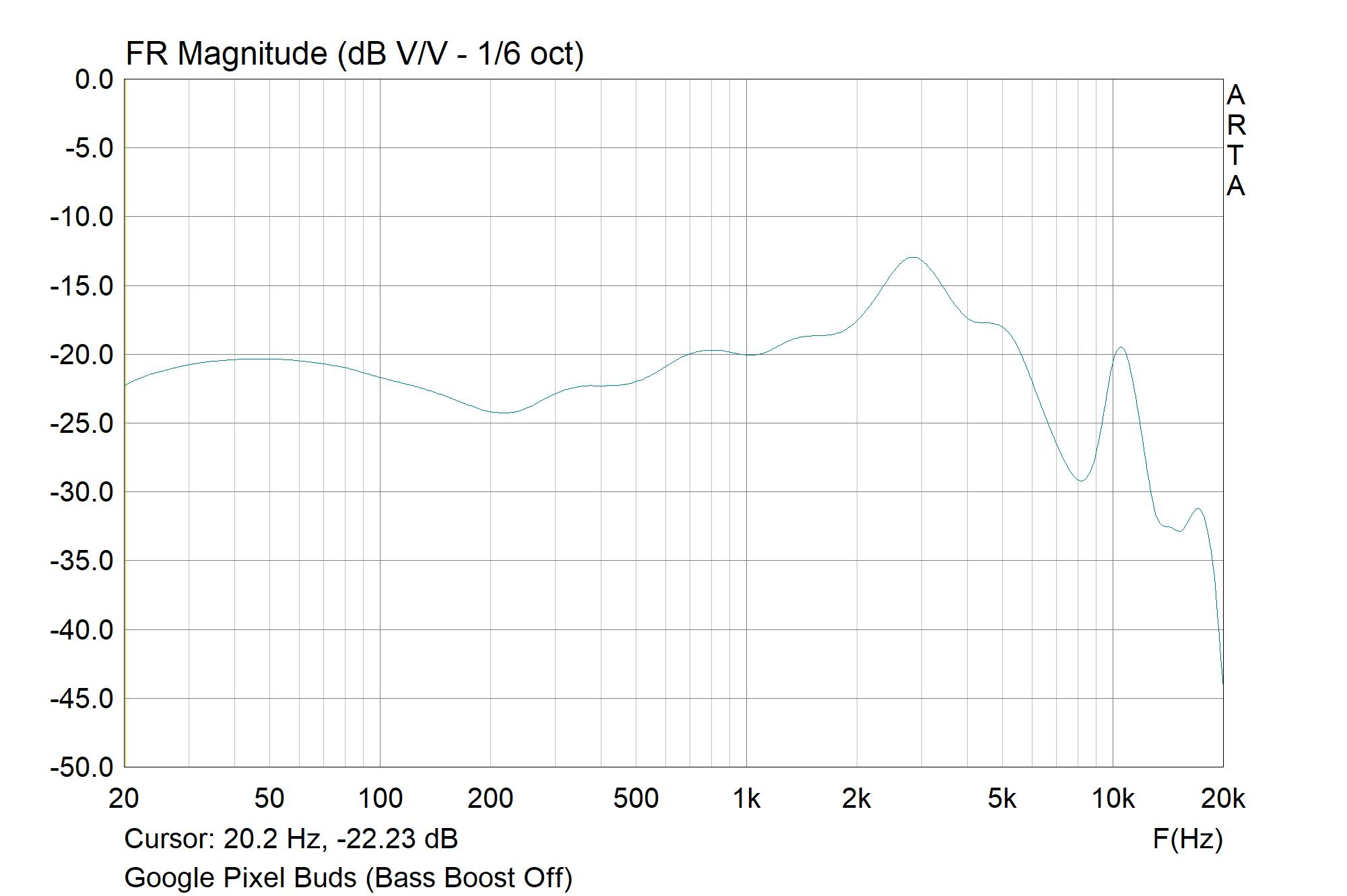
Testing Methodology: Measured using Arta via IEC 711 coupler to Startech external sound card. 7-9KHz peaks may be artefacts/emphasised due to my measurement setup, less so with deep fit. Measurements besides channel balance are volume matched at 1KHz. Fit depth normalised to my best abilities to reduce coupler resonance. Still, due to these factors, my measurements may not accurately reflect the earphone or measurements taken by others.
Tonality –
The Pixel Buds may just convince those sceptical that a large mainstream tech giant can make a good sound. Of course, don’t expect parity with a similarly priced wired in-ear nor the greatest resolution, but there is certainly a nicely balanced sound on display; hardly bass dominated nor wonky through the midrange. The low-end is quite modest, with some focus on the deep-bass, generating a bold note albeit not an overly forward bass presence. There’s a smooth transition into the midrange with good body from the lower-midrange and rising emphasis to 3kHz prominence for a natural voicing. The upper midrange sits slightly in front of neutral, bringing vocals forward and introducing a hint of intensity at times. This is followed by an impressively even lower-treble that prevents glare, sharpness and fatigue. Altogether, a well-considered sound, balanced and a good option for enthusiasts who also value smart features too.
Bass –
The large driver is clearly providing some volume in the sub-bass mitigated by the very open form factor. There’s good extension but not huge sub-bass pressure as a result. Still, the note presentation is quite bold and full, derived also from a lightly emphasised sub-bass and mostly linear upper-bass that results in slight warmth and enlarged notes. However, bass on a whole is a touch laid-back relative to the midrange, albeit not anaemic since it is full in its voicing, just not forward in positioning. I am enthused with the timbre on display, it’s impressively dynamic and textured albeit not the most detailed. Lows aren’t bloated or tubby, nor muddy and the buds portray a nice, well-defined rumble.
Driver control is above average but not outstanding with some smearing of fine details. Attack is smoother and decay somewhat longer, contributing to the full and thick note structure instigated by its sub-bass emphasis. In turn, separation is just mediocre as is note definition with greater focus on depth and a weighty slam. Ultimately, it was a wise decision not to have bass sit too forward in the mix as this way it doesn’t ever encroach upon the rest of the sound and the net result is quite well-balanced overall. The low-end provides good drive and volume alongside a satisfying extension and rumble, its thick and weighty voicing preventing the sound from ever coming across as anaemic or lean. Just don’t expect huge quantity here.
Bass Boost
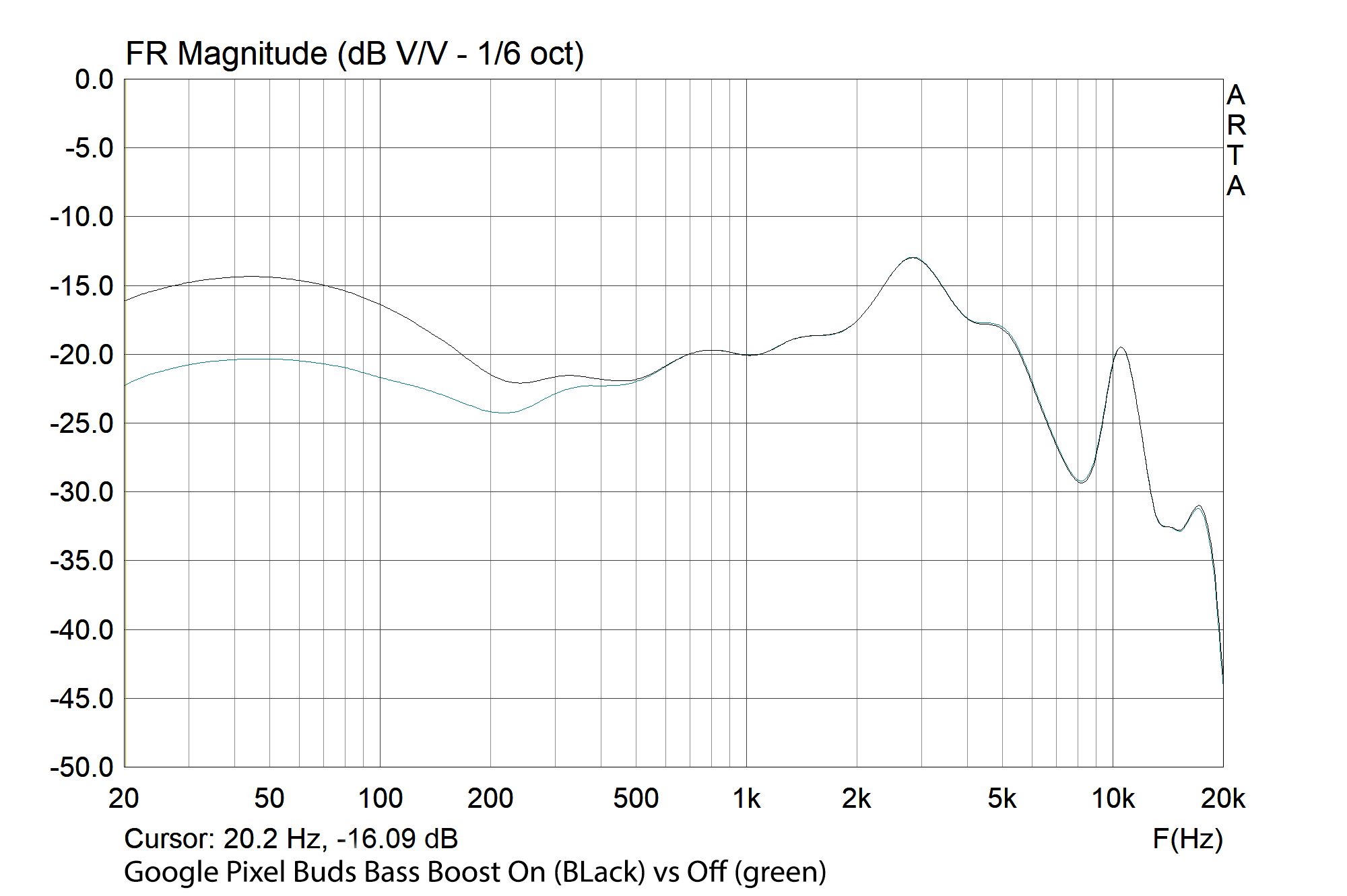
Things do change with the 550 firmware update which introduces a much requested bass-boost feature. As stated, the toggle enhances the bass and doesn’t touch the rest of the sound too much. It’s a fairly even emphasis across the low-end that cuts short well before the lower-midrange to avoid excess colouration of higher frequency ranges. There’s a bit of bias towards the sub and mid-bass, providing an immediately fuller, bigger and warmer bass but without skewing the timbre too significantly so it isn’t too tubby. Of course, control does not improve so there’s a bit more bloat and bloom when it’s on, but nothing obnoxious.
Subjectively, they still sound more balanced with the toggle off, however, the bass boost is very effective when listening in louder environments where bass tends to get drowned out by competing ambient noise. The midrange comes across as fuller and more powerful, in turn, but surprisingly isn’t too affected with no veil or muddiness. This is a tasteful and very useful bass boost implementation that many users will enjoy. I’m also glad that Google didn’t just decide to increase the bass with the update since enthusiasts can enjoy the Bud’s more balanced sound with it turned off too.
Mids –
The midrange impresses me quite a bit, especially with regards to vocal timbre that is one of the stronger TWS performers. With a lightly warm low-end and fairly linear transition into the lower-midrange, there’s a light warmth set to a fairly accurate vocal body. However, this is counterbalanced but a smooth and gradual rise to 3kHz prominence before a gradual fall-off into the 4kHz range. The result is a pleasantly open presentation with good vocal extension and clarity while retaining smoothness and a natural voicing. It’s a slightly more contrasty presentation so not quite as coherent as flatter earphones like the TEVI or Galaxy buds, but definitely in the same ballpark in its approach.
In addition, the 6kHz region is a touch laid-back relative to the Harman curve which creates a smooth articulation that prevents stridence and excessive intensity and sharpness. Nonetheless, those accustomed to a warmer consumer sound may find the Pixel Buds a touch forward with their slightly enhanced upper-midrange presence. This also means vocals aren’t especially rich or powerful in their voicing, rather, they lie on the cleaner and more open side with just a hint of colouration introduced by the low-end. For my preferences, they could have shaved just a hair off the upper-midrange but even as is, this remains one of the most natural and balanced TWS earphones I’ve come across.
Highs –
Whether it be due to BT codec limitation or the quality of the driver and surrounding acoustics, the top-end is just above average in terms of quality. In particular, the extension is very mediocre albeit sufficient for general listening. The tuning, however, much like the midrange is well-considered, with a pleasantly linear lower-treble and just slightly laid-back 6kHz region that creates a slightly smoother note attack. As such, percussion and cymbals especially have slightly blunter note attack without the crunch of a more linear earphone. As there remains ample presence and good linearity elsewhere, the Pixel Buds have ample openness and headroom in addition to a balanced detail presentation with the rest of the sound. They don’t come across as dark or closed in. I would characterise the tuning as quite clean and inoffensive.
Instruments do come across as well-bodied and nicely textured accordingly, but you won’t see the detail retrieval of a high-end TWS earphone yet alone a wired one – as can be expected. They roll off around 8kHz like a lot of TWS earphones so naturally, layers aren’t especially apparent nor are background details. I can commend the control of the presentation, however. This earphone strikes a good balance between detail presence and long-term listenability, inciting minimal fatigue while avoiding too much blunting of the presence region that is commonly seen on ANC headphones designed for travel. The Pixel buds offer good clarity and a pleasant instrument timbre in addition to nicely resolved and textured instruments, just don’t expect much more.
Soundstage –
Due to the spatial vent, you actually do get a quasi-open impression when listening to the Pixel Buds. There’s good width on display, stretching just outside the head and modest depth too for a nice, ovoid presentation. The imaging is a bit hazy as can be expected, directional cues are a bit smoothed over and localisation is vague as treble doesn’t resolve especially well. Layers also aren’t too apparent, but there is good separation. The Pixel Buds are a pleasant pick-up and listen kind of sound, not the most discerning under examination but excellent for easy listening with their voluminous yet low-pressure bass, natural midrange and smooth treble. The wide soundstage adds to the atmosphere and immersion even if it isn’t the most multi-dimension with its vague positioning and lower resolution.
Comparisons –
Lypertek TEVI ($89): The TEVI is an audiophile favourite TWS earphone with a very balanced sound. They have a moderate sub-bass and a little more bass presence overall than the Buds with bass boost off. The note presentation is similar but they offer a slightly cleaner mid and upper-bass working in tandem with higher driver control to deliver a generally more defined and detailed expression of the low-end. In turn, it is not as warm sounding nor quite as natural in its note presentation as the Pixel Buds. The midarnge is more neutrally toned on the TEVI and its vocals are a touch more full-bodied. This is counterbalanced by a darker upper-midrange and lower-treble that aid density and smoothness.
As such, the TEVI offers a more focused and slightly more coherent vocal presentation while retaining a natural voicing and body. The Pixel Buds sound a bit more linear, a touch warmer but also with more accurate body and a bit more openness up top. However, they are also a touch more intense as their vocals sound more forward in context of their more laid-back bass. Both have a smoother treble, not the crispest or most extended as is common for TWS earphones. The TEVI is a touch more detailed with sharper attack, while the Pixel Buds offers more accurate instrument body and texture. The Pixel Buds offer a wider soundstage while the TEVI has sharper imaging with better layering.
Galaxy Buds+ ($150): Now quite famous in the audio world due to their close adoption of Harman curve, the Buds Plus offers outstanding balance and refinement in the TWS space. They are actually not hugely dissimilar from the Pixel Buds. There’s an uptick of sub-bass presence over the Pixel Buds but otherwise quite a similar voicing and just a bit more overall presence than the Pixel Buds with bass boost off similar to the TEVI. The Buds+ sound a bit cleaner and more defined with higher driver control and possess a more solid slam while the Pixel Buds are warmer and mellower in their presentation with slower decay. The midrange is just a touch more natural on the Buds+ as they have a more present low-end to balance their upper-midrange.
Articulation is slightly more accurate on the Buds+ while the Pixel Buds offer a bit more warmth which counteracts their thinner body well. The Buds+ sound more neutral in tone but also a touch more forward and intense yet. The treble is more linear on the Buds+ but the instrument timbre is similar on both, a touch smoother on the Pixel Buds. Neither have the best extension or resolution here, the Buds+ are a touch cleaner that said. The Pixel Buds provide a wider soundstage in return, albeit at the cost of noise isolation.
Master & Dynamic MW07 GO ($199): The MW07 GO provides a more engaging tuning. It has bigger bass all around, but especially the mid-bass. The sub-bass also stands out as more pressurised, delivering a heavier slam and impact. The GO also provides higher driver control, a tighter and more defined bass despite being a larger one. The midrange is also similarly tuned for a natural voicing with a gradual rise to 4K prominence. However, it comes across as warmer as it is more laid-back relative to the bass and the larger bass imbues greater warmth and body. It is also has a 6K trough, with a smoother articulation.
As such, the Pixel Buds offer more accurate articulation and a more balanced and open vocal presentation while the GO is warmer and smoother while upholding a good level of clarity, they will appeal to those sensitive to upper-midrange intensity wanting a richer voicing. The GO offers a middle-treble spike and a sharper transient response that grants it higher detail retrieval but also a thinner instrument portrayal. The Pixel Buds offers more organic instruments with greater texture but at the cost of being quite a bit less detailed and resolving. The Pixel Buds offer a wider soundstage with their more open design while the GO images better with its more resolving driver and treble especially.
Sennheiser Momentum True Wireless ($250): The MTW has its share of issues but remains a strong sonic performer in the TWS space. At a now heavily discounted price thanks to the MTW2, it provides good competition to newer midrange models like the Pixel Buds. The MTW2 has a bigger, fuller and more powerful bass all around. It has greater sub-bass depth and slam alongside a warmer, punchier mid-bass. The MTW has stronger driver control, sounding more defined and powerful than the Pixel Buds despite larger emphasis. However, the Pixel Buds do sound more balanced and natural in their note expression, the MTW erring more on the engaging side.
Through the midrange, the Pixel Buds once again sound more balanced while the MTW is quite a bit warmer with more laid-back vocals. The MTW is dense and smooth, very rich in its voicing which provides contrast to the open and airy Pixel Buds. The treble is much crisper on the MTW, it has better detail retrieval and much more detail presence for a more vibrant and engaging sound. The Pixel Buds offer more air but the MTW is generally more resolving in addition to being a bit sharper and more aggressive in its presentation. The Pixel Buds offer a slightly wider soundstage while the MTW has better depth.
Verdict –

Though not especially outstanding in any one regard, the Pixel Buds are simply a pleasure to use day to day. The pairing process is optimised, especially mono pairing and the baked-in app offers excellent assistant integration in tandem with class-leading touch controls. This puts settings, battery life and commands at the user’s beck and call. Meanwhile, ongoing support from Google means easy feature expansion in future and further refinement of existing performance. Wearing comfort is also a highlight, aided by minimal pressure and a svelte design albeit the rigid stabiliser fins do wear on the ear over time. The articulate, balanced and textured sound ensures no fatigue over long listening and delivers surprisingly natural vocals on top. Still, even post-update, connection is a bit spotty when other signals are competing for air space. If you are willing to contend with this and await future firmware updates to refine this, I can wholeheartedly recommend the Pixel Bud for their excellent spatial awareness and convenience in addition to their balanced musical performance now with versatile bass-boost.
The Google Pixel Buds are available from Google (Australia) for $279 AUD at the time of writing. I am not affiliated with Google and receive no earnings from purchases through this link.
Track List –
Bob Segar – Night Moves
brb. – relationshit
Crush – Digital Lover
Gorillaz – Plastic Beach
Kansas – Audio-Visions
Mac DeMarco – 2
MAMAMOO – reality in BLACK
MGMT – Congratulations
Radiohead – Pablo Honey
Rich Brian – 1999
Seal – Seal
Spoon – Ga Ga Ga Ga Ga
Stephen Speaks – No More Doubt
TAEYON – Purpose

Ryan Soo
Avid writer, passionate photographer and sleep-deprived medical student, Ryan has an ongoing desire to bring quality products to the regular reader.
 Everyday Listening