

Vision Ears EVE 20 Review – A Different Breed

Sound –
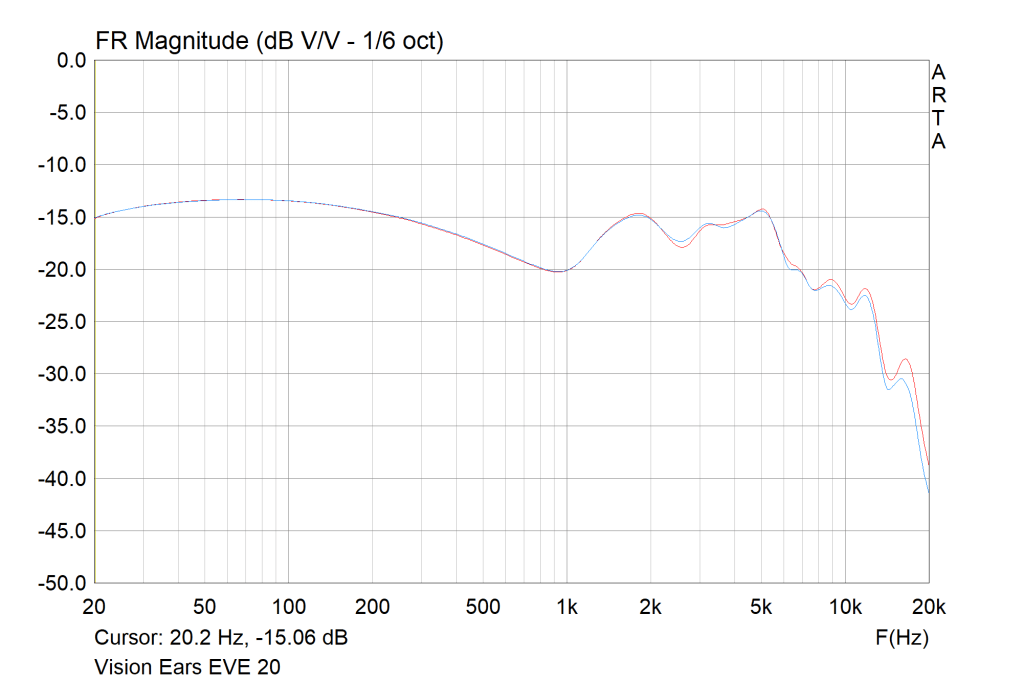
Tonality –
The EVE 20 is a warm, rich and powerful sounding in-ear monitor with grand notes that form a generally less orthodox presentation. Yet, somehow it works and it works well too. This is a relatively balanced sound, perhaps a touch L-shaped with its large and full low-end though it’s hardly a mellow or bass focused sound either. It upholds good separation with a lower-midrange dip and the midrange appears well compensated for the warm low-end, maintaining a clean expression and impressive vocal clarity. Highs are progressive, crisp, just a touch smooth and with a clean background. The icing on the cake is a nice, linear upper-treble extension that aids a pleasant sense of dimension and what I would call quiet resolving power, detailed but never calling for attention.
Bass –
Surely the first thing that stands out on the EVE 20 and a delightful foundation for the rest of its sound. The EVE 20 is not an explicitly bassy earphone and doesn’t deliver the same pressure and sheer volume as some high-end dynamic driver competitors. However, it does extend very well for a BA earphone, just shy of those with physical low pass filters. In turn, the EVE 20 conveys a palpable slam at the very bottom alongside clear and well-defined rumble. The mid-bass steals the show, being most voluminous and super punchy in its delivery. Lows then taper off into a recessed lower-midrange to avoid spill and excess midrange colouration. Bass also has desirable qualities that enhance the listening experience.
Attack is quick and decay lingers longer than most BA earphones producing a presentation that is not just full and punchy, but richly textured and dynamic too. It upholds good organisation and pace, without smear, bloat or excessive skewing of bass timbre; the decay properties ensuring notes don’t sound too rounded or tubby. In turn, separation is not the highest, but definition performs well due to strong driver control and the EVE 20’s mid-bass especially is surprisingly articulate given its size. Curiously, the EVE 20 doesn’t strike as an earphone targeting purists or bass-enthusiasts, rather, it lies somewhere in between. I think the beauty of its presentation lies both in the bold tuning and curated note delivery that work delightfully in tandem to produce a rich, warm and inviting yet highly textured image.
Mids –
I was honestly quite shocked by the vocal delivery of the EVE 20 as it is impressively natural and vivid given its warmer and larger low-end tuning. Quickly climbing to a 2kHz hump with relatively even emphasis into the lower-treble, vocals sit in harmony with the EVE’s enlarged instruments. They are not pushed forwards to my ears but rather enjoy similar power and size for an overall lucid and grand presentation. Though not usually my cup of tea, the lower-midrange dip here is also appreciated, being of moderately large magnitude in order to compensate for the bass emphasis. Accordingly, vocal definition is enhanced, a strong performer in this regard, alongside midrange layering and separation. Veil and chestiness are a non-issue, if at the cost of a thinner vocal body and loss of absolute note coherence.

As the midrange tone is medium warm, the presentation is hardly sterile, anaemic or thin though slightly more variable in its voicing between tracks than more linear earphones. Articulation is a touch on the smoother side so not a hint of sibilance creeps in. Vocals nonetheless carry inviting extension and openness due to the upper-midrange tuning, though as this range does not appear emphasized relative to surrounding frequencies, do not expect boosted clarity and air. The same goes for coherence and timbre, the EVE 20 is naturally voiced, refined smoothness and even-handed between male and female vocals. It is surely not the flattest sounding earphone, but I am not so sure this would be possible given the bass presentation either. What this appears is a well-considered tuning portraying empowered instruments set to large, robust vocals.
Highs –
Up top too, the EVE 20 represents an even-handed delivery. It is still not the most linear and accurate nor the most instantly gratifying but feels well-curated to complement the rest of the presentation. With good linearity from the upper-midrange to the lower-treble, instrumentation comes across as well-bodied and organic. Cymbals and strings are crisp and textured albeit note attack is a touch smoother than neutral due to the drop-off around 6kHz. In return, the EVE 20 is never sharp nor fatiguing. Its treble sits, again, in balance with the midrange but avoids any glare or other intrusive characteristics. High hats appear well-resolved at the very top with a pleasing shimmer and just a slightly quicker decay. The EVE 20 presents good clarity and air set to a clean, slightly darker background. That said, it doesn’t have energy and clarity up top to match its generally warmer and bigger instrument delivery.
It’s for this reason I wouldn’t describe it as V-shaped or with a focus on engagement. No, the EVE 20 is more balanced, more mature. For beyond this lies an impressively linear extension into the upper-treble. Surely, this isn’t the most energetic and sparkly presentation, but one with strong fine detail retrieval and, better yet, a good balance between foreground and background to ensure micro details aren’t overshadowed. Resolving power is about what you’d expect around this price, very, very good in isolation but not outstanding relative to other high-end monitors. The EVE 20’s raison d’etre is surely its superb, organic tuning that isn’t so easy to come by. Those wanting the most open and resolving treble won’t find that here, but those who enjoy a clean transient response and even-handed expression will greatly enjoy the EVE 20.
Soundstage –
The EVE 20 has one of the larger soundstage presentations I’ve encountered around its asking price and with a stunning combination of both width and depth. Width stretches healthily beyond the head on tracks that permit it while the grand, voluminous bass creates an excellent sense of depth projection. Despite this, its generally larger note size and crisp treble transients permit a focused imaging presentation. Vocals are strongly centred and never lost in the mix due to their bolstered size. The EVE 20 has an especially outstanding portrayal of distance due to its mostly even treble response. This means that though not the crispest or sparkliest, it upholds a strong ability to localise and layer. Separation is surely one of its lesser qualities and is easily outdone at this price. Though it is never congested, this can make the EVE 20 sound less open than it is actually capable of under scrutiny.
Driveability –
The EVE 20 is a very efficient earphone with a low, but not excessively so, 20 ohm impedance alongside a very high 120dB sensitivity.
Output Impedance Sensitivity
Switching between the 10-ohm Hiby R6 and 1-ohm Shanling M2X revealed surprisingly little difference. There was some colouration, arguably from the source tuning itself, but similar overall balance. Bass was a bit woollier on the Hiby, treble was also a touch smoother, especially in attack. Furthermore, vocals sounded a touch warmer and fuller on the Hiby. That said, it was perfectly enjoyable, the EVE 20 is substantially less source sensitive than most high-end multi-driver IEMs.
Driving Power
The EVE 20’s efficiency means that it doesn’t require much power to achieve very high listening volumes. It will discern hiss on some sources that most IEMs do not in turn, however. I didn’t find it overly sensitive like Campfire Audio’s high-end models; hiss wasn’t present on most sources and was relatively quiet on the ones I had on hand that did hiss more. In terms of power, it is not so discerning. The EVE 20 does scale very well with a more expansive and higher resolution source, but it doesn’t require huge power to achieve an extended or controlled bass, even BT receivers such as the Shanling UP2 were sufficient.
Suggested Pair Ups
A source with a low noise floor is recommended, especially for low-volume listeners. Conversely, I wouldn’t consider an external amplifier to be necessary for those with even entry level sources or better smartphones, especially given the resistance to output impedance. In terms of source tonality, I did most prefer the EVE 20 from the more neutral JDS Atom and THX 789 which really brought out the nuances in the midrange, warmer sources pushing it a little too far into warmth. The slightly cooler iBasso DX200 with AMP5 module was also a good fit, offering a slightly sharper note attack and cleaner, more focused sound but sacrificing some balance and long-term listenability in so doing.
Comparisons –

Avara EST-6 ($1100): The EST-6 is a more linear and balanced earphone. It lacks the same bass extension, similarly, the same quantity. It provides a more linear low-end with a smidge of mid-bass emphasis but not really too much warmth either. It is more defined and separated but noticeably less textured and dynamic. The midrange is appreciably more even on the EST-6 though the EVE 20 is surprisingly natural in voicing even with its wonkier tuning. The EVE 20 is warmer while the EST-6 has a light warmth but also a more accurate body. The EVE 20 has a slightly smoother articulation while the EST-6 has a slightly crisper lower-treble with more density to compensate.
In turn, the EST-6 sounds more coherent and wholly resolved while the EVE-20 is a bit more defined and layered, both upholding similar levels of openness. The treble is crisper on the EST-6 and thinner but with superior fine detail retrieval and more sparkle. The EVE-20 has a smoother but more even foreground, delivering more body and texture. The EVE-20 has a slightly larger soundstage, especially depth, while the EST-6 offers sharper imaging and better separation.
Campfire Audio Ara ($1299): The Ara is a more mid-forward and considerably more attack focused earphone, more aggressive sounding in general. It has noticeably less bass emphasis but better sub-bass extension and greater sub-bass focus giving it a weightier albeit more laid-back presentation. The Ara has quicker attack and decay that maximises definition and articulation. However, it also isn’t as full, warm or punchy if you prefer that style of tuning. The midrange is slightly fuller on the Ara but also a lot cleaner in tone. The voicing on the EVE 20 is a touch more natural due to the vocal positioning and it is a smoother performer.
The Ara has more definition and texture, but it is also more intense sounding with lifted clarity and a forward vocal presentation. The Ara has a brighter treble, slightly less even than the EVE 20 so thinner in body but also with a more concise attack and slightly cleaner transient response. The Ara is more detailed in both the foreground and background as such, while the EVE 20 has more body and texture, a slightly cleaner background and more accurate shimmer. It has better contrast and layering while the Ara is sparklier with a larger soundstage and sharper imaging.
VE 3.2 (1062 EUR): The 3-driver VE 3.2 is offered as the balanced, all-rounder in Vision Ear’s custom line. Both earphones have essentially identical bass tuning so it’s likely the EVE 20 implements two of the same driver in parallel to reduce the distortion. This appears to be the case in listening, both are voiced similarly but the EVE 20 sounds noticeably more controlled and articulate. The VE 3.2 is well-detailed but a bit woollier, the EVE having better mid-bas definition and detail retrieval. The midrange voicing differs to a larger extent, the VE 3.2 sounding noticeably more linear and coherent. It also has a lower-midrange dip for separation as well, but sounds less contrasty with a more accurate body in exchange for slightly lower definition. It is also slightly more vocal forward and its vocals have a more accurate timbre.
The EVE has more apparent warmth and a glossier articulation. It has a more forward upper-midrange that create a higher clarity but also less coherent voicing. The treble is slightly crisper and more energetic on the EVE while the VE 3.2 is a bit more laid-back but upholds slightly higher linearity especially around the 6kHz area. In turn, it has better balance between note attack and body, sounding a bit cleaner but less organic, the EVE providing a more textured shimmer. Though both have a dark background, the EVE 20 is slightly more detailed and also benefits from noticeably greater extension and headroom. It has a larger soundstage but the VE 3.2 has slightly more coherent imaging.
Lime Ears Aether R (1200 EUR): The Aether R is perhaps similar at face value, being warmer yet higher contrast in its tuning, though it is a more aggressive sound overall. The Aether has superior sub-bass extension, it is harder hitting and a bit more linear. The EVE 20 has more bass and a warmer presentation compared to the Aether R with bass switch off, but less of both with the switch on – for the sake of comparison, I’ll leave the bass boost off. The Aether R is slightly cleaner in the mid-bass and quicker decaying. It is a bit less textured but more defined, detailed and dynamic. The midrange is a bit more natural in voicing on the EVE, the Aether R being even more contrasty with a bigger lower-mid dip and greater 3kHz emphasis alongside a large 4k dip for density.
In turn, it sounds more truncated but also has more vocal presence and intimacy without sounding intense. The EVE sounds more open and extended but it also has larger vocal size, sounding richer and more powerful. The treble is brighter and more aggressive on the Aether R with a cleaner transient response. The EVE is more even-handed with more body and a bit more texture while the Aether R has much sharper attack and a slightly more detail image in general. It also offers a more open headroom and greater air while the EVE is darker but with more defined layers. The Aether R has a wider soundstage while the EVE is deeper.
Verdict –

The more I listen to earphones around this price, the more I appreciate the unique intentions of every model. The EVE 20 is an especially unique product and an ode to the creative spirit behind Vision Ears. Though not the most accurate or technical in-class, I would argue such qualities are almost a commodity when reaching into the 4-digit price range. What’s less typical is the EVE 20’s grand and voluminous presentation. It portrays substantial notes and does so with great maturity, upholding admirable tri-frequency balance, natural vocals and plenty of clarity to remain defined and focused. The isolation and seal are also outstanding, with a visually arresting and superbly sculpted uni shell. As always, personal preference is key, but if you enjoy a warm and punchy sound but don’t want to sacrifice balance, you will find that the EVE 20 sits within an essentially uncontested niche.
The EVE 20 is available from Vision Ears (International) for 1300 EUR incl. German VAT and 1092,44 EUR Internationally excluding tax at the time of writing. I am not affiliated with Vision Ears and receive no earnings from purchases through this link.
Track List –
Bob Segar – Night Moves
brb. – relationshit
Crush – Digital Lover
Gorillaz – Plastic Beach
Kansas – Audio-Visions
Mac DeMarco – 2
MAMAMOO – reality in BLACK
MGMT – Congratulations
Radiohead – Pablo Honey
Rich Brian – 1999
Seal – Seal
Spoon – Ga Ga Ga Ga Ga
Stephen Speaks – No More Doubt
TAEYON – Purpose

Ryan Soo
Avid writer, passionate photographer and sleep-deprived medical student, Ryan has an ongoing desire to bring quality products to the regular reader.
 Everyday Listening