

Shozy Black Hole Review – Captivating, Unconventional

Sound –
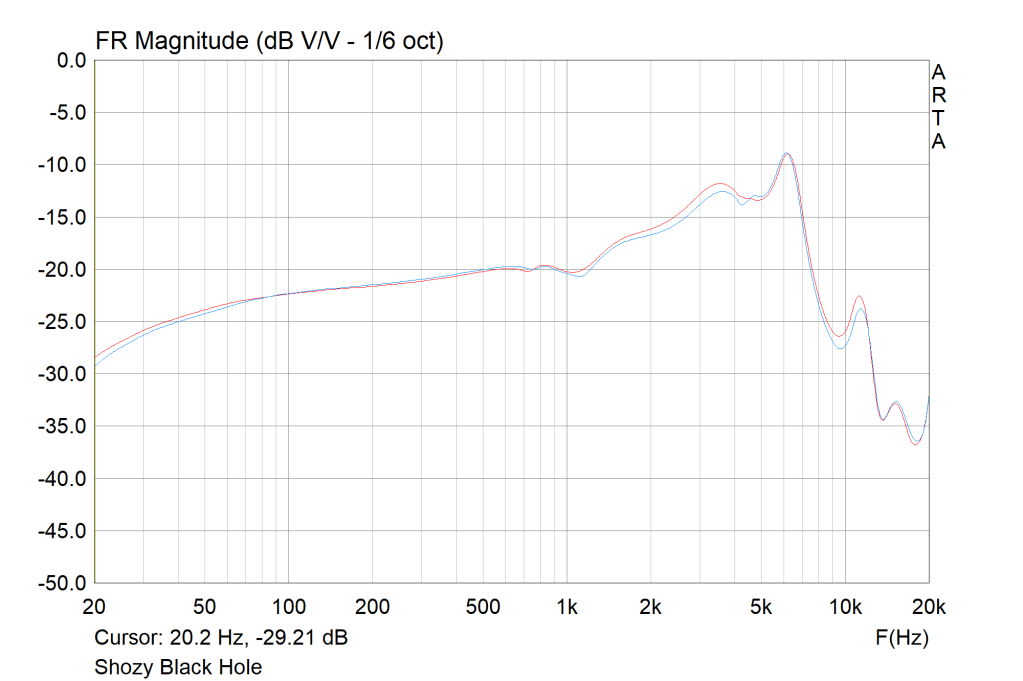
Testing Methodology: Measured using Arta via IEC 711 coupler to Startech external sound card. 7-9KHz peaks may be artefacts/emphasised due to my measurement setup, less so with deep fit. Measurements besides channel balance are volume matched at 1KHz. Fit depth normalised to my best abilities to reduce coupler resonance. Still, due to these factors, my measurements may not accurately reflect the earphone or measurements taken by others. I gave the Black Hole 100hrs burn-in to ensure maximum performance prior to subjective breakdown.
Tonality –
Similar to its design, the sound of the Black Hole is quite different from what most would be accustomed to and measurements surely don’t do it justice given the unique design. In turn, expectations must be in order; the Black Hole doesn’t deliver balance and fidelity like a traditional IEM, on the flipside, it does provide unique traits that you won’t find elsewhere. Shozy have also implemented a few tuning decisions that can be polarising on regular IEM designs, but in the context of an open-back design, make more sense. At its most fundamental, the Black Hole is a slightly n-shaped in-ear with a clean, upper-midrange focus. That said, coming from balanced BA earphones, it does sound relatively balanced with the DD providing a bit more fullness than measurements would suggest. It has a slightly fuller bass note structure that balances out its atmospheric presentation; but as lows remain laid-back relative to the midrange, don’t expect a bassy or warm sound here. The timbre is different to most in-ears too and surely is not a specialty of this earphone, but it also isn’t an unnatural earphone either. Tone-wise, the Black Hole is neutral to slightly cool depending on track, representing a departure from Shozy’s usual house sound. This is a highly atmospheric in-ear with lighter note weight and clear, open tuning that highlights this quality.
Bass –
It is hard to orientate a product such as this in the market. It does not compete with IEMs in terms of use case due to the lack of isolation, similarly, it cannot be compared to an earbud due to the sealing design. And accordingly, the listening experience is dissimilar to both. The tuning is slightly laid-back which lays the foundation for a revealing and open sound over a coherent and full-bodied one. Bass in and of itself is mostly flat with a slightly sub-bass bias to my ears. Extension impresses, being as strong as you would expect from a good DD in-ear. With such a tuning, I perceive a hefty slam with uptick of note weight despite roll-off on measurement, alongside subtle pressure and a well-defined rumble. The mid-bass is clean and the upper-bass extends linearly into the midrange.
This tuning delivers a subtle warmth and a slightly bolder and fuller note structure that enhances engagement and ensures the Black Hole doesn’t present as thin or anaemic. The note presentation also complements the tuning with a focus on timing and separation. Attack is very quick while decay is longer, contributing to the impression of a fuller note despite absence of bass emphasis. Bass texture is smooth due to the longer decay. Though driver control is high and the earphone is without bloat or muddiness, it does have lower note definition relative to most competitors. Still, the Black Hole is able to keep pace well with faster tracks and it upholds good dynamics considering the laid-back tuning. Though not for the bass lover nor balanced in a conventional sense, the Black Hole’s bass performance provides a good foundation for its sound and very enjoyable timing for musical enjoyment.
Mids –
No doubt the highlight of this earphone, the midrange lies at the forefront of the presentation and is where the open-design is most easily enjoyed. This is a hyper-clear, open and atmospheric sound with an intoxicating sense of space, layering and dimension. In terms of signature, it sees a progressive climb from the lower through to upper-midrange before a small peak in the lower-treble. Despite this, the earphone does not sound intense, sharp or overly intimate, only slightly vocal-forward. It comes across as articulate, delicate, a little raspy and breathy but also very high definition with minimal sibilance. I can only attribute this to the form factor as I do perceive most earbuds to sound quite laid-back relative to most IEMs, so it is possible the Black Hole suffers from similar fall-backs and has been tuned with a forward upper-midrange to compensate.

As with all sculpted sound signatures, the presentation is unique and enjoyable in some regards and less inspiring in others. With its laid-back low-end, the tone is highly clean but also somewhat cool at times. In addition, note body is on the cusp of what I would consider to be just adequate to avoid thinness and stridence. Vocals do hold clear focus over instruments, and they are most flattered in the presentation. Female especially are presented with enhanced size and forwardness in addition to surprising smoothness that makes them sound impressively refined. Still, the timbre is not perfect as they are lacking some density or body to counterbalance. In conjunction with the tonal coolness, this can produce a slightly metallic timbre on some tracks.
Unsurprisingly, the Black Hole is most in its element when listening to Asian pop genres where its outstanding clarity and definition create a hyperpalatable vocal experience. Though biased towards female vocals, male vocals are similarly flattered with liquid smoothness and excellent definition with minimal dryness that is a feat considering the style of tuning. The voicing remains mostly natural that said, despite the unique tonality. Altogether, a somewhat dualistic beast that is difficult to rival when tackling its preferred genres of pop and Asian vocals but can lack some refinement on others requiring a more natural timbre such as jazz.
Highs –
It is here where I most disagree with the measurements posted online in addition to those taken by myself – and I did re-measure quite a few times to confirm. To further complicate matters, when booting up a sine sweep I also did not hear a 6k peak, rather, a fairly even treble sitting just behind the upper-midrange. And in music listening, this is the experience I received. Highs are even, well-bodied and of natural timbre, just a little crisper than neutral in tuning. This is counterbalanced by a slightly smooth note attack, lacking the hard-edge provided by most lower-treble emphasized closed IEMs. Still, fine detail retrieval is quite strong, especially in the foreground, and both body and decay are natural, providing a highly textured portrayal. As emphasis falls off quickly after through the middle-treble, the Black Hole provides a dark, clean background for heightened contrast between layers.
This works to good effect in conjunction with its focused and well-detailed foreground instrument presentation. It isn’t the sparkliest and highest energy performer, but hardly lacking in openness due to its design and upper-midrange tuning – So given the effect of the design on how its sound is perceived by the listener, I feel the treble is in good taste. Extension is also quite good with a nice linear portrayal of the upper-treble that provides a good sense of micro and background detail. This contributes strongly to its ability to portray distance and layers convincingly in tandem with its design. It isn’t the most overtly high resolution in-ear I’ve heard and resolving power is commonly bested in such a competitive price range. However, surely the presentation is the centrepiece here and the Black Hole is put in a disadvantageous position with regards to resolving power due to its lack of isolation and immediacy – so to reiterate, it is not a bad performer here at all, just not the best.
Soundstage –
If you weren’t convinced by my prior comments, the soundstage performance on offer is most likely to change your mind. Forget about comparison to other IEMs, the Black Hole almost rivals open-back headphones in terms of its ability to portray space and imaging. It is here where its tuning starts to make sense even though objectively, it still cannot be dubbed as especially accurate or balanced. Width is sensational, stretching well-beyond the head and depth too, even with its forward vocals, is able to project a great sense of distance. And, despite this, the stage is not sparse or lacking focus, with the treble presentation aiding a sharp sense of direction and location.
Layers separated and hyper-defined, and imaging is very multi-dimensional if not especially holographic due to the lack of energy in the middle and upper-treble. In addition, though note definition is not the highest from an IEM point of view, the excellent separation on offer ensures each detail is easy to pinpoint. The leaner bass tuning makes sense when maximising separation, so too does the forward vocal presentation and crisper treble in the context of such a vast and atmospheric soundstage. The Black Hole ultimately sounds very impressive and quite unlike an IEM which is the highest compliment I can give an in-ear with regards to soundstage performance.
Driveability –

With a fairly standard 16 ohm impedance and a higher 105dB sensitivity, the Black Hole does not present much challenge with regards to driveability. It isn’t too sensitive to hiss, similarly, it doesn’t require heaps of power to achieve a high listening volume. Being a single-DD, it also shouldn’t be too affected by output impedance.
Output Impedance Sensitivity
Comparing between the Hiby R6 (10-ohms) and Shanling M2X (1-ohm) revealed that the Black Hole isn’t too susceptible to output impedance as expected. Still, there were small differences, a slightly fuller and less defined bass on the Hiby alongside a slightly crisper and more forward lower-treble. This may be partially attributed to the colouration of the source itself, and as the changes are very small, the Black Hole can still be enjoyed from high-impedance sources.
Driving Power
The Black Hole scales very well with greater power and larger sources in general. Switching from the Shanling to my THX789 desktop setup revealed a noticeably tighter and more controlled bass with greater definition. Highs had slightly better fine detail retrieval as well. In particular though, the soundstage was substantially larger on the desktop source. It had an altogether, more complex and layered sound that was more immersive and a better showcase of the Black Hole’s unique abilities. Hiss was barely audible on the Shanling and completely inaudible once music was playing, even on the lowest volume setting.
Suggested Pair Ups
The Black Hole is not too source selective in terms of noise and output impedance but does scale well with a bit more power or a source with a larger soundstage. In terms of tonality, I did enjoy the uptick of warmth provided by the Shanling and Hiby despite the slightly softer note presentation. It provided a more natural body and timbre in the midrange especially. Given that it isn’t too affected by output impedance and source noise, the Black Hole would be a good match for a tube amplifier or warmer SS source. Neutral sources like the THX789 and iBasso DX200 with AMP5 module are enjoyable most with Asian genres as aforementioned.

Ryan Soo
Avid writer, passionate photographer and sleep-deprived medical student, Ryan has an ongoing desire to bring quality products to the regular reader.
 Everyday Listening