

Oriveti O800 Review – Redefine
Sound –
Tonality –
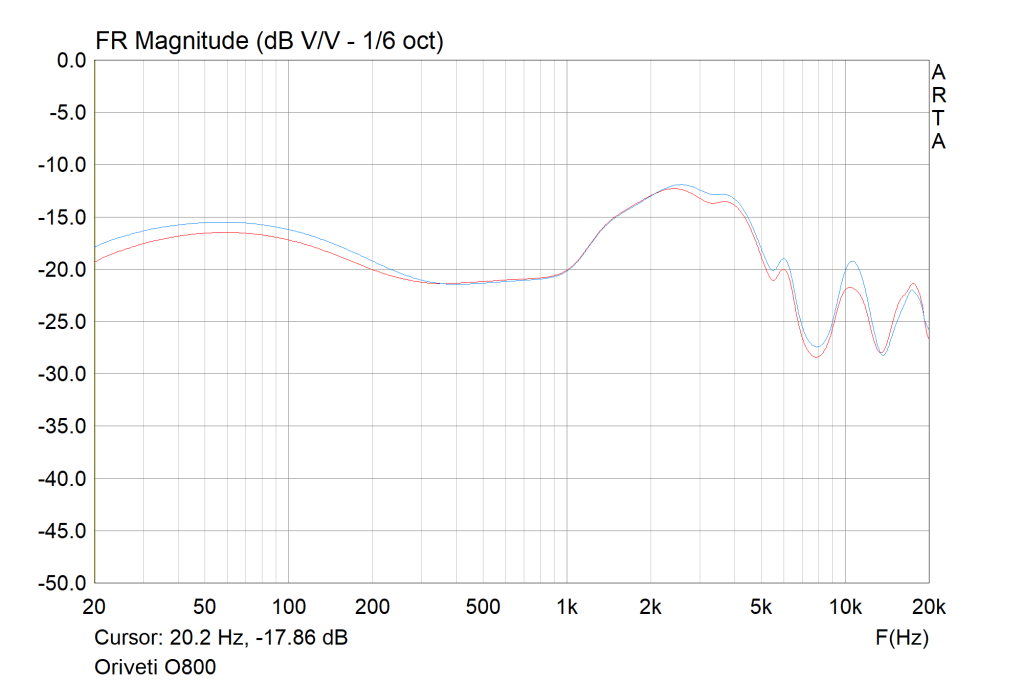
The O800 represents a new take on the Oriveti house-sound – that being a smooth, mid-focused sound with a dark background – and is the most coherent sound form the company to date. It remains roughly n-shaped with a focus on vocals, though they are presented with a gorgeous smooth, lush voicing that has become somewhat of a speciality of the company. Introduced as well is a more robust bass than we’re used to from Oriveti, shifting focus away from the sub-bass with greater mid-bass body and warmth in return. Treble is dark and smooth with a jet-black background but also a small blip around the lower-treble to retain detail presence alongside a bump in the upper-treble for sparkle and openness. I would still consider the O800 to uphold admirable balance overall in turn – for though it is vocal-focused to some degree, it is not the least bit sharp, thin or bright, quite the opposite. This is surely a less conventional approach to sound tuning and one that may not appeal to listeners wanting a high-energy treble or deep, dynamic bass. Yet it remains a sound that rewards greatly in many aspects, introduces unique strengths and feels well-constructed and executed to boot.
Tip choice
Oriveti provide two main tip choices out of the box, standard silicone tips and Azla’s TPE Xelastec tips. The stock tips are definitely more comfortable to my ears, with less wearing pressure and a slightly deeper fit too. They provide a warmer and smoother voicing with more fullness and weight in the bass. They bring out the O800’s darker and smoother character well but the midrange can sound a little too smooth, the top-end a bit too laid-back for my tastes. The Xelastec tips bring out the top-end and slightly even out the bass, however, they also bring the midrange a little more forward. They have a more resolving sound with noticeably improved detail retrieval, and a more balanced sound in general. I am also a fan of how they open up the upper-midrange as vocal clarity and definition is appreciably improved without introducing any thinness or sharpness. I am not always a fan of the Xelastec tips, but they do feel made for the O800 here so I will be using the Azla tips for all sound analysis below.
Bass –
Two over-sized Oriveti branded woofers are visible form the shell’s exterior promising a robust low end and this is precisely what the listener receives. The O800 has good if not outstanding extension for a BA-earphone. On the flipside, where I find most conventional BA-models can lack depth, this was never the case with the O800 that even offers a little pressure and a nice, defined rumble if still clearly lacking the slam of a good DD. The voicing is rich and full due to its moderate mid-bass hump. Though as emphasis isn’t excessive and falls off through the upper-bass and lower-midrange, the midrange itself isn’t overly coloured and similarly, lows don’t come across as muddy or bloated in the slightest, if perhaps a little tubby on certain tracks. Note size is elevated and bass commands a satisfying sense of volume and scale with its fullness. The agile BA-drivers impart a tactile, punchy character and the presentation remains natural and well-defined on a whole.
While the O800 will never be mistaken for a DD earphone as some BA earphones have come to achieve with trick acoustic design, it does carry many desirable traits. Attack and decay are quick as expected, similarly, control is excellent and, in turn, so is note definition. However, the O800 does decay just a little slower than most BA-earphones. This contributes to its richness and provides a more textured sound than usual in addition to complementing its smoother overall character. Timing remains a strong performer given its tight, punchy and well-defined mid-bass. With its speed, separation is also never lacking despite the mild mid-bass focus. Though bass isn’t forward, it successfully imparts a sense of drive, scale and richness into the sound without excessively colouring the higher frequencies. I found the O800’s low-end a satisfying foundation for its sound, full and rich but not overly emphasized nor ever to the detriment of detail retrieval. It isn’t the deepest extending or the most impactful, but impressively dynamic, very punchy and well textured.
Mids –
No doubt, the focus of this earphone, the midrange maintains a similar character to the bass without being excessively coloured by it. With a plateau between the upper-bass and centre-midrange, the O800’s midrange is left with only light warm tone in addition to high separation. This places a spotlight on vocals over instruments and room, enabling a presentation that is not only large and powerful but also especially well-defined and perfectly clear. The midrange isn’t lacking in extension nor is it dry despite its slightly scooped lower-midrange. Vocals are forward, lavish and large, with silky smooth articulation offsetting strong upper-midrange extension and clarity. The result is outstanding vocal definition without truncation nor diminished body or size.
The voicing remains very natural even coming from IEMs tuned to popular reference curves. Similarly, the vocal timbre is very accurate; the tone, body and extension demonstrate masterful balance despite their noticeably enhanced size and presence. The added smoothness and utter lack of sharpness means that though the midrange is forward, it doesn’t fatigue nor overshadow other elements of the sound. Instruments also remain easy to appreciate, though they aren’t quite as enriched, they maintain excellent clarity and a rich, natural timbre. The O800 places clear focus on its midrange both with regards to tuning and driver designation. And this is certainly in good taste as, in this regard, Oriveti’s latest earphone provides an outstanding musical performance.
Highs –
Upon first listen, most tend to turn focus towards the extremities of the frequency range. In this sense, something like Campfire Audio’s Solaris may provide jarring dichotomy from Oriveti’s more centred offering. And it is here that most listeners will likely have issue with the O800 for its treble is reasonably laid-back which is exacerbated by an especially dark background. Blunt or lacking extension or headroom is not an accurate assessment that said. Simply, its pitch-black background and associated reduction in air alongside a lack of any treble emphasis means this earphone doesn’t showcase its resolving power like many competitors. On the contrary, such a tonality may just suit your preferences and the crisp voicing helps to some degree to retain engagement and the impression of a balanced overall presentation. Though it is laid-back, there remains a nice bite and crispness due to a small 6k emphasis and good foundation in the upper-midrange on top. Accordingly, instruments are slightly thin but are delivered with a highly clean transient response that contributes to a focused note attack and excellent fine-detail retrieval in the foreground.
Background/foreground separation is also outstanding due to the middle-treble valley and subsequent upper-treble peaks. With very strong top-end extension, the O800 upholds a high-resolution image, excellent micro-detail retrieval and a nice sense of sparkle too – far more than the OH-series despite a reduction in treble presence. In fact, it almost draws focus to the minutiae as the foreground doesn’t’ steal too much attention. This enables it to maintain plenty of headroom and openness whilst maintaining a smooth, refined and coherent character utterly devoid of harshness or fatigue. It can take some adjustment as the O800’s resolving power isn’t pushed into the listener’s face, but certainly, it is not due to a lack of ability but an intentional tuning decision to draw focus to the earphone’s gorgeous midrange. Spend some time with the O800 and you’ll find a very nuanced earphone with a superb sense of layering and effortless detail portrayal.
Soundstage –
The O800 provides a spacious and highly layered presentation that stretches easily beyond the head in terms of width. Due to its intimate midrange, it isn’t as overtly spacious as something like the CFA Andromeda, but certainly is capable of great size when called for by the track. The depth is what makes this earphone especially impressive to me, not noticeable so much with vocals but directional cues. The ability to project great depth in addition to width makes the O800 very immersive and grants an impressive sense of scale that many IEMs are unable to provide.
Imaging is fairly standard for a high-end IEM, directional cues are sharp and localisation is accurate, it isn’t especially holographic nor is coronal positioning anything special, that said. However, as aforementioned, layering is an outstanding aspect of this earphone – and each layer is very well-defined especially well delineated to boot. Separation as well performs on a good level as a result, the earphone has a very clean transient response throughout alongside excellent organisation. This contributes greatly to its effortlessly resolving nature.
Driveability –
With a reasonable 15-ohm impedance and high 110dB sensitivity, the O800 is efficient and should not present huge issues with regards to driveability. In fact, I’ve found that a lot of earphones lately are surviving high output impedances very well so we’ll see how the O800 performs.
Output Impedance Sensitivity
I compared the O800 between the Shanling M2X (1-ohm) and Hiby R6 (10-ohms) via an inline switcher, volume matched with an SPL metre. The R6 had a noticeably thinner and more strained sound overall. Bass extension suffered with less slam and depth. In addition, vocals sounded slightly diminished, thin and more strained, the lower impedance source being considerably smoother and more coherent. Treble was also more forward and the sounded less substantial on the R6. It isn’t the most sensitive in-ear to output impedance I’ve heard, a far cry from the multi-driver CFA earphones, but a low output impedance source below 2-ohms remains desirable and personally recommended.
Driving Power
The O800 doesn’t require a huge amount of power to achieve its powerful sound but does benefit from a resolving source with a nice soundstage. Bass power and reach was similar across my portable and desktop sources, the jump in dynamics and depth wasn’t to the same extent as some DD or hybrid earphones experience. That said, I did find my desktop stack to provide a noticeably more expansive and layered presentation in addition to being more resolving in the upper registers. In turn, despite not requiring huge power, the O800 is an earphone that scales very well with higher end sources.
Suggested Pair Ups
The O800 is best paired with a low/sub 2-ohm source with a neutral tonality. It is most forgiving over a cooler/analytical source over added warmth given its already warmer and smoother tuning. As with most gear, I did personally most enjoy them from a more neutral source such as the THX789 and the earphones scale very well with more spacious and resolving sources too. At the same time, huge driving power is not required to achieve a dynamic and texture sound.

Ryan Soo
Avid writer, passionate photographer and sleep-deprived medical student, Ryan has an ongoing desire to bring quality products to the regular reader.
 Everyday Listening
One thought on “Oriveti O800 Review – Redefine” Leave a comment ›