

Moondrop Aria Review – Reimagined
Comparisons –
iBasso IT01 ($99): The IT01 offers a more engaging V-shaped sound but with a trick driver that keeps things in control. It has better bass extension and more quantity, mid-bass especially, providing a punchier, fuller and warmer bass expression. Yet, it also has noticeably higher driver control so separation and definition are much better despite the increased quantity. The IT01 has similar midrange tuning but a noticeably more laid-back vocal range. It sounds more contrasty with a bit more warmth, a more articulate top-end and less body.
The Aria is more even and accurate. Its tone is more transparent and both body and positioning are more faithful. It has higher separation and definition too. The IT01 has a crisper, more energetic lower-treble. The Aria is more even whilst retaining similar definition, offering more body and texture, it has a bit more fine detail retrieval to my ears too. Neither offer outstanding top-end extension, the Aria has a bit more air and a blacker background, in addition, it offers a wider soundstage and sharper imaging.
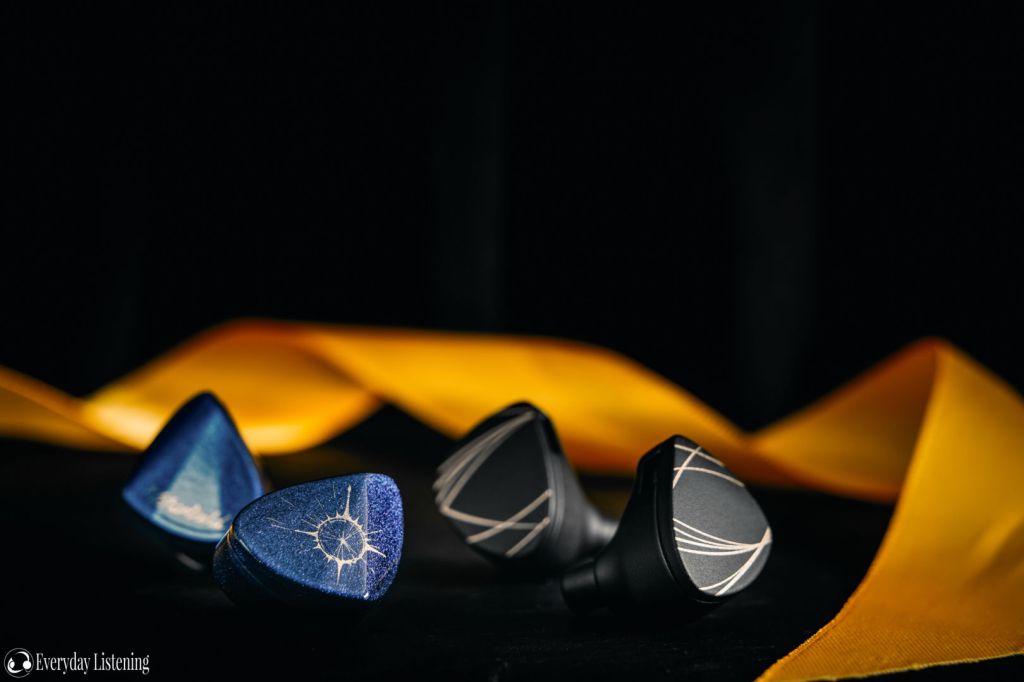
Moondrop Starfield ($109): The Starfield offers a very slightly more robust and smooth sound than the Aria due to its greater sub-bass presence and less prominent lower-treble. Otherwise, both are nigh identical. The bass is slower on the Starfield with noticeably lower definition and separation. However, it also has appreciably more slam and a bolder rumble. The Starfield’s midrange is just a hint more coherent due to its smoother treble while the Aria offers a slightly sweeter sound, being a bit more articulate.
The Starfield has a smoother, more linear treble offering a bit more body and texture. The Aria has a slightly more energetic tuning in addition to a sharper transient response, with better detail retrieval and slightly stronger extension. The Aria has a wider stage and better separation overall, the Starfield is deeper but otherwise, not as organized.
Moondrop Blessing 2 ($319): The Aria’s tuning and technical performance both move it closer to the presentation of the Blessing 2 though not to the same extent. The Blessing 2 remains a slightly more mid-focused and sharper earphone in general. The Blessing 2 has similar bass presence and tuning but better quality. It is faster and more defined in the mid-bass especially. The midrange is slightly more intense on the Blessing 2 and more articulate. Subjectively, this makes it a bit more polarizing than the Aria which is more coherent and slightly more natural in voicing and vocal positioning.
The Blessing 2 has slightly higher definition and a more neutral tone in return. The top-end is slightly crisper on the Blessing 2 at the cost of body, but it is noticeably more detailed with the BA driver setup. The Aria isn’t too far behind but cannot compete above where the Blessing 2 offers much higher resolution of background and micro details. The Blessing 2 is more spacious and has sharper imaging, it also has better separation while the Aria tends to perform better from a tonality and timbre POV.
Verdict –

Having been invested in this hobby for close to a decade, it’s been a real treat to see the portable audio market evolve. We truly are privileged to be able to scrutinise entry-level IEMs with the same judiciousness as we used to evaluate kilo buck flagships – at least, from a tonality point of view. Of course, with improvements at the tail end, so too have there been innovations in high-end audio – this is a debate for another time. What I we can ascertain is that budget audio is becoming very difficult not to justify and the Aria is a champion of this ethos. For though it doesn’t match high-end models in all regards, its minimal-compromise package doesn’t necessitate an upgrade either. Thankfully, Moondrop also demonstrate that Chi-Fi isn’t ever inflating as can be observed in the high-end. Moondrop’s latest earphone appends complaints with their former design whilst retaining benchmark level tonal refinement at a substantial price cut.
The Aria is available from HiFiGO and Apos Audio (International) for $79 USD at the time of writing. I am not affiliated with Master & Dynamic and receive no earnings from purchases made through these links.
Track List –
Arcade Fire – The Suburbs
Archive – Controlling Crows (Parts I – III)
AKMU – SAILING
Bob Segar – Night Moves
Courtney Barnett – Tell Me How Your Really Feel
Eric Clapton – Unplugged
Gorillaz – Plastic Beach
Fleetwood Mac – Greatest Hits
John Legend – Once Again
MAMAMOO – reality in BLACK
MGMT – Oracular Spectacular
Modest House – Good News For People Who Love Bad News
NIKI – lowkey
Nirvana – Nervermind
Radiohead – OK Computer
Social House – Haunt You
suggi – cheer up!
TOTO – Toto IV
Vampire Weekend – Father of the Bride
Vaundy – strobo

Ryan Soo
Avid writer, passionate photographer and sleep-deprived medical student, Ryan has an ongoing desire to bring quality products to the regular reader.
 Everyday Listening
Hi, did you burn in the Starfield before reviewing them? I couldn’t find the mention of a 100 hour burn-in for that review
LikeLike
Hi Han,
At the time I didn’t have a set disclaimer/time for burn-in, but all DD earphones have received at least 40hrs burn-in prior to review for the past few years. Given that the Starfield has gotten some ear-time since that review, I wouldn’t say this would have contributed to the changes heard between the Aria and Starfield in my review.
Best,
Ryan.
LikeLike
Hi, Ryan!
I have some questions…
1. Do you think the vocals on Aria are muffed compared to Starfield? Or is the mid-range as a whole is more behind?
2. Lastly, do you think Aria has better micro-details than Starfield? Would you recommend Aria or Starfield to anyone who mainly listens to female vocals (soprano mainly)?
We were having a very long discussion about Aria on Head-Fi.
Apparently some users report that the vocals on Aria are muffed (in others terms the mid-range as a whole is recessed) compared to Starfield.
Some even agree that the video below accurately represents their signature:
If you listen you will notice that the vocal on Aria looks muffed. But these opinions (and this video), are totally the opposite of most reviews (including yours).
Honestly, I’m wondering if Moondrop had questionable quality control at Aria.
PS: +1 subscribe.
Thanks!
LikeLike
Hi Bruno,
I’ve replied to you on Head-Fi as I could share images of measurements! Hope this helps you out 🙂
Best,
Ryan.
LikeLike
Hello!
I stumbled upon this blog while browsing for comparison between the Aria and FH3, currently looking for my very first pair of IEMs (I listen to mostly jazz/pop for some reference).
I noticed that FH3 is about double the price of Aria so it’s somewhat an unusual comparison, but do you prefer one strongly over the other? I’ve narrowed down my sub-200USD list to FH3 and the Aria (B2 dusk is way outside my budget), would like to hear your thoughts on it (or something else you’d suggest in this price range)!
P.S. I like the FH3 shots on the chainrings in the other blog post 🙂
LikeLike
Hey Nicholas,
Glad you’ve been enjoying my reviews and photos!
Regarding the FH3 vs the Aria, the FH3 is slightly bassier, with more sub-bass in particular. It has noticeably better driver control and speed down low. The midrange is a bit smoother on the FH3 and a bit brighter on the Aria, but both sound natural to me. Treble quantity sounds fairly similar between the two, the Aria has a bit more brightness and linearity, the FH3 has better detail retrieval but isn’t quite as natural in terms of timbre. The FH3 has a slightly larger stage, but I find its imaging quite a bit sharper, it sounds more organised on complex tracks.
Overall, I’m a fan of both, the FH3 I would be more content with day to day personally given its jump in technical performance.
Best,
Ryan.
LikeLike
Hey Ryan,
Thanks for the quick reply – I think now I know which one to go for. Really appreciate the help, I’m glad I found this blog!
Nick
LikeLike