

Lypertek Soundfree S20 Review – Benchmark on a Budget
Sound –
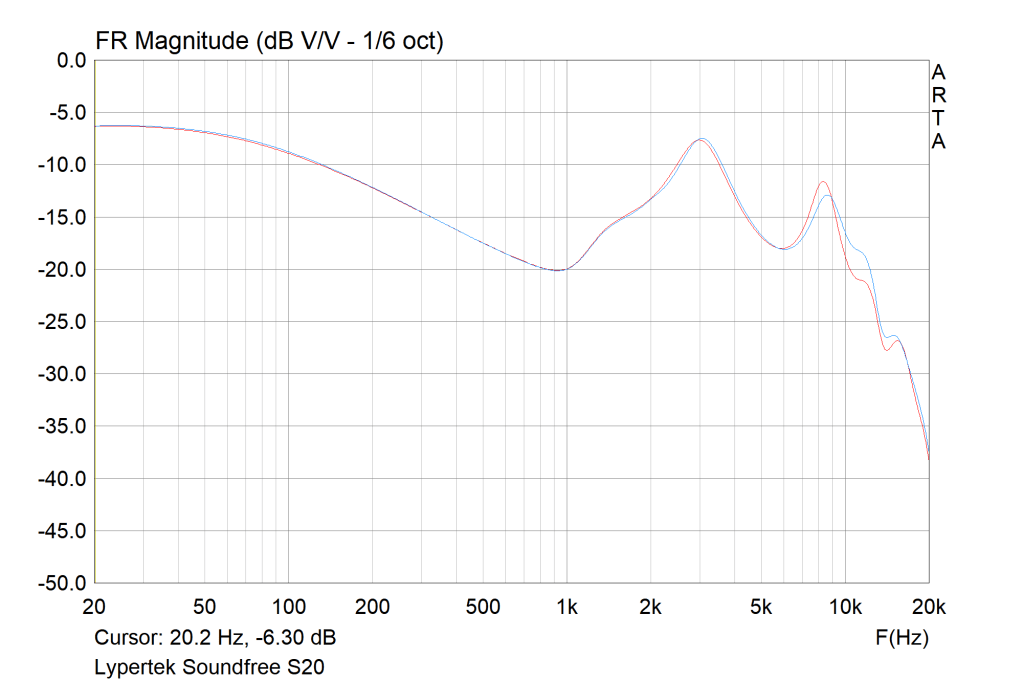
Testing Methodology: Measured using Arta via IEC 711 coupler to Startech external sound card. 7-9KHz peaks may be artefacts/emphasised due to my measurement setup, less so with deep fit. Measurements besides channel balance are volume matched at 1KHz. Fit depth normalised to my best abilities to reduce coupler resonance. Still, due to these factors, my measurements may not accurately reflect the earphone or measurements taken by others. I gave the S20 100hrs burn-in to ensure maximum performance prior to subjective breakdown.
Tonality –
The sound tuning was a defining feature of the TEVI, offering superlative balance and surprisingly good technical performance that put it on par even with some wired offerings around its price. The LEVI isn’t perfectly even nor does it explicitly comply with any reference curves. However, it still pursues a similar style of sound as the TEVI, with a very clean, nigh-neutral tonality alongside a generally balanced signature with a slight tilt towards the bass. By comparison to that model, users can expect a similarly forward sub-bass in addition to a slightly fuller mid-bass. This is counterbalanced by a more aggressive cut through the upper-bass and lower-midrange that redeems midrange separation and retains a clean tonality. Overall, a more contrasty, almost W-shaped expression as opposed to the LEVI’s more linear approach to balance.
Bass –
The S20 provides a slightly more bolstered bass than the TEVI but can hardly be considered a bass emphasized earphone in and of itself. The TEVI offers a slightly more affirmative sub-bass alongside a cleaner tone and higher definition. Meanwhile, the S20 shifts some focus towards a fuller expression placing equal emphasis on both sub and mid-bass but sacrifices some extension in so doing. In turn, the tone remains mostly clean, introducing only a subtle warmth, but it does provide noticeably more punch and fullness. It retains sound linearity but does deliver quantity that should satisfy for bassier genres and portable listening.
The note presentation remains well-controlled and defined as on the TEVI if not quite to the same extent. Where the TEVI was an outlier in the TWS space, the S20 is more of an upper-pack performer from a technical standpoint. Still, this is one of the cleanest and most defined low-ends I’ve heard on a TWS earphone when combined with the sensible tuning. It offers above average speed and dynamics, lacking a little sub-bass pressure but redeeming itself with strong separation and definition. Don’t expect huge bass but a tasteful sub and mid-bass emphasis in good measure alongside impressive detail retrieval for a TWS earphone – all the more so considering the conservative asking price.
Mids –
The midrange continues suit, offering a clean tonality and good balance subjectively. As opposed to the TEVI that was popularised by its strict, linear tuning, the S20 offers a sculpted rendition that plays better complement to its similarly more sculpted low-end. As the mid-bass has been increased, so too has the upper-bass and lower-midrange been attenuated to similar proportion. In turn, the tonality remains neutral in the midrange. However, this comes at the cost of coherence which has been diminished to some degree. To further counterbalance, Lypertek have slowly tapered down the upper-midrange and lower-treble to retain smoothness and increase density.

It isn’t a truncated or dark sounding earphone nor an explicitly smooth one. The S20 prioritises tri-frequency balance, separation and cleanliness over linearity and coherence. In so doing, the earphone upholds a respectable timbre, albeit quite a thin note body, and it has a natural voicing with appropriate emphasis for pinna gain. Overall, it creates a well-balanced presentation with slight bias towards its clear, natural vocals over instruments. Though thin, the S20 isn’t sharp or forward nor sibilant due to its top-end tuning. In turn, I found it to offer a well-rounded performance if not the same level of coherence as the TEVI.
Highs –
The top-end is on the smoother side and appears tuned so as to minimise fatigue, it isn’t overshadowed but never steals the spotlight. Emphasis falls off gradually following the 3kHz hump and treble comes across as smooth in turn. It does resemble the TEVI to some extent here, with no obvious peaks or troughs, simply a gradual roll-off into the middle-treble. In turn, don’t expect huge fine detail retrieval or energy nor abundant headroom and sparkle. Much like the rest of its sound, the top-end is defined by cleanliness, with a nice transient response yielding a sound level of foreground detail retrieval and an admirable instrument timbre.
Note body is accurate for the most part and the presentation is clean with no glare or brightness. There’s pleasing foreground/background contrast but not a huge amount of layering as there is minimal resolution of background and micro-details. In turn, you get a decently wide if not superbly organised stage. I feel the wireless codec is a large limiting factor here, putting the S20 just on par with the average TWS in-ear in terms of extension and treble resolution. Again, the tuning is well-done if you don’t mind a slightly smoother and more laid-back response relative to the midrange. However, the technical chops of this earphone are easier to appreciate in the bass and midrange.
Soundstage –
Despite its modest extension and background detail retrieval, the S20 still crafts a reasonably wide soundstage with slightly more intimate depth. It is able to stretch just beyond the periphery of the head while depth is diminished due to its upfront vocal presentation. Imaging is not bad, the earphone sounds composed on complex tracks and offers both a strong centre image and a pleasing lateral spread of instruments. Directional cues are sharp though localisation isn’t super accurate nor is the presentation especially layered or multi-dimensional. Separation is a highlight due to its generally cleaner tone and thinner note body. This greatly enhances the perception of the detail that is present, making the S20 sound much more nuanced than the average TWS earphone even if technically it’s about on par.
Comparisons –
Lypertek TEVI ($109): The TEVI is slightly pricier and its fit and controls are not as refined. In return, it’s slightly more compact, has wider codec support and a higher water ingress rating. The TEVI has a deeper extending bass and a cleaner but less substantial mid-bass. It is faster in the bass with greater control. The midrange is more linear, with more accurate body and timbre. The S20 is more defined and separated though thinner, it can be warmer or cooler depending on the track due to its more contrasty tuning – where, the TEVI sounds more consistent between tracks. The treble is similar on both, the TEVI is slightly brighter and more balanced overall. It is also more detailed and extended but not by much, neither are especially forward here. The TEVI has a similarly sized stage, however, its imaging is noticeably sharper and more specific. The S20 has higher separation in return, but also lower coherence and organisation.
Audiofly AFT2 ($119): The AFT2 also comes from a company with deeper roots in the wired audio scene. It offers a similar approach to sound tuning but takes contrast and bass emphasis one step further over the S20. It has similar bass extension but a noticeably bigger bass that sits in front of the rest of its sound. It isn’t as controlled nor as tonally clean but fuller and warmer. The midrange is similarly tuned, though more coloured on the AFT2 with a warmer tone and greater body, sounding richer. It isn’t as open up top with faster fall off through the upper-midrange so it doesn’t sound as open or defined. The S20 is thinner but much cleaner and more separated. The treble is smooth on both, the S20 has a bit more energy and detail retrieval, neither extend especially well. The S20 has a slightly wider stage. The S20 is more balanced while the AFT2 will suit those wanting a more robust sound without sacrificing a natural midrange.
Verdict –

Over the years we’ve witness numerous times, the rapid rise of the latest hyped ChiFi brand and their runaway hit followed by a steady decline as they fail to recreate that success. With the backing of the Oriveti design team, it appears Lypertek are not fallible to the same digressions; the S20 is not an upgraded TEVI, but builds upon the learnings achieved from that model while targeting a lower price point. In so doing, the company provide a polished and minimal compromise experience start to finish. Relative to consumer models, there’s no app customisation, no ANC and questionable aware mode implementation. The call quality isn’t excellent but sufficient. However, it does nail the fundamentals of delivering a great day to day audio-focused experience; the design is ergonomically brilliant with excellent passive isolation, the controls far improved over the TEVI and the battery life is nothing to scoff at. The S20 provides a balanced sound with a clean tone and tastefully lifted bass that makes it a treat to listen to for all use cases. Though Lypertek may not have created an earphone that represents an upgrade in all facets, the S20 is substantially better to live with day to day than the TEVI and the vast majority of TWS earphones for that matter.
The Soundfree S20 is available from Amazon (International) for $69.99 USD at the time of writing. Please see my affiliate link for the most updated pricing, availability and configurations.
Track List –
Arcade Fire – The Suburbs
Archive – Controlling Crows (Parts I – III)
AKMU – SAILING
Bob Segar – Night Moves
Courtney Barnett – Tell Me How Your Really Feel
Eric Clapton – Unplugged
Gorillaz – Plastic Beach
Fleetwood Mac – Greatest Hits
John Legend – Once Again
MAMAMOO – reality in BLACK
MGMT – Oracular Spectacular
Modest House – Good News For People Who Love Bad News
NIKI – lowkey
Nirvana – Nervermind
Radiohead – OK Computer
Social House – Haunt You
suggi – cheer up!
TOTO – Toto IV
Vampire Weekend – Father of the Bride
Vaundy – strobo

Ryan Soo
Avid writer, passionate photographer and sleep-deprived medical student, Ryan has an ongoing desire to bring quality products to the regular reader.
 Everyday Listening