

Cayin Fantasy Review – Out of This World

Sound –
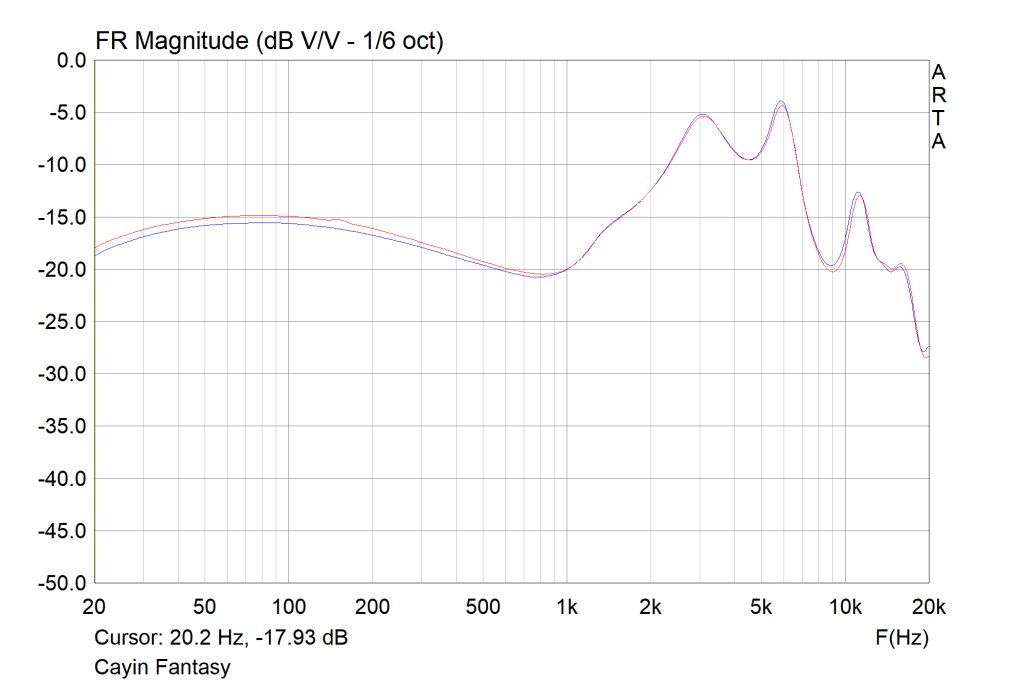
Testing Methodology: Measured using Arta via IEC 711 coupler to Startech external sound card. 7-9KHz peaks may be artefacts/emphasised due to my measurement setup, less so with deep fit. Measurements besides channel balance are volume matched at 1KHz. Fit depth normalised to my best abilities to reduce coupler resonance. Still, due to these factors, my measurements may not accurately reflect the earphone or measurements taken by others. I gave the Fantasy 100hrs of burn-in to ensure maximum performance prior to subjective breakdown.
Tonality –
The Fantasy provides a bright and revealing tuning on the outer periphery of a general balanced descriptor. Fundamentally, the tuning is even and progressive if more aggressively sculpted than most targeting this kind of sound. While the bass is even, balanced and just a touch warm, the midrange does ramp up rapidly to a 3kHz prominence. A 4-5kHz dip redeems some smoothness and density before a subsequent 6kHz peak. The result is a slight reverse L-signature that is bright but not overwhelming in its intensity. The Fantasy is further redeemed by its technical performance that also likely contributes to this impression of brightness. It has a highly sharp, defined transient response reminiscent of the legendary, similarly Be-based A8000 that works in tandem with the revealing tuning to bring every small detail to the fore.
Tuning Tips
As usual, I immediately sprang for the balanced tips. I found they were essentially identical to the pre-installed tips as described above, just a different colour. The vocal tips functioned as described and wouldn’t be my preference given the already brighter nature of the earphone. They slightly attenuated the bass and diminished sub-bass slam while bringing vocals further forwards. These tips sounded a bit peaky and intense to me. The bass tips are a more reasonable contender. They smooth off the treble a bit and slightly bring down the vocal range, making the bass stand out more. I didn’t like the voicing on these either, however, as vocals sounded a bit muted and the presentation was less organised. The balanced or stock tips offered the best timbre to my ears, delivering the most natural voicing even if they weren’t the most balanced. Let’s dive into filters to see how this can be further refined.
Filters
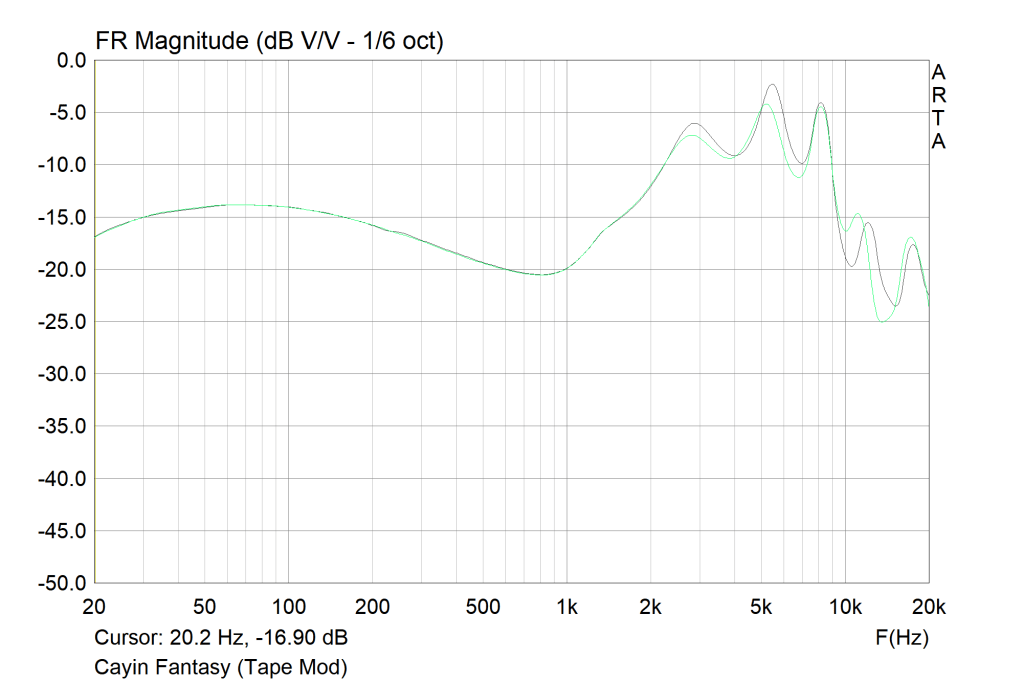
Do note that though the filters do unscrew, you cannot change the nozzle size or sound as on the Fiio FD5. So, my first thoughts upon listening to and measuring the Fantasy were to attenuate its lower-treble peak with a layer of alcohol swab. You do lose some extension and resolution in so doing though for some cases, like the Astrotec Phoenix, the timbral benefits far outweigh the diminished technical performance. In this instance, that is indeed the case. You still get a super fast bass response and a defined note presentation but the treble sharpness is greatly diminished. This mod also smooths off the upper-midrange slightly too. This mod is fully safe, reversible and cost-effective. I would highly recommend giving it a go if you’re looking at the Fantasy. All impressions below will be using this mod.
Bass –
The low-end is well-balanced and also impresses greatly with its technical performance. This isn’t for those wanted long, drawn-out and warm notes, but an agile presentation with immense punch. Sub-bass is lightly rolled-off but tight and well-extended, offering a well-defined rumble. There’s a small mid-bass hump that extends partway into the upper-bass, counterbalancing the brighter midrange. Regardless, the timbre and tone are fairly neutral due to the rapid decay speed and relatively tame extent of colouration. Notes are highly defined and accurately sized with no tubbiness or bloat in sight.
The technical performance steals the show, with masterful timing and top-tier control. Note attack is aggressive and notes decay very quickly. With the uptick of fullness, notes aren’t left hollow or thin, retaining a respectable amount of texture. In fact, the slight mid-bass focus works well in tandem with the driver’s speed to deliver outstanding punch and force. Bass is dynamic, not excessively pressurized, but hugely revealing of fine textures and details. Separation is great without sounding sparse as some leaner earphones can. Altogether, a low-end that meticulously deconstructs even complex tracks with balanced quantity that isn’t suitable for bass lovers.
Mids –
Similar characteristics are to be observed in the midrange which is defined by its clean and textured nature. Even with the filter mod, the Fantasy remains slightly bright earphone though far from excessively so. The 4-5kHz dip does help to redeems some smoothness and density, though this earphone remains aggressive over smooth and coherent. The lightly warm bass does help as well. Due to a lower-midrange dip and climb to 3kHz prominence, the midrange remains tonally neutral and body is just about neutral too. Vocals are brought to the fore and presented with both great size and enhanced clarity though this does imbue instruments with a bit more euphonic warmth and gusto that helps to aid vocal-instrument balance. It also isn’t remotely strained nor peaky and the mod does help to further improve balance with the bass, though some over- articulation is still evident.

Fear not as with the filters in place, the Fantasy remains a clear, extended and open sounding monitor. It has a particular focus on definition yet, impressively so, retains a highly natural voicing and a pretty accurate vocal timbre, articulation aside. Most importantly for my preferences, vocal size isn’t diminished and there isn’t too much intensity in the upper-midrange so the clarity and definition can be enjoyed without upsetting genre versatility. Accordingly, the earphone simply comes across as delicate rather than stark or metallic. It’s immediately evident this is a highly resolving monitor and though most will find them bright out of the box, this is one of the better executions I’ve heard of a top-end forward sound, especially with the mod.
Highs –
This will likely be the most polarising aspect of the earphone due to its prominent 6kHz peak. Details are pushed forward, sitting at the forefront of the presentation. However, treble also sounds relatively thin and can wear on the ear over time, even with the mod in place that attenuates treble to a greater degree than the midrange. While the mod does help to redeem some texture and body, this remains a very crisp monitor, prioritising fine detail presentation over timbre. Its transient response is razor sharp, enabling it to discern micro-details with relative ease, however, this does further contribute to the impression of sharpness. Nonetheless, due to its exceptional separation and note definition, the earphone still sounds quite organised on complex tracks. It is able to differentiate each note without that “wall-of-sound” phenomenon I’ve experienced on other brighter earphones.
What helps as well is that the background is clean and dark with a steady decline through the middle treble. Accordingly, there’s no glare and treble brightness doesn’t overwhelm the rest of the presentation. It provides strong contrast with the aggressive foreground with a bump in upper-treble presence retaining strong resolution of background details. This immensely aids an immersive stage with awesome layering and space. Extension operates at a high-level despite the single-driver nature, it outperforms most competitors in this aspect. In tandem with the tuning, it delivers a hugely fun sparkle and energy into its top-octave forming a presentation that is distinctly high-end in nature. However, though I have no qualms here, the lower-treble is quite sharp and does noticeably affect treble instrument timbre. Do consider this before purchase.
Soundstage –
Beryllium earphones generally provide a really nice soundstage mostly due to their sharp imaging if not their overtly spacious nature. The Fantasy is definitely up there too, offering an especially wide stage that stretches noticeably beyond the head, paired with slightly more intimate depth due to its forward vocal range. Its imaging is very sharp with highly defined directional cues, very fast transients and precise localisation. Listening to a track such as The Cure’s “Close to Me” and you immediately get a very good sense of the three-dimensionality on offer.
The Fantasy further compounds upon this strength with its layering. Though it isn’t hyper-layered, it has exceptional contrast between its foreground and background and even some ability to place along the coronal axis too which you don’t commonly see on any IEM. In turn, it is also quite an organised sound. Strong separation enhances this impression, with its agile and defined note presentation and neutral to thinner note size, the Fantasy maximises its detail retrieval and use of space.
Driveability –

Despite its 37ohm impedance, with a high 108dB sensitivity, the Fantasy is an efficient earphone that isn’t difficult to drive to ear splitting volumes, even from portable sources. Being a single-driver earphone, it is one of the easiest high-end IEMs to drive.
Output Impedance Sensitivity
Being a single-driver earphone, one would assume output impedance would have minimal impact on the sound signature and this is the case here. Switching between the Hiby R6 (10-ohms) and Shanling M2X (1-ohm) reveals a very similar presentation with only subtle colouration that can be attributed to the sources themselves.
Driving Power
The Fantasy scales nicely with a bit more driving power. Switching from the M2X to the Topping A30 Pro revealed a more substantial sub-bass with more power and slam. Bass control was slightly higher and the sound was more articulate on a while. Treble was noticeably more detailed with better separation between each note. The soundstage as well was noticeably more immersive on the desktop source, with more contrast between layers and sharper imaging. A very faint hiss was evident on the M2X at the lowest volume but was not detectable during listening. Though not especially prone to hiss as some BA-monitors, the Fantasy does pick up source noise a bit easier than most DD earphones.
Suggested Pair Ups
The Fantasy runs beautifully out of just about any source as it is impervious to output impedance and doesn’t pick up excessive amounts of source noise. Similarly, though it does scale nicely from a technical point of view, it is hardly slow or sloppy from a less powerful one. Even from my Xperia 5 II, it sounded controlled and detailed, especially given its clean tuning. In terms of synergy, the Fantasy does benefit from some warmth. While technical sources do bring out the sharpest imaging and the greatest detail retrieval, I found they could be a bit too intense, the Fantasy already excelling in these regards.

Ryan Soo
Avid writer, passionate photographer and sleep-deprived medical student, Ryan has an ongoing desire to bring quality products to the regular reader.
 Everyday Listening
Ryan, great review…pray tell: how does one apply the alcohol pad mod?
LikeLike
Thanks Steven!
Open a swab and dry it out, cut into a 5x5mm square and place on the nozzle. Pop the tip back on, this will hold it in place. Easy and reversible, works on any IEM with treble peaks.
Hope I’ve helped you out 🙂
Cheers,
Ryan.
LikeLiked by 1 person
Thanks Ryan…I just got the Fantasy on review tour, using it with a PWAudio Monile 50s cable…I really love it and I am thinking of gettingit but this treble peak is concerning to me…may be a deal breaker…gonna try mod now…
LikeLike