

Fiio FD5 Review – Brazen

Sound –
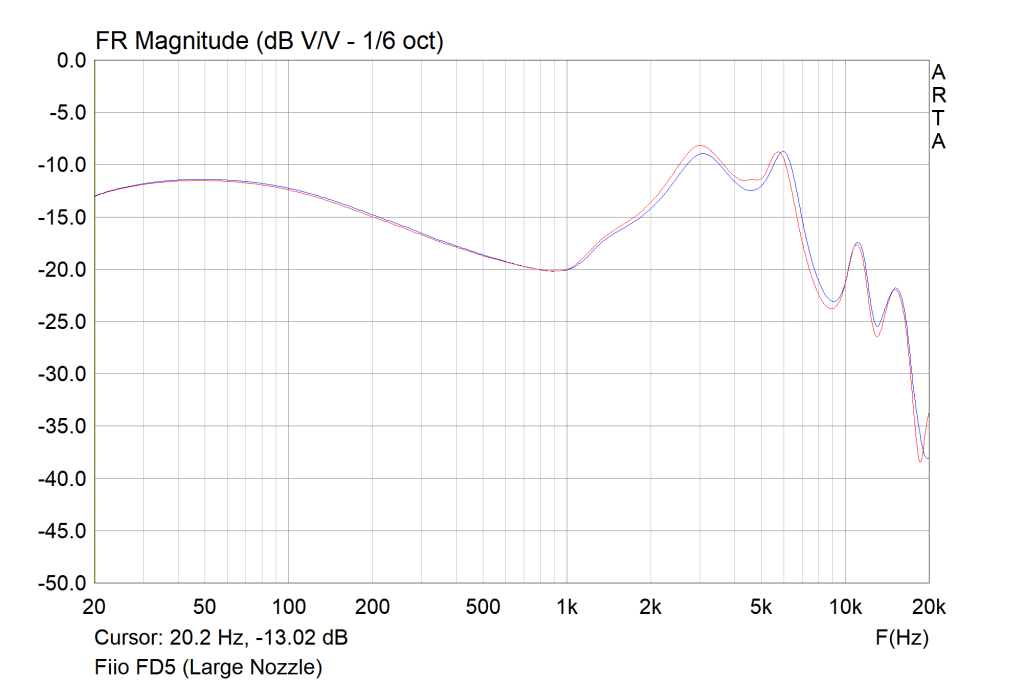
Testing Methodology: Measured using Arta via IEC 711 coupler to Startech external sound card. 7-9KHz peaks may be artefacts/emphasised due to my measurement setup, less so with deep fit. Measurements besides channel balance are volume matched at 1KHz. Fit depth normalised to my best abilities to reduce coupler resonance. Still, due to these factors, my measurements may not accurately reflect the earphone or measurements taken by others. I gave the FD5 100hrs of burn-in to ensure maximum performance prior to subjective breakdown.
Tonality –
The FD5 provides likely the most ear-pleasing tuning of any Beryllium single-DD earphone I’ve tested straight out of the box. Fundamentally, Harman-inspiration is evident. However, a mid-bass bump and small lower-treble peak create a U-shaped character of Fiio’s own creation. Nevertheless, the tonality remains very pleasant. Lows are full yet controlled and super punchy, setting the foundation for an inviting light-warm midrange tonality. Though slightly laid-back, vocals retain focus with a clear and natural voicing. Meanwhile, the top-end is crisp and energetic.
As with many high-end IEMs, focus is centred around the foreground preceding a darker background and subsequent boost in top-octave sparkle. Such a tuning is fairly ideal for my preferences as it brings micro-details to the fore yet without any overt brightness or glare. As contrast is slightly higher, I would characterise the FD5 as a more engaging over linear and coherent earphone, yet as it lacks any midrange intensity, it remains suitable for long-term listening. Altogether, a beautifully tuned signature that’s engaging but not pushed too far so as to alienate lovers of balance.
Narrow Nozzles & Tuning Tips

I feel this deserves its own dedicated section as the bore and tips can have a substantial impact on the sound. Though I am a huge fan of the stock tuning, do note that this is according to my preferences which may not align with yours. As such, some tunability is always a good idea to cater towards a wider range of listeners. The modular bore exemplifies this, not only altering the fit style and tip selection but also the fundamental sound. Note a few dB of attenuation through the midrange and treble. This makes for a smoother and fuller sound, also a more coherent one. However, this does come at the cost of soundstage dimension and separation, with the bass becoming muddier and air being noticeably diminished.
The small bore tips make sense in 3 scenarios; you prefer a smoother sound, you are listening from a low power portable source, you cannot get a seal/fit with the large bores. Indeed, the FD5 sounds leaner and brighter from low power sources, in turn, the small bore can regain balance. In addition, I did not a slightly deeper fit, if you have small ears, this is a good option to have. I did personally prefer the large bore tips by a large degree. So, for the sake of review, I will be evaluating the FD5 with the stock balanced tips and large bore as these were most to my preference. For those sensitive to treble, the small bore tips will be a good avenue and this experience can be further refined with the tuning tips.
Bass –
The FD5 has a hefty, well-weighted low-end tuned for engagement over linearity and balance. Thankfully, the bump is tasteful and doesn’t swing too far into bass-head territory; this earphone will be enjoyed by those wanting balance while satisfying listeners wanting a bit more oomph too. Sub-bass extension is excellent, providing a hearty slam reaffirmed by palpable pressure at the very bottom. Rumble is well-defined and bass retains great definition into the sub-audible, very satisfying for electronic and drums. Mid-bass sits at the forefront, with a moderate hump. In turn, bass is full and presented with a warm tone. It tapers off smoothly into a recessed lower-midrange thereafter to avoid midrange colouration and excessive warmth. While notes are clearly bold and enlarged, due to the progressive tuning and only modest mid-bass emphasis, bloat and muddiness are absent. However, separation is not the FD5’s strong point in turn, being just a little woolly at times.
That said, detail retrieval is well above average. The FD5’s note presentation is highly controlled, aided by a rigid driver and strong magnet structure. Decay is on the faster side for dynamic driver and attack is aggressive too, helping to counterbalance the increased fullness. Dynamics are on the higher side as a result, though subjectively would have been aided by a cleaner tuning. In particular, the FD5 possesses a very hard-hitting response, both in the mid and sub-bass, but misses some tightness and definition in the mid-bass, especially relative to its higher-end Be competitors. Perhaps this is an unfair comparison, however, as the FD5 has likely the most robust tuning of them, excluding the Periodic Audio Be which is more clearly bass-emphasized. While detail retrieval is a good performer, the reduced separation means this isn’t the defining trait of this earphone. Rather it is the impressive depth, power and texture on display that operate without upsetting overall balance.
Mids –
With a recessed lower-midrange and progressive rise to 3kHz prominence for pinna gain, the FD5 retains a mostly natural voicing and avoids excessive tonal colouration too. It remains a coloured earphone, with a light warm tone that counterbalances a slight reduction in midrange note body. Despite the 3kHz emphasis appearing large in measurement, the FD5 actually sounds a little laid-back in the midrange with its bass and treble tending to draw more focus. Subjectively, I find this contributes to a slightly easier listening experience, as it avoids the intensity and strain I encountered on the similarly tuned A8000 and Cayin Fantasy. The progressive tuning does mean the earphone retains a very natural voicing, vocals sit just in front of midrange instruments but aren’t peaky nor sibilant. If I had to critique, they are a little raspy and over-articulated, a result of a subsequent 6kHz peak with only a small dip in between.
However, never is the FD5 pushed into the realm of sharpness to my ears, especially when considering the slightly laid-back midrange position. The added warmth too makes this a more inviting listen your usual reference earphone. It is a little more forgiving but also isn’t coloured nearly to the extent that muffle and veil become an issue; if anything, the FD5 is a clarity enhanced earphone due to its articulate nature. While its timbre isn’t perfect, the FD5 is easy to enjoy with no notable weak points. Perhaps those sensitive to treble may find it a little bright leaning with its slight raspiness and slight thinness, but the lack of forwardness is a tasteful execution. The net result is a midrange that sounds natural yet clear with a hint of additional warmth augmented by enhanced note definition. While not perfectly even, it is perfectly enjoyable.
Highs –
Similar to the midrange, the FD5 injects a little extra energy and zing here without overstepping boundaries. It is defined most by a small 6kHz peak in equal measure to the upper-midrange, albeit, due to the nature of human hearing, appears slightly forward by comparison. Relative to the more linear earphones I’ve been enjoying lately, the FD5 is crisper, sharper and more energetic. It has great foreground detail retrieval owing to its clean transient response which enhances separation. Subjectively, some fine detail is overshadowed due to the bright upper-mid set to bright lower-treble which could do with a little more damping in the 4kHz region, albeit treble itself is clean and clear. While note attack is keen, decay is a little quick, exacerbated by the dive into middle-treble trough. Alongside the thinner note body, this saps some texture and shimmer, increasing the perception of thinness.
Regardless, the FD5 is nicely detailed and has awesome contrast to its dark, immaculately clean background. This draws further focus to the lower-treble, minimising glare, ringing and preventing over-brightness. As with many earphones of this nature, a small upper-treble lift aids layering and headroom in the absence of middle-treble presence but don’t expect a lot of air as a result, it sounds quite muted. While extension isn’t uncharacteristic of the price range, it isn’t at all lacking, producing a pleasing amount of energy and background detail. There still isn’t much sparkle and micro-detail at the very top that pricier models with this style of tuning may provide. However, the FD5 does provide a nice sense of space without feeling sparse and its layers are nicely defined, even smaller details in the background. While it doesn’t highlight said details, it provides enough nuance to achieve a good sense of dimension and depth that is far from a given at this price point.
Soundstage –
With good treble extension and an open form factor, the FD5 sews its presentation together well with a nice, spacious soundstage. It stretches beyond the head with great width and has good but not sensational depth, forming an oval presentation. Imaging performance is good but not great. The FD5 has good coherence and sharp positioning across its lateral plane. Directional cues are sharp and layering also performs at a high standard, being defined and delineated. However, the centre image could do with more sharpness, being a bit diffuse and pushed laterally. Coronal positioning is nothing special.
This means that though the FD5 stretches wide and has obvious air and space, it isn’t quite as multi-dimensional and immersive as something like the A8000. Of course, you’ll have to excuse the $1700 price difference there and these sentiments do apply to basically every earphone at the FD5’s asking price. Separation is a mixed bag. Bass separation is reduced due to its fuller voicing, however, the midrange and high-end impress. The transition from upper-midrange to lower-treble can get a little messy on some tracks though this is rare. Overall, the FD5 offers impressive scale and dimension, width especially, augmented by sharp imaging and localisation left to right.
Driveability –
The FD5 has a reasonable 32 ohm impedance and a 109dB sensitivity making it a relatively efficient earphone. In addition, its adoption of a single dynamic driver takes much of the complication out of source pairings one may experience with a multi-driver design.
Output Impedance Sensitivity
Switching between the Shanling M2X (1-ohm) and Hiby R6 (10-ohms) revealed minimal shift in sound signature beyond colouration of the sources themselves. In turn, it can be established that the FD5 will pair nicely with most sources and will reveal the colour of the attached source well.
Driving Power
While output impedance doesn’t have a huge impact on the FD5’s sound, it does thrive from sources with a bit more driving power. Switching from the Shanling to my Topping 30 Pro desktop stack provided a heavier-hitting sub-bass and a more layered, immersive soundstage. In particular, the Topping stack had a lot more depth in addition to an increase in bass power. The midrange was also slightly fuller and treble had more body and texture, occupying a slightly more laid-back position for better overall balance. The Shanling skewed a bit brighter, lacking gusto by comparison. Despite being sensitive on paper, the FD5 didn’t pick up any hiss on the M2X as some of my similarly sensitive BA earphones do.
Suggested Pair Ups
The FD5 benefits from a powerful source but doesn’t require a low output impedance. In addition, it can tolerate slightly higher noise floor well. Due to its sound tuning, it does achieve more versatile pairing than this would suggest. For instance, despite being brighter from the M2X, it wasn’t lacking body due to its added mid-bass warmth. That said, it also has plenty of room for additional warmth should the listener have a warmer source. Perhaps the lower-treble will be the deciding factor as the diminished warmth on less powerful sources can further draw focus to the treble. The FD5 sounded best to me from powerful reference sources like the 30 Pro stack as this maximised separation and a defined note presentation without veering into sharpness. The easy solution here is to switch to the small nozzles which reduce brightness and increase bass body. While you do sacrifice some definition and soundstage here, the tonal balance is restored.

Ryan Soo
Avid writer, passionate photographer and sleep-deprived medical student, Ryan has an ongoing desire to bring quality products to the regular reader.
 Everyday Listening