

Soundz NOVA Review – Stratospheric
Sound –
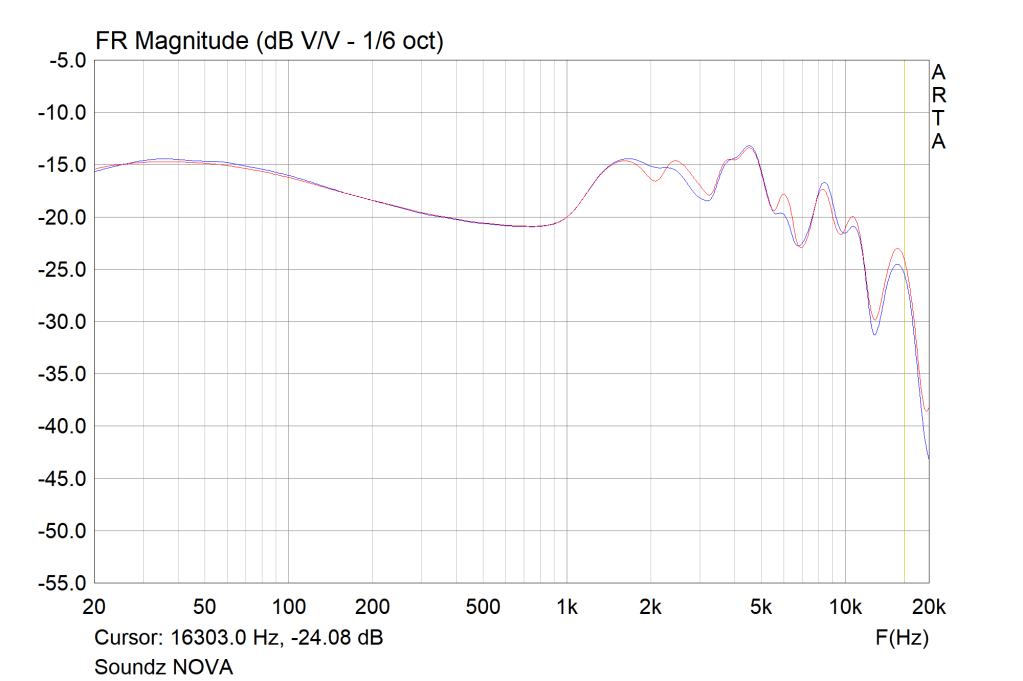
Testing Methodology: Measured using Arta via IEC 711 coupler to Startech external sound card. 7-9KHz peaks may be artefacts/emphasised due to my measurement setup, less so with deep fit. Measurements besides channel balance are volume matched at 1KHz. Fit depth normalised to my best abilities to reduce coupler resonance. Still, due to these factors, my measurements may not accurately reflect the earphone or measurements taken by others.
Tonality –
The NOVA has an intriguing tuning that is well balanced yet powerful, energetic and superbly airy. It has an emboldened sub-bass presentation complemented by a vibrant, slightly forward midrange and clean, airy treble. With heightened separation between the three core frequency ranges, it comes across as W-shaped though with a slight midrange focus. The EST implementation is also interesting, and it is good to see in general that manufacturers are learning how to better integrate this tweeter system. Technically, the NOVA is undoubtedly a high-end design, and this is apparent simply due to the fine detail retrieval in the treble and resolution of minutiae in the midrange especially. While I wouldn’t say it is technically outstanding, you wouldn’t miss much coming from class-leading competitors either. Altogether, a technically solid and well-voiced earphone that differentiates itself with a slightly more coloured, albeit still mostly natural presentation.
Bass –
With a sub-bass forward tuning, the NOVA provides far more power than most BA competitors if fairly typical extension for a high-end BA woofer array. This means few will find it lacking impact but those that love a visceral, physical slam at the very bottom may still want to investigate a dynamic driver/hybrid model. Otherwise, it is tight, satisfying and well-defined. Emphasis continues into the mid-bass but falls off progressively into a slightly recessed upper bass for separation. The result is a light warm, but mostly clean tonality and a bold, robust note structure responsible for its powerful voicing. There are no odd timbral characteristics, forming an enjoyable bass voicing that feels substantial yet well balanced with the higher frequencies. As you’d expect, the note presentation is agile and controlled with a focused note attack and fast decay.
It sounds typical BA here with their signature note presentation that lacks the texture and natural decay of a dynamic driver. However, the fuller voicing is in good taste here, meaning note body doesn’t sound diminished in the slightest. I personally do find certain sub-bass emphasized tunings to affect mid-bass separation, resulting in some fine details being masked over. While separation isn’t outstanding, I didn’t find this to be the case here as the emphasis is modest and the decay is fast. This means you get a higher note weight but still great separation through the mid-bass, for a defined, articulate and responsive low-end even during complex tracks. The NOVA doesn’t do anything outstanding here with regards to dynamics and extension. However, it upholds the strong detail retrieval intrinsic to the responsive BA driver tech with a powerful tuning that will appeal to many listeners.
Mids –
The midrange tuning is less orthodox and has an eclectic mix of strengths and timbral oddities. As the NOVA has negative pinna gain with compensation in the surrounding frequency ranges, the presentation comes across as more coloured than most, and the voicing is a little off but isn’t overtly unnatural either. Vocals aren’t too small as the centre and lower-midrange sound more forward by comparison, bolstering vocal body and power. Similarly, the upper-mid tuning lifts clarity and brings forward vocal positioning. Tonal colouration has been minimised courtesy of the bass tuning. As the 4-5kHz region has been lifted, vocals aren’t lacking clarity or openness even with the 3k dip. They are clear, slightly forward and pleasantly articulate. At the same time, never is the NOVA prone to sibilance as treble smooths off above, nor intensity due to the 3k dip. The listener is rewarded with excellent cleanliness and high definition accordingly, with the fuller note structure preventing thinness and strain.

You do receive a higher contras sound in turn, instigating its energetic nature, though strong midrange resolution ensures that small details are clearly apparent and well resolved. There are always compromises to a sculpted tuning and the same can be said here; the NOVA comes across as somewhat boxy in the lower midrange and a little strained up top. Though mostly vivid and clear, the NOVA can sound congested through its bass/midrange transition on some tracks, yet simultaneously has a notably dry vocal presentation. It’s an odd timbral characteristic, not over-articulation, diminished note size nor thinness and not as grating on the ear as these either. Altogether, this still means the NOVA does fall behind most competitors in terms of timbral accuracy, perhaps not to the extent that most would be irked, but enough not to foster wide recommendation. I still cannot discount its strengths as the NOVA does offer excellent resolving power with minimal thinness or intensity which may be a priority for some listeners.
Highs –
While I wasn’t blown away with the midrange, the top-end here is very solid to say the least. It’s also pretty unique even for an EST implementation, with peaks at 4.5, 6 and 8 kHz forming a presentation that is crisp, airy and energetic but perfectly versatile altogether. As the peaks are small and treble sits in line with the midrange even at its highest point, Soundz were able to retain balance and an enjoyable timbre. As with many EST earphones, a superbly clean transient response grants outstanding separation between notes, permitting an effortless detail presentation with perfect organization even on complex tracks. The voicing does intrigue, however, as lower-treble appears a touch laid-back while the middle-treble sits in equal proportion to the upper-midrange. While there is no glare overshadowing small details, it remains clear that the focus here is more on crafting an airy and atmospheric over focused and hyper-detailed presentation, with which it excels. With that in mind, the small 6k peak does reintroduce some foreground detail presence whilst sharpening its notes, improving the perception of fine details.
Conversely, it doesn’t push the presentation too thin nor over sharpen the image, retaining fine detail and well-textured instrumentation. Note body is slightly reduced but percussion doesn’t overshadow finer textures or decay. Similarly, the 8k peak doesn’t introduce sibilance or brittleness, the NOVA is rather imbued with an outstanding sense of atmosphere and delicacy, delivering air and openness in abundance. A sizeable dip at 7kHz means the background remains clean and the foreground and background are well contrasted. Above lies outstanding headroom due to its excellent top-end extension that enhances the aforementioned sense of air and note clarity, even in the absence of overt brightness. The NOVA has a pleasing yet natural sparkle and above average micro-detail retrieval even amongst premium competitors. The execution is easy on the ears without overly smoothing off small details. This is a highly enjoyable top-end that doesn’t shove brightness into the listener’s face but rewards with hugely satisfying air and an effortless detail presentation.
Soundstage –
The NOVA provides a spacious stage with many impressive immersive qualities. Width stretches well beyond the head while depth is more intimate, forming an ovoid stage with a priority on strongly centered, forward vocals. The imaging performance prioritizes atmosphere over pinpoint precise localization. The NOVA’s specialty is its ability to craft an airy and open image yet without much brightness. It does so through its well-resolved background and intriguing yet not overly forward lower treble tuning. In so doing, contrast is preserved, and the NOVA does offer distinct and well-delineated foreground and background layers, but doesn’t differentiate layers as some do.
In turn, and as its lower treble isn’t so pronounced, its localization isn’t especially sharp. However, the quick transients, abundant background detail and excellent extension do contribute to a holographic and multi-dimensional stage. The NOVA is able to position coronally to some degree, a quality lacking on many, which aids this impression. Separation generally operatives on a high level too, the bass does sacrifice a bit of mid-bass separation in favour of a more weighted note presentation. However, I have few complaints overall and small details are easier to discern for the listener.
Drivability –
With a 110dB sensitivity and a 25 Ohm impedance, the NOVA is relatively efficient, especially for an EST earphone. At the same time, it isn’t overly sensitive meaning source noise shouldn’t be a huge concern and the impedance is on the higher side which should further simplify source pairings, let’s dive in.
Output Impedance Sensitivity
Switching between the Shanling M2X (1-ohm) and Hiby R6 (10-ohms) revealed a surprisingly similar experience. The NOVA sounded very similar from both and differences may even be attributable to source colouration. I did hear a slightly more prominent treble from the Hiby but, overall, the voicing and balance was highly similar. In turn, while I wouldn’t go so far to say that the NOVA has a flat impedance curve, it does tolerate a higher output impedance well and it is far less of a concern here than on many other high-end multi-driver earphones. This opens up more flexibility with source pairings.
Driving Power
The NOVA doesn’t require much power to achieve a dynamic and balanced sound. Bass was equally extended from even my Xperia 5 II’s integrated headphone jack as my THX789 desktop amplifier. The THX789 did provide greater dynamics on complex passages and technical performance scaled well, fine detail retrieval and imaging in particular. However, the NOVA is not a picky earphone in terms of power demands. It does require a step or two more volume than your typical high-end IEM, but I wouldn’t consider this a drawback as it also is far less sensitive to source noise. For instance, sensitive IEMs do pick up noise on the M2X at volume 0, where music isn’t audible, but the amp circuit is active. The NOVA was dead silent.
Suggested Pair Ups
This is another strength of the NOVA, being almost source agnostic within reason. That means tube amplifiers with huge output impedances may skew the sound significantly, but any modern solid-state source will have no issue. The same goes for professionals, if your interface has a slightly higher impedance, the NOVA will tolerate this well with minimal signature deviation from a 1-ohm source. Similarly, it is tolerant of higher amounts of source noise without being too power hungry. In terms of source colouration, I found the NOVA to pair best with more dynamic sources with a sharper transient response. The THX789 was a perfect complement here, delivering a bit more slam while bringing out more fine detail through the mids and treble. Smoother sources can be tolerated given separation is high, but for my preferences, I did enjoy the step up in detail presence on the THX amp.

Ryan Soo
Avid writer, passionate photographer and sleep-deprived medical student, Ryan has an ongoing desire to bring quality products to the regular reader.
 Everyday Listening