

SMSL SX-8s Stack Review – DAC/AMP On a Diet

SU-8s Sound Breakdown
Frequency Response –
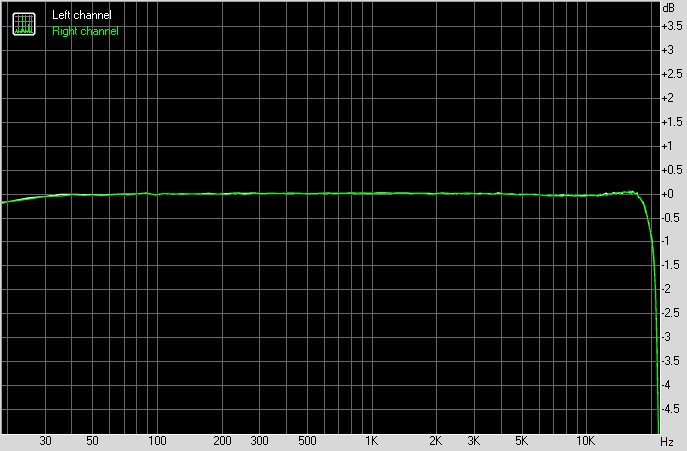
Testing Methodology: RMAA via Startech External Sound Card
The SU-8s has a linear frequency response suggesting that it represents audio with great fidelity. Due to the quality of my sound card, I am unable to reliably test other measures such as distortion and crosstalk so they will be used as a personal reference only. Qualities here can also impact the sound as I will detail via subjective listening.
Subjective –
The SU-8s is clearly derived from a similar foundation as the SU-9 and many characteristics crossover between the two. I would posit that the SU-8s represents a slightly scaled back experience in most degrees and never outdoes its pricier sibling but does match it in some regards. While the differences are apparent under direct volume matched comparison, the SU-8s does stand up as a respectable source on its own. The two share most similarities with regards to tonality. Both are on the smoother side with a light warm/full-bodied tilt in the bass and midrange. The SU-9 comes across as a little cleaner down low while the SU-8s actually has a bit more crispness in the treble. This can also be attributed to their style of note presentation, the SU-9 being noticeably more defined and resolved, the SU-8s a bit fuzzier around the edges lending the impression of a warmer voicing despite that not necessarily being the case. In this sense, though it is a tad brighter, I would still consider the SU-8s to be on the forgiving side in terms of overall character.
Bass –

The SU-8s like the SU-9 provides a slightly fuller bass presentation that instigates its well-structured nature. In most respects, bass is linear and free of overt emphasis or nadirs, perhaps you could say there is a hint of mid-bass warmth, but I didn’t think that was the case personally. The note presentation is likely most responsible for this impression. Compared to the SU-9 there is noticeably more fuzz here. To reiterate, notes have a slightly softer attack and decay slightly slower, in turn, notes come across as slightly more diffuse and less direct in their presentation. Though it is hardly a sloppy or slow sounding source, it isn’t an especially assertive or dynamic one either. The SU-8s is forgiving and pleasantly textured but errs on the smooth and laid-back over aggressive and pacey side.
Mids –
A similar character is to be observed in the midrange though here, the colouration is less evident. Once again, the midrange is presented with a slightly full-bodied character and this gives the source a fair amount of gusto and power in its vocal delivery. Notes sound complete and nicely resolved with abundant texture. While definition isn’t huge due to their softer leading edge, coherence operates at a high level without introducing any form of veil or recession. The SU-9 is a slightly more vibrant source in this respect. The SU-8s is one step smoother and denser with a lick less clarity. Despite this, it achieves a similar sense of layering and nuance just with a slightly softer and fuzzier note presentation as observed in the bass. This means that though fine details are present, they aren’t as clearly highlighted to the listener.
Highs –

I think my former comments would dictate your expectations for the SU-8s’ treble performance, but here, there is a slight tonal deviation from the SU-9. Specifically, the SU-8s has a slightly brighter top-end, treble instruments sit one notch forward relative to the SU-9. However, given that I would consider the SU-9 to be slightly laid-back here, I would say the SU-8s is more authentic in this regard. When it comes to note presentation and timbre, this is a different story. The SU-9 greatly impressed me with its resolving power and natural, textured notes. The SU-8s, unfortunately, is noticeably thinner if not especially brittle in this regard. It is lacking some body and texture, the SU-9 coming across as more refined and mature. Still, there is plenty to enjoy here. Sure, the leading edge also isn’t quite as defined as the SU-9, but it’s pretty close and fine details are presented clearly. It retains a clean background free of glare and grain albeit, don’t expect the same extension and headroom as the SU-9 above. The SU-8s overall provides a well-balanced presentation with good bite and crispness but won’t suit those wanting the most airy or textured sound.
Soundstage –
I was quite impressed by the soundstage on the SU-8s, I had the same experience on the SU-9 and the cheaper model gets impressively close, punching above its price here. Dimensions impress especially, it has just a little less width than SU-9 but similar depth forming a well-proportioned stage altogether. This aids its imaging, which is multi-dimensional and delivers a sharp sense of direction due to clear directional cues. Scrutinising the presentation, we can see the SU-8s isn’t quite as nuanced as the SU-9. Chiefly, its background isn’t as well resolved meaning it overall isn’t as organised and composed sounding, especially on complex passages. This was most noticeable to me with regards to layering where the SU-9 was able to discern between each layer more clearly. Separation also takes a step back due to the less defined note presentation that leaves less air between each element. That said, the generally balanced and linear nature of the amp means this can hardly be criticised in the grand scheme of things.

Ryan Soo
Avid writer, passionate photographer and sleep-deprived medical student, Ryan has an ongoing desire to bring quality products to the regular reader.
 Everyday Listening