

Soft Ears Volume Review – Turn it UP!
Sound –
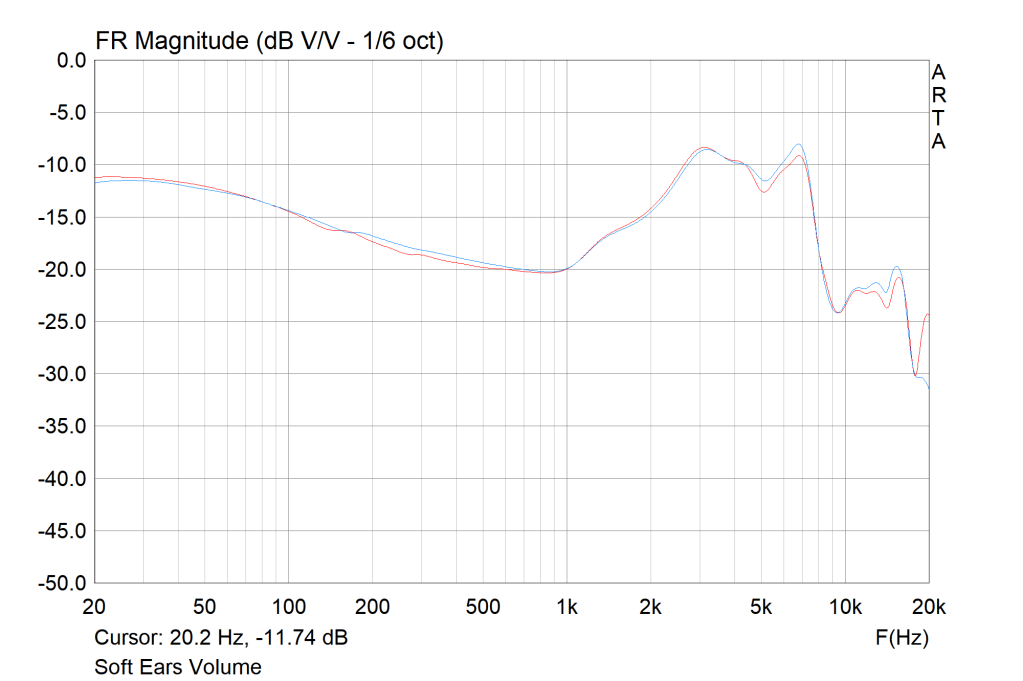

Testing Methodology: Measured using Arta via IEC 711 coupler to Startech external sound card. 7-9KHz peaks may be artefacts/emphasised due to my measurement setup, less so with a deep fit. Measurements besides channel balance are volume matched at 1KHz. Fit depth normalised to my best abilities to reduce coupler resonance. Still, due to these factors, my measurements may not accurately reflect the earphone or measurements taken by others. I gave the Volume 100hrs burn-in to ensure maximum performance prior to subjective breakdown.
Tonality –
Despite Soft Ear’s marketing, the Volume strikes me as a close relative of the Blessing 2 and RS-earphones which should please a wide range of listeners with its balance and refinement. Relative to those models, the Volume is most similar to the Blessing 2 sporting the best bass extension and slightly reduced but also more linear lower treble. As measured, it appears to have more bass but given that the midrange has been brought up to match, in actuality, the lower midrange simply appears slightly more recessed giving it a slightly higher contrast sound.
This means it places more of a spotlight on bass and vocals individually whereas the B2 sounds slightly more linear and coherent. The Volume in return, offers higher clarity and definition despite the reduction in treble bite. Overall, these are sensible changes on a tuning that I had little complaint with. Whilst the slight reduction in coherence is notable, so too will listeners enjoy the slightly more vibrant expression and superior sub-bass extension. I believe Soft Ears has done a great job with the Volume as it retrieves small details noticeably better than the Blessing 2 at lower cost and with fewer drivers.
Ear tips
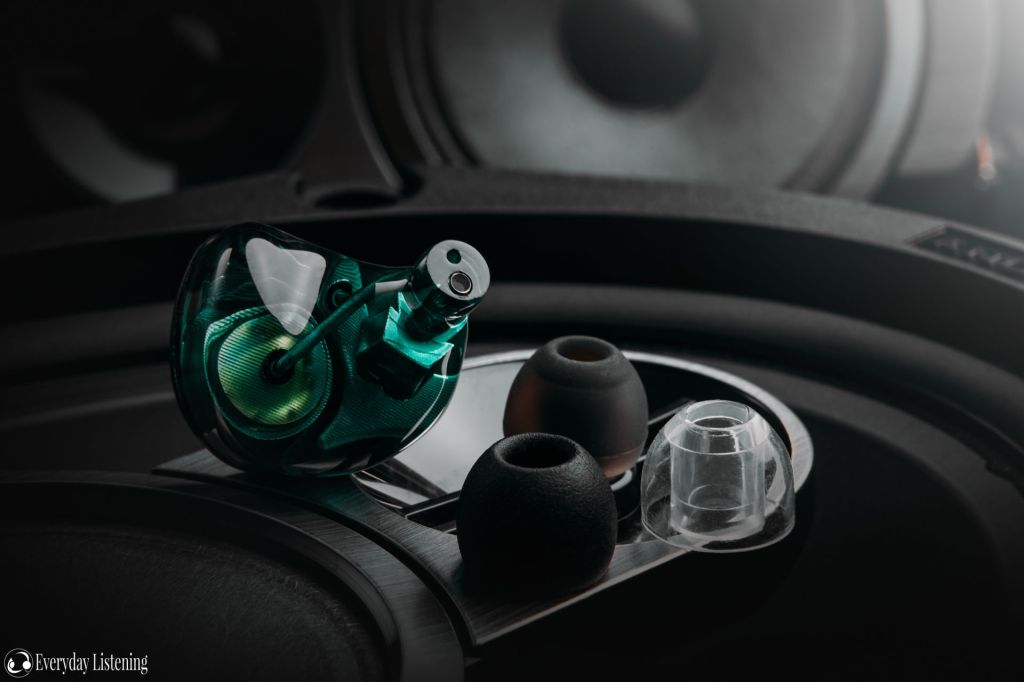
The liquid silicone tips, similar to the Xelastec tips, provide a slightly brighter tilt with a clean albeit more laid-back bass. These weren’t to my particular preference as I don’t find the Volume to be a bass-heavy in-ear. In addition, they have a thinner wall than Azla’s tips which makes them more prone to caving in on themselves when inserted into the ear. I would suggest sizing them down to avoid this. The foam tips are quite nice in terms of design, their tapered shape and smooth coating mean they don’t need to be rolled like regular foam tips. They also isolate noticeably better than the silicone options. Sonically, they sound a bit softer with a warmer midrange and slightly woollier bass.
They tone down the treble one step but do hurt extension and air somewhat which some may not prefer. If you like a warm sound with a bit more bass emphasis, these are great for travel and commute, they also aren’t quite as warm as something like a Comply tip but remind me of Shure’s Olive tips. The grey silicone tips are likely the “balanced tips” as they provide a bit more bass than the Xelastec tips and a bit more air than the foam tips. They were my preference for comfort, convenience and tonality but, as always, experiment to find the best option for your preferences and intended uses.
Bass –
Unsurprisingly, the Volume closely resembles the Blessing 2 in overall voicing given that the bass range especially measures very similarly. If you match the graphs by average rather than at 1kHz specifically, the Volume does have slightly more sub-bass bias and, in turn, appears cleaner through the mid and upper-bass by comparison. It has noticeably better extension with slightly more pressure at the bottom alongside greater rumble and definition in general. The B2 sounds a touch warmer and fuller in the mid-bass giving it a punchier character. The Volume has good weight and an accurate timbre overall. Subjectively, it sounds slightly more accurate than the light warm B2. It should also be noted that, despite the Volume being marketed as having powerful bass, it isn’t a bass-heavy earphone. Raw bass quantity appears similar if not a touch lower than that on the B2, achieving an ever so slightly laid-back presence relative to the midrange.
Where improvements have been made is with regards to driver quality which represents a step up over the older Moondrop model. The new driver indeed provides a noticeable jump in definition and decays more rapidly. In tandem with the slightly cleaner mid-bass, the Volume separates better and has higher resolving power that impresses for the asking price. Where the Volume falters incidentally is with regards to dynamics. I am not perceiving the tightest, most assertive attack, in fact, even the B2 appears slightly more authoritarian in this regard. Consider it nit-picking, however, though controlled and representing immaculate tonal cleanliness, the Volume doesn’t command quite as much power as I would have hoped for. This is the main area that differentiates it from higher-end models as the tonality cannot be faulted and detail retrieval is healthily improved over the Blessing 2.
Mids –
I am a huge proponent of a good midrange, and this has always been an area where Moondrop and especially Soft Ears have excelled. The difficulty lies in finding the exact model for your preference as all tend to vary by a few dB in different places leading to a slightly different voicing. This is the case here for though the Volume closely resembles the Blessing 2, it does err slightly more on the revealing side due to a relative reduction in lower-mid presence. Some found the Blessing 2 to be intense but for me, I didn’t think this was a huge issue. The Volume lacks the slight warmth of the B2 and is a hair more vocal-forward. However, the voicing is actually slightly wetter, lacking the slight dryness of the B2. I would attribute this to its slightly more present 2-3kHz range that increases vocal size combined with a denser 4kHz region. The net result is a sound that is slightly more forward, but also less strained and intense with a reduction in fatiguing qualities.
The best way to imagine this would be the Meze Rai Penta that has a notable mid-focus, yet this is an earphone that was never labelled as fatiguing or intense due to its smooth nature. The Volume follows a similar path, albeit this is not to say the two earphones sound at all similar. Soft Ear’s latest model has a slightly smoother articulation too meaning though it isn’t as full-bodied, the Volume also isn’t as sharp as the B2. Resolving power also represents a slight bump over the B2 with a more defined fine detail presentation. However, I did find the B2 to layer slightly better perhaps owing to its more even bass/midrange transition that gives it greater balance between foreground and room. Still, it’s impressive that Soft Ears has managed to tune the Volume to be less intense than prior models yet with a slight bump in clarity and vocal size. These qualities give it a very likeable, inviting yet highly natural midrange presentation that the vast majority of listeners will love.
Highs –
If there’s one thing that delineates a proper high-end IEM treble response its complexity. High-end IEMs pick out the small details and intricacies in a way that many cheap IEMs “simplify” into a more one-note kind of sound. The Blessing 2 was such a model that I lauded for its detail dense lower-treble. However, this came at the cost of sounding slightly thin and lower-treble biased. The Variations was a healthy upgrade here, doing so but with a far more natural note presentation. The Volumes sits somewhere in-between in terms of voicing. It actually has a slightly sharper transient response than the B2 with a more defined leading edge that makes it sound crisper on initial listen. However, beyond that, it actually has more texture and note body than the B2 if not quite to the same degree as the Variations. The B2 and Variations are still slightly more “complex” sounding to me, in that they are able to dissect complex passages better.
However, while the B2 does pick up more fine detail on especially complex passages, the Volumes presents foreground details with more definition and clarity than the B2. It does so without introducing the usually associated sharpness as the Volumes has slightly less lower-treble presence than the Blessing 2. This also gives the impression of greater separation on the Volume. Above, both have a dark, clean background without much emphasis on sparkle or air. The Volumes has slightly more air but isn’t an overtly airy in-ear. It tends to decay and shimmer a little longer which gives it a more lifelike quality to my ears. Neither is especially impressive with regards to micro-detail retrieval in the highest octaves, but such would not be realistic to expect at this asking price. The Volume’s ability to keep up with and even outpace the B2 at times in technical performance whilst boasting a more natural voicing is a huge win for budget audiophiles.
Soundstage –
The Volume is a relatively spacious earphone with standout separation. Dimensions are overall, very similar to the Blessing 2 to my ears, trading a bit of width for greater depth. This gives it slightly rounder proportions. Imaging is quite immersive as it encompasses the listener from all angles due to the rounded stage. However, the Blessing 2 does layer perceptibly better which gives its sound more dimension and slightly more organisation. The Volume has more empty space around each element which conversely, provides the impression of greater detail retrieval on complex or busy tracks. At the same time, directional cues are tack sharp and the Volume has impressive distance portrayal for its asking price. Just don’t expect the most holographic, immersive stage relative to higher-end IEMs. Separation overall performs at a very high level due to the clean and well-balanced tuning. Small details are easy to pick out and each element has ether surrounding giving details a clear, isolated quality without smear.
Driveability –
With a 5 Ohm impedance and 123.7 dB sensitivity, the Volume is a highly efficient earphone suitable for portable, low-power sources. For those worried about the impedance, this earphone responds very intriguingly to output impedance as I’ll detail below.
Output Impedance Sensitivity

Interestingly, the two BA drivers have a flat impedance curve that barely changes with higher output impedances. This means the midrange and treble do not change with different output impedances. However, the dynamic driver volume increases with higher impedances below the 1kHz crossover point. With a 20 Ohm output impedance/impedance adaptor, you get a 3dB bass shelf that gives the Volumes a warmer, fuller voicing without changing the treble voicing at all. Those wanting a more coherent sound with greater warmth and punch will find the changes to be in very good taste. Impedance adaptors/sources with a higher output impedance like the Hiby R6 are an excellent choice to tune these earphones to preference.
Driving Power
The Volumes sounds perfectly at home on portable sources, even dongle-style adaptors like the Astell & Kern Dual DAC provided no drop off in bass. Compared to my desktop stack, there was as slight reduction in sub-bass tightness and dynamics but not by a large degree. The Volumes works wonderfully with lower powered sources. In addition, it isn’t nearly as hiss prone as the sensitivity may suggest. Connected to the Shanling M2X with amp circuit on at volume 0 revealed a barely audible hiss that wasn’t apparent when music was playing.
Suggested Pair Ups
The Volume is a very easy earphone to drive due to its favourable impedance curve and efficiency. It will run happily from low powered dongles or even integrated smartphone audio outputs. Furthermore, impedance adaptors can be used as a tuning tool to increase bass warmth exclusively. This effectively gives the user an adjustable bass boost without harming mids or highs. Source colouration is, therefore, a less decisive factor in the pairing process but can still be used to fine-tune. The Volume benefits most from a warm source which helps to fill in its midrange and mid-bass slightly. I would not suggest sources with a sharper treble nor purely neutral or clinical sources though they aren’t grating on the ear, it is simply not perfectly ideal if other options are available. If you do have such a source, simply pair the earphones with a 20-ohm adaptor for a 3dB bass boost and enjoy, just note that volume will drop so ensure the source has sufficient power to drive this setup.

Ryan Soo
Avid writer, passionate photographer and sleep-deprived medical student, Ryan has an ongoing desire to bring quality products to the regular reader.
 Everyday Listening
Nice review Ryan
How would you compare the volume to moondrop kato?
Thanks Jonathan
LikeLike
Hey Jonathan,
The KATO has less bass emphasis and isn’t as detailed. You will notice a larger stage and better micro detail retrieval on the Volume. The KATO has a slightly more even tuning to my ears in return, especially around the midrange which gives it a bit more coherence. The Volume is slightly more vibrant and has a crisper treble.
Best,
Ryan.
LikeLike