

Earsonics ONYX Review – Expect the Unexpected
Sound –
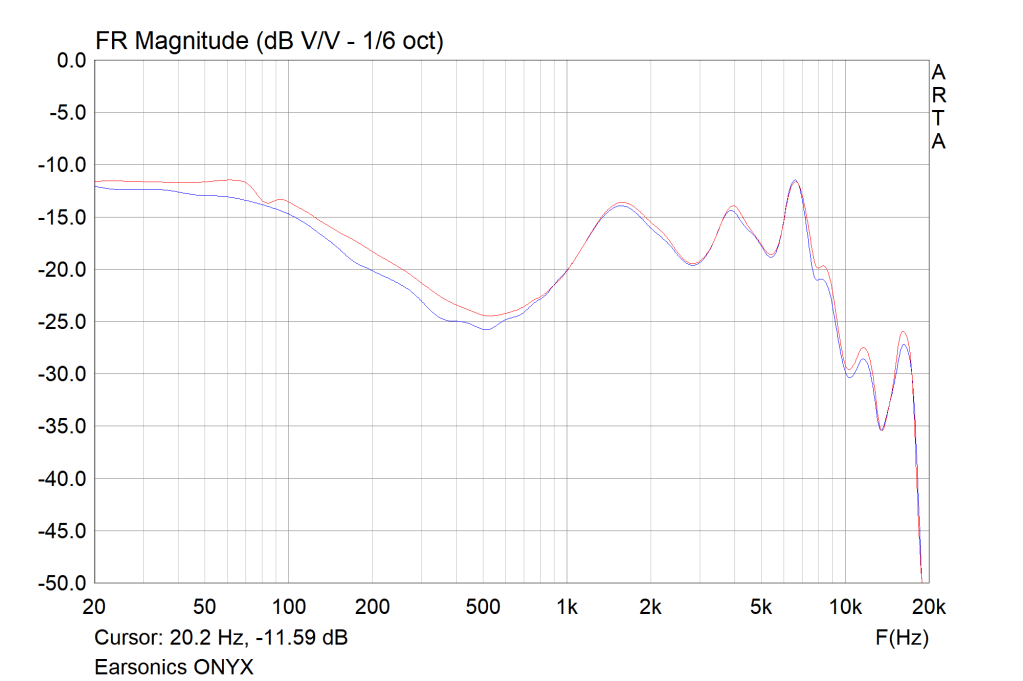
Testing Methodology: Measured using Arta via IEC 711 coupler to Startech external sound card. 7-9KHz peaks may be artefacts/emphasised due to my measurement setup, less so with a deep fit. Measurements besides channel balance are volume matched at 1KHz. Fit depth normalised to my best abilities to reduce coupler resonance. Still, due to these factors, my measurements may not accurately reflect the earphone or measurements taken by others. I gave the ONYX 100hrs burn-in to ensure maximum performance prior to subjective breakdown.
Tonality –
The ONYX has an intriguing sound tuning that is quite different in measurement to many competitors but provides a perfectly natural voicing during listening all the same. In direct comparison to something more linear in its tuning, the ONYX has an intriguing W-shaped character with exaggerated separation between each frequency band. This character begins with a modest bass emphasis equally focused around the sub and mid-bass regions instigating a bold, meaty low-end with an abundance of power and drive. A sizable upper-bass/lower-mid dip aids a well-separated midrange and prevents spill. The midrange employs dual 1.5kHz and 4kHz humps meaning both male and female vocals are brought forward with instruments sitting behind. They occupy an intimate position in-line with the bass. Finally, a 6kHz peak provides a crisp, energetic top-end that serves as a foil to the thick bass and big midrange. Altogether, a unique and well-executed earphone that upholds respectable balance whilst oozing loads of personality.
Bass –
As the mids and treble have been brought up to a similar degree, Earsonics was able to achieve a powerful voicing without bass dominance. To my ears, they have a slight sub-bass bias though mid-bass does sit roughly on par so as to avoid upsetting balance and timbre. This provides enlarged bass notes with a thick, weighted character. The dynamic driver also extends terrifically, it has a good amount of pressure and a visceral rumble. As the mid-bass has also been elevated, the low-end sounds consistent between tracks with no shortage of punch and impact on albums mastered with less sub-bass. The earphones also have a much narrower bass shelf than many bass-boosted IEMs, with a steep drop above the mid-bass through to the lower midrange.
Accordingly, they aren’t especially warm nor are they bloated or tubby. The ONYX delivers a focus on excellent dynamics, slam and power. The note presentation plays into this as well as Earsonic’s dynamic driver provides a keen, tight attack and well-controlled decay. The ONYX has a very well-defined bass, especially when taking its level of emphasis and style of tuning into consideration. Sub-bass slam is tight, well-paced and satisfying. Notes decay slightly quicker than neutral, redeeming separation. Though the thick note structure means this isn’t a defining feature of the ONYX’s low-end, it also never presents as muddy or smeared on complex tracks. This is a responsive, technically impressive bass response with a well-executed fun and engaging character.
Mids –
It’s impressive that despite the robust, powerful bass, the midrange manages to draw equal focus and it does represent ingenious colouration on Earsonic’s behalf. Those wanting utmost linearity and balance may find the vocal/instrument balance leaves them wanting. However, for sheer musical enjoyment, the ONYX is an appealing package that genuinely surprised me. For instance, the earlier 1.5kHz rise brings male vocals forward and the smaller 4kHz lift equally services female vocals. This is a refreshing change from many IEMs that have more of an upper-mid bias so, if you like male vocals, the ONYX presents them with awesome clarity, size and definition. The 4kHz bump combined with reduced note body from the lower-mid dip means the ONYX has a more revealing character within the midrange itself though never in an intense manner.
Hints of warmth seep in from the bass preventing the monitor from presenting as sterile, metallic or cool. I also find the earlier 1.5kHz emphasis gives vocals a bit more size and gusto than your usual 2-3kHz emphasis. The result is large, intimate vocals that aren’t perfectly natural coming from more linear reference monitors, but impressively close despite the colouration. The ONYX is quite an articulate monitor on top which helps to bring small details to the fore. Since treble emphasis is on equal footing with the ONYX’s forward vocal range, it also isn’t head-voice dominant or sharp. Altogether, the ONYX doesn’t sound explicitly linear, but it does have a lack of unnatural qualities. Moreover, it does so with awesome vocal definition and separation from the bass and excellent clarity without intensity or rasp.
Highs –
We tend to innately focus on the top-end performance when first evaluating a high-end IEM as treble extension and sparkle have since become unanimous with these designs. However, in actuality, this does not necessarily have to be the case. The ONYX proves this as its standout features are surely its bass and midrange. Treble, meanwhile, performs at a good level but doesn’t strike as being so outstanding. It has a moderate 5.5-6kHz peak that instigates a slightly more energetic foreground treble presentation. It doesn’t quite have the precision and fine resolving power here of class leaders, but an average amount augmented by a crisp and engaging tuning. I find the leading edge isn’t over-sharpened despite the tuning and the ONYX has a surprising amount of body and texture if here at the expense of raw note definition. It still separates well and provides a mostly natural timbre that is easy to enjoy.

Above, the tuning quickly falls off, providing a clean, black background. This gives the earphone a hyper-contrasted foreground/background that contributes towards an enjoyable layering experience. While background and micro detail in the highest registers won’t win any awards, there is enough information here to provide a well-defined background to enable a good sense of distance projection. I do believe the treble will be one of the more polarising aspects of this earphone as it doesn’t present as especially well-extended or open. Perhaps, more overt brightness and sparkle here would have made the overall presentation more fatiguing given the already engaging bass and midrange tuning. To my ears, this has always been a defining characteristic of Earsonic’s designs and it does make sense when taken as an overall package.
Soundstage –
Despite the darker treble tuning, I found myself impressed by the soundstage performance of the ONYX. It showcases well above average dimensions with width especially stretching nicely beyond the head. Depth is no slouch either, but the stage proportions are ovoid overall. The imaging performance is also one of the best performers in class. The ONYX has a very strong centre-image and a fairly keen sense of direction too.
It doesn’t have many layers or dissect vocal harmonisations like a TOTL monitor but has a hyper-defined foreground and dark background with good contrast. Separation is also quite good, especially impressive given its thick, weighted bass. The ONYX has a well-controlled bass response with excellent separation to the midrange and treble. The upper-frequency ranges themselves lie on the revealing side with a slightly thinner note body meaning there is a sense of ether surrounding each element. This makes small details easier to perceive by the listener.
Driveability –
With a regular 16.5-Ohm impedance and a 122dB sensitivity, the ONYX is an efficient design suitable for portable sources. I found this to be the case during testing as well, hitting ear-splitting volumes from low powered dongle-style sources yet alone DAPs and desktop gear. The upside to this as well is that the ONYX sounds dynamic and well-voiced from lower power sources too making it easy to live with.
Output Impedance Sensitivity
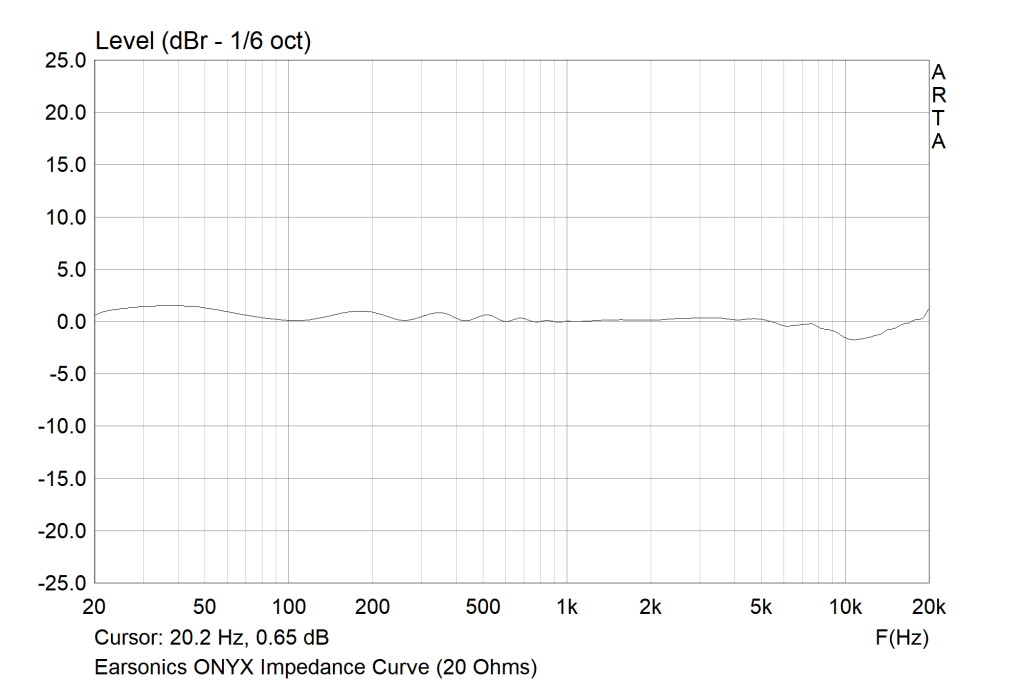
Fortunately, the ONYX has a relatively flat impedance curve and this is something I confirmed in subjective testing as well. The rule of eighths dictates that the sound will only be as the designer intended from a 2-ohm source, however, even from a source with a 20-ohm output impedance, the sound signature remains essentially unchanged. This bodes well for performance from integrated audio solutions in laptops and phones for instance, that often sit around a few Ohms and can skew the sound of most multi-driver in-ears. The ONYX has a very consistent character between sources which widens suitable pairings.
Driving Power
Similarly, the ONYX is an efficient earphone that I didn’t find to require much driving power. Switching from the Shanling M2X to my desktop stack with THX789 revealed a small jump in dynamics and sub-bass definition but a similar voicing otherwise. The Astell & Kern Dual DAC cable drove the earphones just as well as the larger DAP making this earphone a great choice for those without high-end sources. Though the sensitivity is high, they aren’t overly hiss sensitive. On the M2X with the amp circuit active and volume on 0, hiss was vaguely audible but completely inaudible when music was playing.
Suggested Pair Ups
The ONYX is a very easy to drive earphone which adds to the value proposition as ideal source pairings aren’t a requirement to derive an enjoyable sound. It plays well with higher output impedances and lower-powered sources but does scale nicely with regards to dynamics and soundstage size from better sources. Hiss also isn’t a huge concern on this design. Given its sound signature, I found neutral-leaning sources were to my preference as their keep the low-end as clean as possible. However, it also isn’t an especially warm or stuffy sound so there is leeway for warmer sources too. There is also ample body to enjoy them with bright sources but I did find the midrange was a little thin.

Ryan Soo
Avid writer, passionate photographer and sleep-deprived medical student, Ryan has an ongoing desire to bring quality products to the regular reader.
 Everyday Listening
How does the Onyx compare directly to the VxV?
LikeLike
Hey,
I’d give the detail retrieval and soundstage advantage to the VxV, the ONYX has better build quality and a bassier, fuller sound if that is to your preference. Some may find the VxV to be too thin but it is technically strong even at its elevated asking price (relative to the Onyx). Let me know if you need any other details!
Cheers,
Ryan.
LikeLike
Thanks, I haven’t had a chance to try the Onyx, while I found the VxV too rounded off as when vocalist had sore throat – you couldn’t hear that in songs with VxV. Coming from graphs I don’t feel it has as much bass as it theoretically ‘has’ even after tip rolling. I think the dynamics were quite average on the VxV. They played almost at equal level (the loudest and the quietest of sound), so been after if Onyx is a bit more refined in these regards.
LikeLike