

Campfire Audio Orbit Review – Out Of Space
Sound –
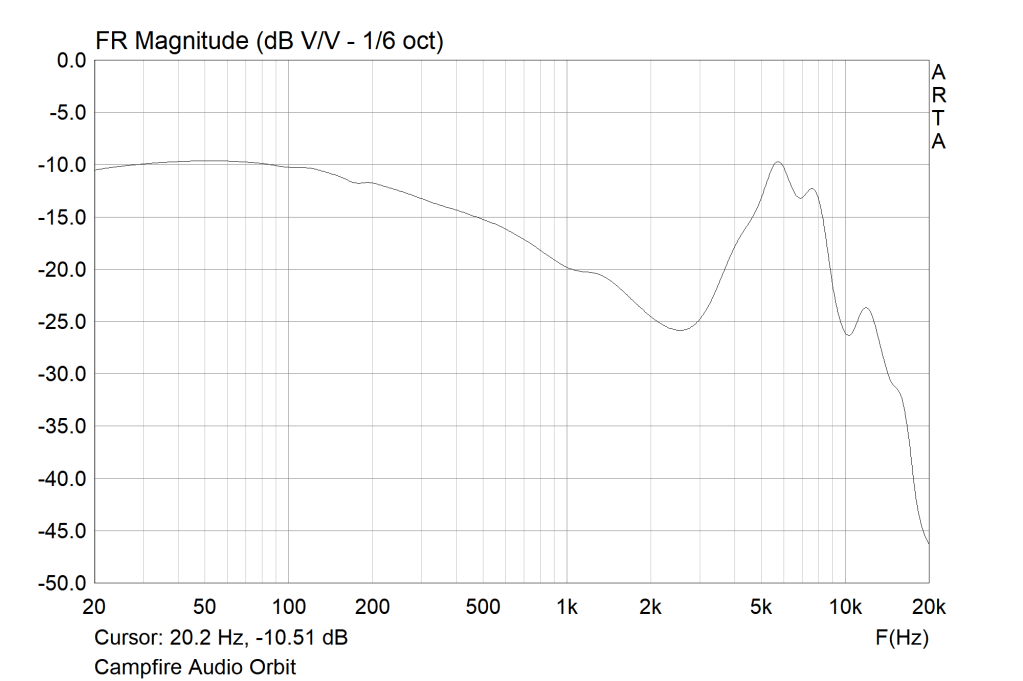
Testing Methodology: Measured using Arta via IEC 711 coupler to Startech external sound card. 7-9KHz peaks may be artefacts/emphasised due to my measurement setup which I found to be the case here. Measurements besides channel balance are volume matched at 1KHz. Fit depth normalised to my best abilities to reduce coupler resonance. Still, due to these factors, my measurements may not accurately reflect the earphone or measurements taken by others. I gave the Euclid 100hrs burn-in to ensure maximum performance prior to subjective breakdown.
Tonality –
I didn’t know what to expect from the Orbit given Campfire Audio’s notably diverse range of tunings. For returning customers, you’ll likely find the Orbit to most resemble their older dynamic driver models with a large bass emphasis and broadly v-shaped signature. Whilst bass is broadly elevated, it also carries a warm character with a hump extending into the upper bass and lower mids creating a warm, roomy sound. In conjunction with a 2kHz nadir that pulls back vocals, this does create a very rich and full-bodied sound out of the box, likely too much so for many listeners. Some may consider these earphones to be quite veiled too though I would argue that the brighter top half of the tuning does help to redeem acceptable vocal clarity and detail presence for the most part. That said, the vocal image is thick, warm and very laid-back. If you enjoy a more balanced sound, I would highly suggest using the app-based eQ to increase the 2kHz region and tone down the bass. Whilst still warm and full in this configuration, it makes them a far better all-rounder if still not an especially good one in the grand scheme of things. The Orbit is a bassy earphone through to its bones though at the very least, has very good bones.
Bass –
Immediately, bass stands out as the biggest and most gripping aspect of the Orbits sound. It wears its dynamic driver on its sleeve, delivering excellent bottom end extension, power and slam. If this is what you desire, the Orbit will provide a strong experience for bass heads wanting a true-wireless form factor as it delivers a lot of bass in general. This is also what I find contentious in the context of general listening as the bass shelf simply extends too far which creates rather bloated, rounded notes that lack authenticity and separation. The upper-bass and lower-midrange tuning especially contribute towards a roomy and somewhat veiled midrange. I did find this to be intrusive on some but not all tracks. With eQ, I was able to sizably tone down bloat and bloom in the upper bass whilst maintaining the excellent sub-bass kick. The Orbit was still warm and bassy, but I found these adjustments to provide a happy medium between maintaining some character and increasing balance for greater genre versatility and a more natural timbre.
The driver quality is on the better side for a true-wireless earphone and is especially impressive considering the level of bass. Though notably bloated in stock form, I was impressed that the Orbit managed good levels of articluation through the vast majority of tracks alongside a relatively low level of muddiness. Toning down the mid-bass/upper bass a little and bringing up the vocal range clean up the image considerably. Notes maintain a slightly rounded structure, but separation is considerably improved as are dynamics due to improved balance between sub and mid-bass. Driver control is impressive, and bass upholds strong definition regardless of eQ setting and the strong driver quality foundation is what makes this earphone so receptive to customisation via eQ. With that said, the tuning out of the box won’t be for all and it must be understood that there is very limited granularity in the CFA app meaning the Orbit will never truly be a balanced earphone.
Mids –
When it comes to the midrange, the bass tuning does make a little more sense. I’ve found that earphones with a bump in the lower midrange often deliver an intriguing imaging experience and it appears that this was one of the goals when designing the Orbit. Many current reviews laud the headroom achieved by the Orbit but when adjusting the eQ settings, it became apparent that this impression is equally derived from the tuning as the acoustic design. The added room and bass volume create the impression of a larger stage and draw focus to backing elements creating an almost holographic experience. Whilst not accurate, it makes for a fun and immersive listen. It is then unfortunate that when adjusting the sound to improve balance, so too are imaging and perceived soundstage size affected.
Out of the box, the midrange is warm, full and very laid-back relative to the bass. Vocals are coloured but in a mostly pleasant manner that is easy to enjoy. That said, on tracks with already laid-back vocals, especially notable on older albums, the Orbit can sound veiled and exceedingly recessed. For hip-hop and newer genres, this is less the case as the upper-midrange bump helps to balance this out. The V-shaped tuning picks up around the 3-4kHz range and continues into the lower treble. This means that, for the most part, vocals achieve perfectly ample clarity and come across as quite articulate which helps to bring fine details to the fore.
Vocals are large and coherent. The timbre isn’t natural at all, but the large added warmth saps any sharpness, sibilance or metallic timbre that may grate on the ear. This makes for a coloured midrange that is also suitable for easy listening; being articulate but with richly filled-in notes. When adjusting the eQ to bring up the 2kHz region, vocals assume a more upfront presentation, increasing the perception of balance. Separation is increased and layering improves notably. As aforementioned, however, attenuating the bass means the soundstage no longer comes across as quite so grand and holographic. It will be a preference, so some will prefer one or the other. The ceiling is certainly above average, especially with the use of eQ. The stock tuning also produces a unique and often inspiring listening experience if one that has rather limited genre versatility to my ears.
Highs –

Whether relating to the codec or constraints in designing a sound chamber in such a compact chassis, many TWS earphones fail to extend far past the mid-treble. The Orbit falls into this category too. It delivers a good amount of lower-treble presence that sits a few steps behind the bass but in front of the midrange alongside a mid-treble 8kHz peak on measurement. In subjective listening, the mid-treble bump is less apparent meaning the background is on the darker and cleaner side. Overall detail retrieval is above average for a TWS earphone. The lower treble is crisp and clearly defined with good definition and separation yet it is also natural with convincing note body and texture. This makes it more discerning of fine details than most and, combined with the rich low-end, makes the Orbit a lovely earphone for acoustic tracks. You can also adjust the top-end a little via fit depth with a shallower fit opening up the top-end a little and a deeper fit producing a smoother presentation. This can be adjusted by cutting the stem off a spare pair of silicone tips to make spacers that sit beneath the stock tips or simply by adjusting the tip size so long as you are able to achieve a seal with multiple sizes. Regardless, don’t expect terrific extension above nor much background detail. For the most part, the Orbit is a superficially inviting listening experience much like its competitors. Very few TWS earphones provide much more and expect to pay considerably more to for that luxury at this time.
Soundstage –
I do actually find the soundstage to be quite involving on the Orbit. It’s nothing spectacular in the realm of wired in-ears, yet alone a good set of over-ear headphones. That said, it’s clear that CFA knows what they’re doing here as this has always been a strength of their designs and the same is true here. eQ or not, the Orbit delivers some of the best soundstage size I’ve heard from a TWS earphone. This is less with regards to depth when eQing up the midrange, but the width remains an impressive performer. Imaging is interesting if not especially accurate out of the box due to the wonky bass/lower mid tuning. However, with eQ this cleans up considerably, providing a more centred vocal image alongside better delineation between foreground and background layers. The Orbit places its instruments quite well too. It doesn’t have the best separation or contrast but provides a more multi-dimensional experience than most TWS in-ears. As you may expect, separation is just passable out of the box, saved only by a solid driver. With eQ adjustment, this improves but remains below average relative to modern competitors, many of which are more balanced.

Ryan Soo
Avid writer, passionate photographer and sleep-deprived medical student, Ryan has an ongoing desire to bring quality products to the regular reader.
 Everyday Listening