

Oriveti OD100 Review – Master of Minute
Sound –

Testing Methodology: Measured using Arta via IEC 711 coupler to Startech external sound card. 7-9KHz peaks may be artefacts/emphasised due to my measurement setup which I found to be the case here. Measurements besides channel balance are volume-matched at 1KHz. Fit depth normalised to my best abilities to reduce coupler resonance. Still, due to these factors, my measurements may not accurately reflect the earphone or measurements taken by others. I have the OD100 100 hours of burn-in prior to evaluation.
Tonality –
The OD100 is a nicely tuned earphone with a rough W-shaped tuning. It’s relatively balanced overall but does have a notably warm tonality imbued by a mid-bass-focused low end alongside a slightly crisp treble voicing. Overall, it is a likeable and well-expressed sound that is coloured but has no glaring faults. As there is ample separation between bass and midrange, mids aren’t overly warmed up nor is it veiled in the slightest. There’s a good amount of pinna gain too, providing well-present and clearly expressed vocals that are a bit more tonally transparent than midrange instruments. The top-end has a small lower-treble emphasis. While it doesn’t have huge extension, it is crisp, mostly clean and doesn’t have any offensive qualities. Altogether, a nicely tuned entry-level in-ear that offers a good amount of mid-bass punch to heighten engagement whilst retaining a clear midrange and solid detail presence in the treble too.
Bass –
The OD100 has a good amount of bass but isn’t bass-focused, achieving commendable tri-frequency balance. Sub-bass extension is okay. Being a dynamic driver, there’s some pressurization but a lack of power and slam at the very bottom due to a notable sub-bass roll-off. With a decent mid-bass hump, bass is warm, full and offers a good amount of punch. Notes are rounded and a little bloated, but bass isn’t muddy or exceedingly bloomy overall.
Emphasis sustains somewhat into the upper bass but slopes downwards into a recessed lower midrange so as to avoid excessive midrange colouration. Bass has just average tightness and lacks the concise note attack provided by the better options around this price. It is full and punchy but offers ample separation and dynamics as a result. The OD100 provides a fun performance that will suit the average listener but may not satisfy under scrutiny.
Mids –
Oriveti has always excelled with their midrange tuning and the OD100 offers a good performance for such an affordable in-ear in this regard. The tuning has peaks and drops in the right places, the highs and lows are just somewhat exaggerated in order to provide a bit more vibrance and fun. Some warmth does spill over from the bass which casts a warm tint over instruments and to a slightly lesser extent, vocals. They are mostly well represented otherwise with minimal intensity nor sibilance.
Vocals do sit one step forward relative to instruments and female vocals are especially flattered with a clear and natural voicing. Male vocals are also natural for the most part but tend to be more laid-back due to the lower-mid nadir. Furthermore, despite the lower-treble bump, the midrange isn’t sibilant or overly breathy as the added bass warmth aids a convincing sense of coherence and note body. While layering and resolving power are just ample, the tonality is perfectly enjoyable with a wide range of genres.
Highs –
Treble is defined by a 5kHz bump and a progressive roll-off thereafter. As a result, the earphones provide a crisp foreground and good detail present in line with the midrange and bass, but do miss out on background and micro-details above. Given the entry-level asking price, this is to be expected as you are looking at spending about twice as much to achieve any meaningful micro-detail retrieval. Nonetheless, this is a fine surface-level experience. Treble is balanced and voiced well to draw attention to macro detail in the foreground.

Percussion has a nice crisp note attack and the background is dark, lacking fatigue or glare. While extension leaves to be desired, treble is enjoyable and complements the remaining sound. I do feel that there are a few similarly priced IEMs that extend a little further and resolve better but many are also wonkier in terms of overall tuning. Cheap IEMs are certainly getting very good, yet some concessions do have to be made to achieve such a low price point. Oriveti has done a commendable job at providing a well-rounded package even if it doesn’t excel in any particular regard.
Soundstage –
As the treble rolls off so soon, the OD100 provides a relatively intimate soundstage in all aspects. The sound is very much inside the head even when space is called for. Imaging is also an average performer. The well-tuned midrange helps as vocals are well-centred and left/right positioning is sharp. However, layering leaves to be desired as the earphones lack the background detail retrieval to delineate meaning the presentation is fairly two-dimensional overall. Separation is above average with the balanced tuning and good tri-frequency separation especially. The earphones don’t have much resolving power admittedly but take good advantage of what they do possess.
Drivability –
With a 16 Ohm impedance and a 105dB sensitivity, the OD100 is easy to drive. Moreover, being a single dynamic driver earphone means source pairing is made easier too.
Output Impedance Sensitivity
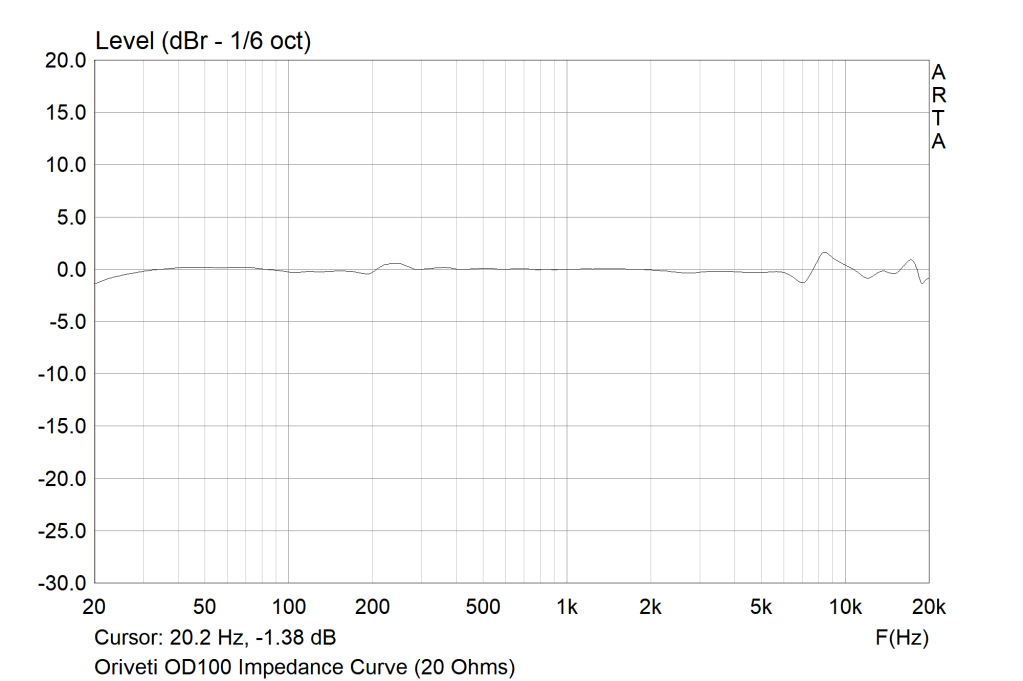
The OD100 has an essentially flat impedance curve meaning it will deliver a consistent sound profile from linear sources regardless of output impedance. My measurements confirmed my subjective testing as, from a 20 Ohm source, the frequency response is broadly identical. This makes the OD100 a good choice for those desiring a consistent sound profile from multiple sources.
Driving Power
Given the OD100’s efficiency, the earphone doesn’t require much driving power nor does it require dedicated amplification to reach high listening volumes. At the same time, this also means they don’t scale much with a better source. Altogether, the OD100 delivers a consistent sound from most sources so long as they aren’t coloured themselves.
Suggested Pair Ups
The OD100 benefits from a more neutral source even a brighter source which helps to open up the top-end and maximise separation. Nonetheless, as the tonality is quite balanced and the midarnge isn’t overly warm, the OD100 pairs acceptably with warm sources too. Driving power nor output impedance are much of a concern either making this a great choice for those that don’t want to shell out extra investment for a dedicated source too.

Ryan Soo
Avid writer, passionate photographer and sleep-deprived medical student, Ryan has an ongoing desire to bring quality products to the regular reader.
 Everyday Listening