

DITA Navigator Review – Something Different

Sound –
Frequency Response –
Testing Methodology: RMAA via Startech External Sound Card

The Navigator has a linear frequency response suggesting that it represents audio with great fidelity. Due to the quality of my sound card, I am unable to reliably test other measures such as distortion and crosstalk so they will be used as a personal reference only. Qualities here can also impact the sound as I will detail via subjective listening.
Output Impedance & Hiss –
Testing Methodology: SPL volume matched comparison through an inline splitter to THX789 + SMSL SU9 to Campfire Audio Andromeda and Ara
The Navigator was clearly designed for IEMs whilst offering enough oomph to service portable headphones too. It adopts two of ESS’ flagship portable-orientated chipsets, the ES9219, which is a 2-Channel DAC that offers an in-built headphone amplifier too. Doubling the chips was likely used to run two independent circuits for the balanced output which is reinforced by the substantial boost in driving power through the 4.4mm output. Various features suggest this to be the case. For instance, the Navigator has its own internal volume control in addition to the volume control offered by the source device.
This gives it more granularity for sensitive IEMs. Moreover, the noise floor is incredibly low as I was barely able to perceive hiss when the amplifier circuit was active and no music was playing on the Ara which is one of the most source-sensitive IEMs I have on hand. Moreover, the Navigator appears to have a very low output impedance of around 1 ohm as the Ara sounded full-bodied as intended. While sub 1-ohm sources are available, this is not common and the Navigator serves basically all other IEMs with aplomb.
Subjective –
Testing Methodology: SPL volume matched comparison through an inline splitter to THX789 + SMSL SU9 to Soft Ears RS10 (flat impedance). Powered by Xperia 5 II with Poweramp Pro via high-resolution output.
The navigator provides a smooth and full-bodied presentation that reflects the house sound of their IEMs. It offers a sound dynamic performance for a portable source, especially so via the balanced output. Even from the single-ended output, the Navigator provides a robust bass response that has convincing size and depth. While my desktop sources all flaunt superior dynamics and a noticeably more palpable bass slam, the Navigator offers a tight, pacey and well-controlled low end overall. In particular, texturing of the mid-bass is a standout, sounding articulate and discerning when paired with a nice high-end dynamic driver in-ear. Relative to larger sources, don’t expect the same sub-bass depth but, besides this, the Navigator holds its own with aplomb.

Moving up, the midrange showcases the greatest colouration out of the entire sound signature to my ears. It has a distinctly full-bodied and dense character that gives vocals especially a rich and filled-in voicing. While this will not be to everyone’s preference, I do find it a nice complement to the wealth of Harman-based in-ears that have been released in recent years as it reduces intensity and intimacy. Vocals otherwise showcase a natural voicing, good articulation, and a neutral position. Relative to more neutral sources, the Navigator can sound a little warm and fuzzy, lacking the precise definition and separation of these leaner presentations. In addition, upper-midrange extension is slightly reduced which is something to consider if you prefer a delicate and clear sound over a coherent and relaxed one.
Conversely, the top-end showcases excellent linearity and extension, devoid of emphasis or nadirs. Treble notes are well represented throughout the audible spectrum and instruments are presented in a natural manner. The leading edge is slightly sharpened over dead neutral which provides a hint of additional crispness but hardly anything that would count towards forwardness or brightness of any kind. Fine detail retrieval impresses as does background detail. Notes are defined, textured and accurately decay thereafter, due to the increased crispness they are just a touch thin. While there isn’t quite as much headroom as a full-sized source, the Navigator portrays a slightly better atmosphere than your typical dongle perhaps simply owing to its larger dimensions.
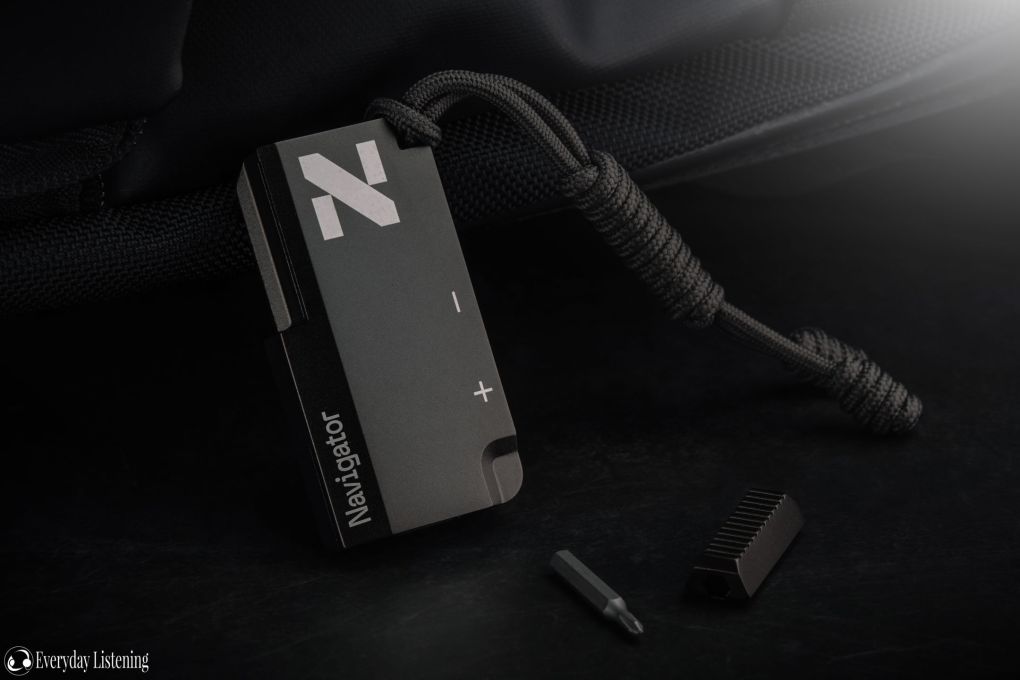
In terms of soundstage, the Navigator produces good dimensions for a portable source but isn’t an outlier in this regard. Width extends just beyond the head and depth stretches in equal proportions, benefitting a well-rounded stage. The highlight is imaging as the Navigator creates a very stable image with centred vocals and good stereo separation. Layering performs at a good level too with ample background detail to separate between foreground and background. Separation performs slightly worse than your average portable source due to its more full-bodied midrange. Though actual resolving power is among the upper-end of the pack so this isn’t to the deficit of overall detail retrieval, there just isn’t as much room and ether surrounding elements as there could be.

Ryan Soo
Avid writer, passionate photographer and sleep-deprived medical student, Ryan has an ongoing desire to bring quality products to the regular reader.
 Everyday Listening