

Oriveti OD200 Review – Smooth, Sonorous
Sound –
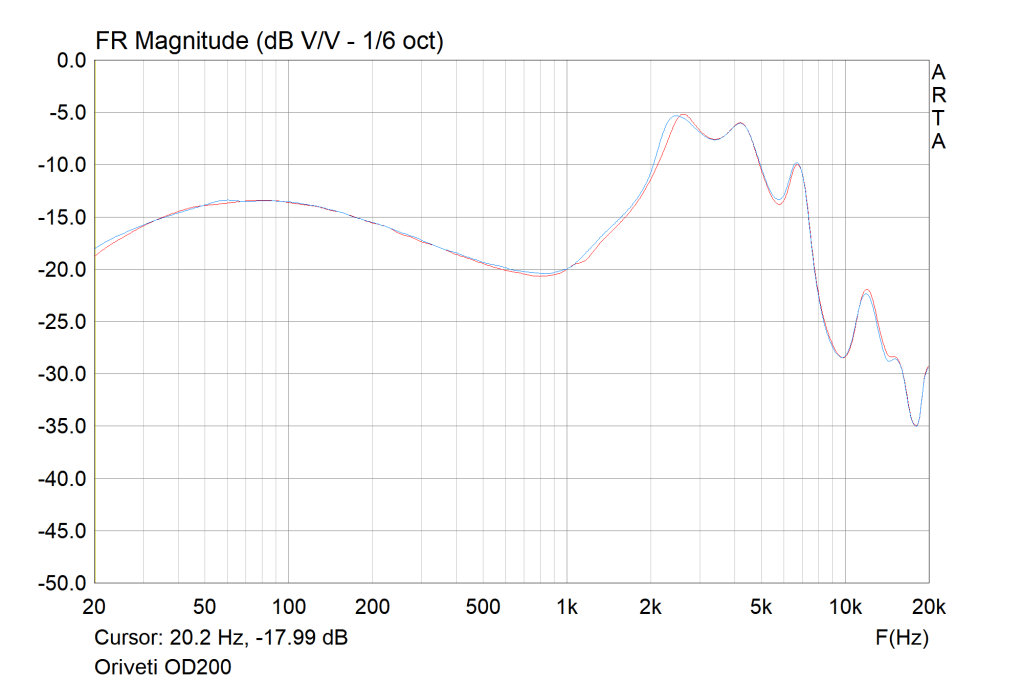
Testing Methodology: Measured using Arta via IEC 711 coupler to Startech external sound card. 7-9KHz peaks may be artefacts/emphasised due to my measurement setup which I found to be the case here. Measurements besides channel balance are volume-matched at 1KHz. Fit depth normalised to my best abilities to reduce coupler resonance. Still, due to these factors, my measurements may not accurately reflect the earphone or measurements taken by others. I have the OD200 100 hours of burn-in prior to evaluation.
Tonality –
I wasn’t sure what to expect from the brand given this is just their third dynamic driver design, though the OH-series should have set a clear precedent as to the brand’s ethos. Like the OH300 and OH500, the OD200 very much resembles the OD100 tonally whilst slightly increasing balance and considerably upping technical performance. Bass is a bit cleaner but remains mid-bass dominant and the treble is less peaky with a more focused 6kHz lower treble bump alongside slightly improved extension above. That said, the midrange takes a strange turn.
As opposed to a natural 3kHz hump, the OD200 has twin 2.5 and 4kHz peaks that give it a somewhat intense and shouty presentation. Though the treble is a touch smoother overall, the OD200 comes across as compressed and lacking separation as a result. Thankfully, tuning nozzles are included and these drastically aid overall coherence. While the silver nozzles are objectively superior, some may prefer the extra clarity and vocal forwardness that the green/black nozzles afford so I can’t criticise the OD200 for this inclusion – only that the tuning out of the box may be a turn off for some listeners.
Nozzles
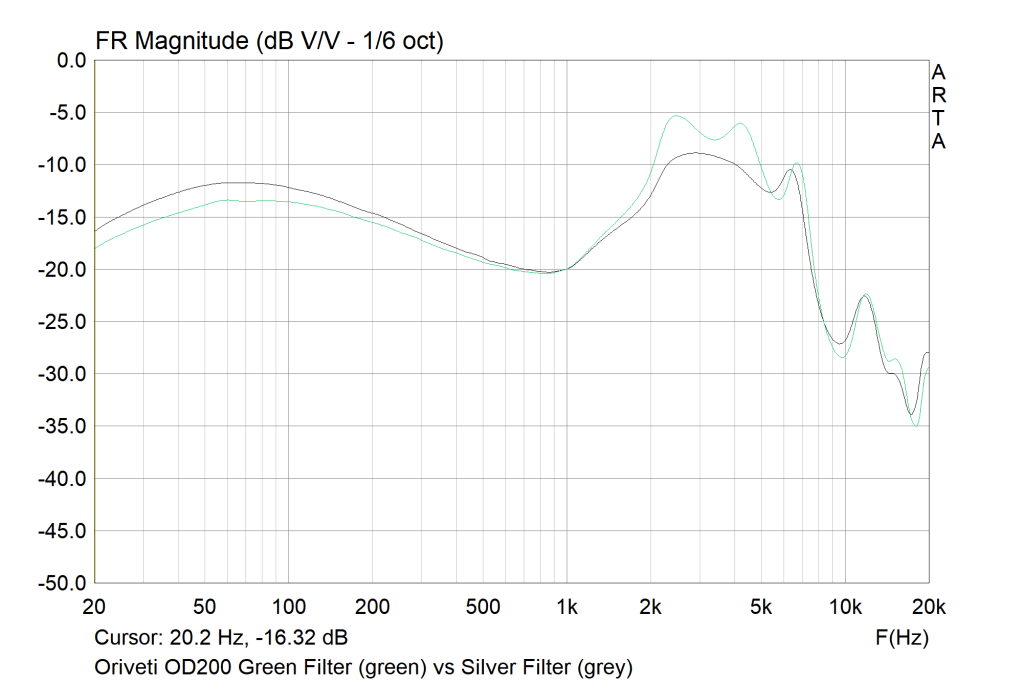
The OD200 comes with two tuning nozzles that offer intriguing effects on the sound. The standard green nozzles offer a mid-forward sound with a slightly lighter bass and enhanced vocal clarity. At the same time, the sound is a little strident and intense to my ears. The silver nozzles increase the bass by a few dB whilst maintaining separation with the midrange. They also tone down the midrange and completely remove the 4kHz hump, greatly aiding coherence and vocal positioning. At the same time, treble remains untouched maintaining detail presence and clarity. The result is a smoother, more coherent sound with better separation and range. Vocals are more appropriately sized and have a more natural timbre. The overall balance is improved as it is no longer so mid-dominant, in fact, vocals are now just a touch laid-back giving them an L-shaped sound. There is a slight bass bias and a warmer tone but overall, it offers excellent long-term listenability. The silver nozzles and large bore silicone tips were my personal preference and were used for the following assessment.
Bass –
The OD200 offers a warm and rich sound that is smooth and easy to listen to. While the tuning isn’t conducive to the most dynamic, separated sound, hiding behind the warmth is an impressive technical performance. Like the OD100, bass is mid-bass centric delivering rounded notes but also a sense of grandness and scale to the low-end. The downside is dynamics, as sub-bass does come across as rather rolled-off. There isn’t much pressure or weight behind notes but a good amount of size and punch in the mid-bass nonetheless. Some bloat is apparent and separation is reduced from what is typical, however, there’s minimal smear of fine details. As quantity reduces through the upper-bass the tone also isn’t overly warm nor is the midrange especially coloured.
The DAD system does indeed offer some benefits when it comes to note presentation. The bass is quite fast and well controlled. Though the presentation is bloated, the driver impresses with its articulation and responsiveness that permits impressive pace and detail retrieval during complex passages – something the OD100 was not capable of. The quick decay and peppy attack characteristics mean despite the reduced sub-bass, bass still sounds snappy and satisfying. While some fine textures are smoothed over by the tuning and separation leaves to be desired, the OD200 showcases a smooth and rich sound here whilst still maintaining a good amount of detail retrieval.
Mids –
It can be argued that the green nozzles create a slightly more balanced experience in this regard, however, the vocal timbre is not as pleasing due to the upper-midrange intensity. I am personally quite sensitive to this frequency range, and it is not to my preference so for those valuing greater midrange focus and clarity, these may be for you. With the silver filters, I find the sound more relaxed and coherent. Separation is improved even if the mids and treble now sit one step behind the mid-bass. The voicing in this configuration is natural and slightly laid-back. Vocals are delightfully rich and filled-in with high coherence. The tone is light warm, but I find the presentation is more defined its density and uptick of body derived from the slightly wide midrange hump and upper-mid tuning.
Vocals are also slightly more articulate which aids clarity and the definition of small details. While it won’t ever be labelled as a well-separated or revealing sound, the OD200 does avoid veil and muffle well. The upside to the tuning is balance between male and female vocals that benefit from a more equal weighting as opposed to the more upper-biased Harman tunings. Instruments sound rich and are presented with an appropriate sense of room that enhances the layering apparent within the midrange. Some may crave greater clarity and separation but there is no denying that Oriveti has done a wonderful job at creating a smooth and coherent presentation that still sounds natural, balanced and versatile. It’s nice to have well-executed options that offer something different from the norm.
Highs –
In typical Oriveti fashion, the top-end of the OD200 is broadly dark which contributes to the excellent background cleanliness on display. The lower treble has a subtle elevation which aids crispness and detail presence in addition to enhancing articulation in the midrange as aforementioned. The leading edge is nicely defined if lacking the aggression of some competitors. I find this complements their style of sound well by avoiding over sharpening in return for missing a hint of fine detail apparent on these competitors. Instruments have a good amount of bite nonetheless and also provide a pleasing sense of body and texture above. The mid-treble is quite dark which can make instruments sound a little over-damped. There is reduced shimmer, air and sparkle on display.
As always, this is a matter of preference as some prefer a more vibrant top-end, some a dark and smooth one. The OD200 of course, swings more towards the latter camp yet with that nice crisp lower-treble providing engagement and presence to the top-end. Extension is notably improved over the OD100 as is fine detail retrieval. They offer well above average foreground detail retrieval if a little less background and micro detail than competitors that offer more mid-treble presence. The OD200 has enough resolving power here to offer a good sense of layering but not much atmosphere or air. Don’t expect the most open top-end but a nice, focused foreground detail presentation and natural, well-textured notes.
Soundstage –

The OD200 provides a medium-sized stage that has sound dimensions but nothing out of the ordinary for the price and form factor. Width and depth are well balanced, providing a rounded stage. Imaging performance is also about average in class, you get a nice sense of background and foreground layers but minimal differentiation of layers between. Directional cues are accurate but the darker treble means you don’t get a holographic sense of direction nor the most accurate distance portrayal. Separation leaves to be desired due to the warmer sound with roll off on either end. It isn’t congested but simply doesn’t have the same space between elements as more neutrally toned earphones.
Driveability –
Output Impedance Sensitivity
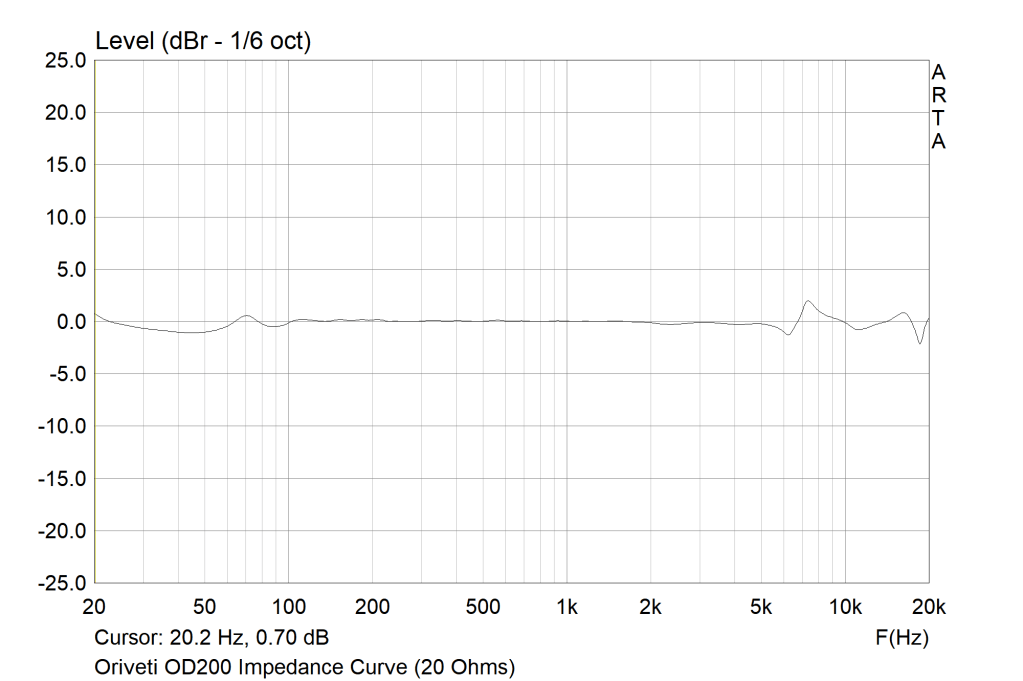
The impedance curve is effectively flat meaning the OD200 will provide a consistent sound from a variety of sources. This is, of course, given that the source itself provides a linear output. This is a great result and means the OD200 can be enjoyed from a wider range of sources.
Driving Power
The OD200 scales somewhat with better sources but isn’t hugely demanding of the source overall. It has average efficiency for a single-DD earphone meaning even portable sources can drive it to high volumes. Comparing my desktop stack to the DITA Navigator revealed subtle changes with no major tonal shifts. The largest benefit of better amplification you can expect is bass quality. The desktop stack was tighter, faster and more defined. Actually, the Navigator provided a slightly fuller and bigger bass but it wasn’t as well controlled. Besides this, there were no huge changes.
Suggested Pair Ups
The OD200 benefits from a cleaner source given that it is already warm and full. While it isn’t overblown, bass can sound more bloated when paired with warmer sources. I enjoy brighter sources even that bring out the treble a little more. I would personally avoid warm sources as the compounded effect can lead to some congestion. This is, as always, a preference. The OD200 doesn’t require much driving power and isn’t overly sensitive to either hiss or output impedance making source pairing quite simple.

Ryan Soo
Avid writer, passionate photographer and sleep-deprived medical student, Ryan has an ongoing desire to bring quality products to the regular reader.
 Everyday Listening