

Oriveti OH700VB Review – Full Range
Sound –

Tonality –
The OH700VB is a very interesting IEM that provides a very similar voicing to most Harman-style IEMs but with a more clearcut sub-bass focus and just a slightly leaner mid-bass and midrange body. It measures quite differently to many IEMs I’ve tested but produces a natural and well-compensated sound with a mild vivid and energetic character. The technical performance is also impressive, especially the treble. In typical Oriveti fashion, the mid-treble has been toned down to prevent fatigue and sharpness however, highs still benefit from a small lower-treble peak for enhanced crispness alongside an uptick in upper-treble that means sparkle and air are still well present. The bass tuning is very interesting with a large sub-bass boost, a sharp mid-bass cut and gentle climb through the upper-bass and lower-midrange.
To compensate for the relative lack of warmth and fundamental body here, the upper-mids and treble have been tuned down by a few Db to avoid excessive intensity. In so doing, the sound appears balanced and neutrally toned, a touch lean on note body but with a bombastic sub-bass that hits hard but also remains well separated from the rest of the sound. If you’re at all familiar with HiFi systems, the OH700VB feels more reminiscent of a multi-speaker system than many hybrid IEMs that strive for coherence. By comparison, the OH700VB feels like adding a good subwoofer to a 2.0 speaker set and turning up the dial a couple of notches.
Tuning Switch
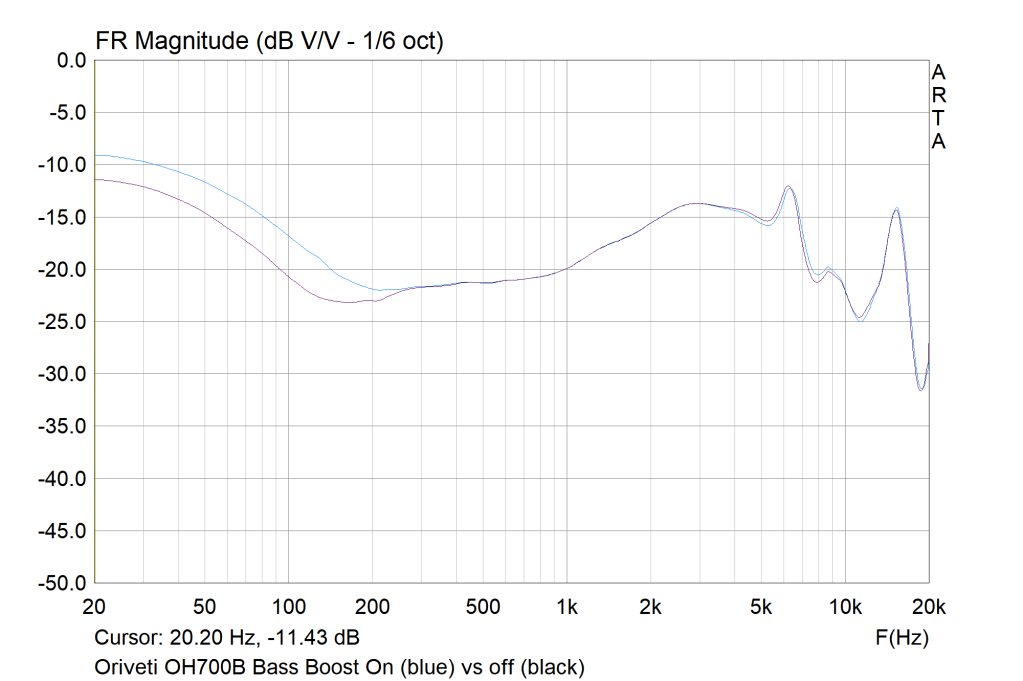

Lately, we’ve seen the popularization of all-rounder sound signatures that leverage sub-bass to achieve a sizable bass presence whilst upholding tonal cleanliness. Yet, as the adage goes, a focus on versatility results in a mastery of no particular attribute. The solution has come in the form of tuning switches that permit a more coloured, less versatile tuning but also multiple sound profiles to compensate. In the case of the OH700VB, the sub-bass dominance has been counterbalanced with a mid and upper-bass cut. On the majority of tracks note body is ample and the tuning is quite satisfying.
However, issues arise on older tracks especially where sub-bass wasn’t as heavily incorporated into the mastering style. Here, the mid-bass deficit results in an overly thin sound that lacks fullness and punch. The tuning switch not only serves to increase bass presence by around 3 dB, it also extends the shelf further into the mid-bass. This produces a slightly fuller, rounder note with greater warmth and mid-bass punch. While sub-bass heavy tracks can feel off-balance here, leaner tracks benefit from the increase in fullness. Alternatively, those craving a big bass in general will enjoy the sense of grandness and weight provided in this form.
Bass –
The first thing that stands out is sub-bass. The OH700VB has a heap of it. In either configuration, the OH700VB is relatively bass forward yet it is presented in a tonally clean and dynamic manner as a result. With bass boost off, bass sits slightly in front of the rest of the sound whilst with it on, it has a clear emphasis. Emphasis is focused on the sub-bass with a sharp cut into a recessed mid and upper bass. There’s a lot of structure and power on display with big, emboldened notes that aren’t the slightest bit tubby or rounded. As there is heaps of note weight and slam, the relative lack of mid-bass doesn’t bother. Still, it does produce a bass that is more percussive over textured, prioritizing pressure and impact over fine mid-bass details. As aforementioned, the biggest issue with the tuning occurs when listening to tracks mastered with reduced sub-bass where there is inadequate body in the mid-bass to compensate. The bass boost switch offers a good solution by slightly increasing warmth and fullness.
Usually, the biggest issue with a sub-bass boost is the loss to separation yet this has handily been addressed with the mid-bass cut that removes any chance of bloat or bloom from the presentation. Though bass notes tend to be large, they are defined and clearly expressed. Mid-bass does lack some texture at times, instead focusing on an enhanced and clearcut rumble at the very bottom. The raw driver quality is quite nice too, delivering good responsiveness especially considering the level of emphasis. There isn’t overwhelming pressure but it is well present. Notes are well articulated and decay quicker than most, further cleaning up the response. Many competitors offer greater balance and some also a slightly more concise note attack, but the OH700VB provides awesome rumble and power with good control and without the usual drawbacks. This makes for a very unique low-end that will suit sub-bass lovers that still want quality and balance in the mids and highs.
Mids –
I spent a lot of time ABing the OH700VB with the other Harman-target IEMs and the Blessing 3 stood out for having the most similar style of voicing. The OH700VB is clearly expressed, tonally neutral and just a touch lean due to the upper-bass dip. This is most notable with male vocals that offer a balanced presence, accurate size and a natural voicing but have a touch dry at times. Female vocals are displayed in balanced measure and have a delicate and clear expression. There is good extension without excessive intensity and vocals are articulate yet not too breathy. Oriveti has tuned the midrange well and the surrounding frequencies in tasteful restraint to avoid excessive colouration. The Blessing 3 sounds just a touch more coherent but the voicings are incredibly similar despite the dissimilar tunings. This can be attributed to the overall tuning methodology.
The Blessing 3 has more warmth to its low-end but more upper-midrange and treble. The OH700VB has less warmth but reduced upper-midrange and treble presence that make its lower-midrange appear more present by comparison. As a result, it achieves convincing body without tonal colouration and the midrange showcases excellent separation from the bass, aiding separation. This is likely the most impressive aspect of the OH700VB, its ability to separate within each frequency range and between them. Fine details are easy to isolate and overall resolving power is high which works in tandem with the tonally clean tuning. While those wanting a warmer, more forgiving sound will want to look elsewhere, the OH700VB is nicely balanced and transparent with a natural voicing and just a slight revealing character.
Highs –
The OH700VB isn’t a bright earphone but a balanced one just with an energetic voicing. It has a small 6kHz peak that gives the leading edge of notes a bit more crispness and bite. The transient response is also very clean, showcasing a high level of fine detail retrieval appropriate for the price tier. The mid-treble drops off to permit a clean background and a lack of any overarching intensity, splashiness or brightness. Though crisp, the OH700VB isn’t overly sharp or fatiguing as a result but certain instruments such as cymbals can sound a bit over damped as a result. Earphones with a more even mid-treble provide a more accurate sense of note decay with the OH700VB focusing more on a focused fine detail presentation over intricate textures and shimmer.
The main differentiator is the upper-treble emphasis that injects another layer of clarity and sparkle into the sound. Micro details are abundant and brought more to the fore giving the earphones excellent resolving power on complex tracks. Compared to the OH500, the OH700VB discerns fine details noticeably better in the foreground alone and presents micro details that weren’t even apparent on the cheaper model. Higher-end IEMs do provide greater resolving power yet but this often comes with greater brightness on top. Few IEMs are able to deliver this with a more linear tuning on top but expect to pay much more for this. The OH700VB doesn’t perform at the highest level of technical performance but a very high level with an enjoyable tuning to boot.
Soundstage –
The OH700B provides a relatively well-rounded stage with good dimensions all around. It is able to extend beyond the head in both width and depth and larger than the majority of IEMs on tracks that call for it. The imaging performance is sound with sharp localization and a keen portrayal of directional cues. Layering is a strong performer with defined and delineated foreground and background layers. However, distance portrayal leaves to be desired which can sap some of that multi-dimensional quality from the image that you may find on the best performers. Separation, meanwhile, is excellent especially in the mids and highs. This can be attributed to the sharp transient response and lean, transparent tuning. While the bass isn’t muddy, the sheer volume of sub-bass means it doesn’t perform at the highest level in this frequency range.
Driveability –
Output Impedance Sensitivity
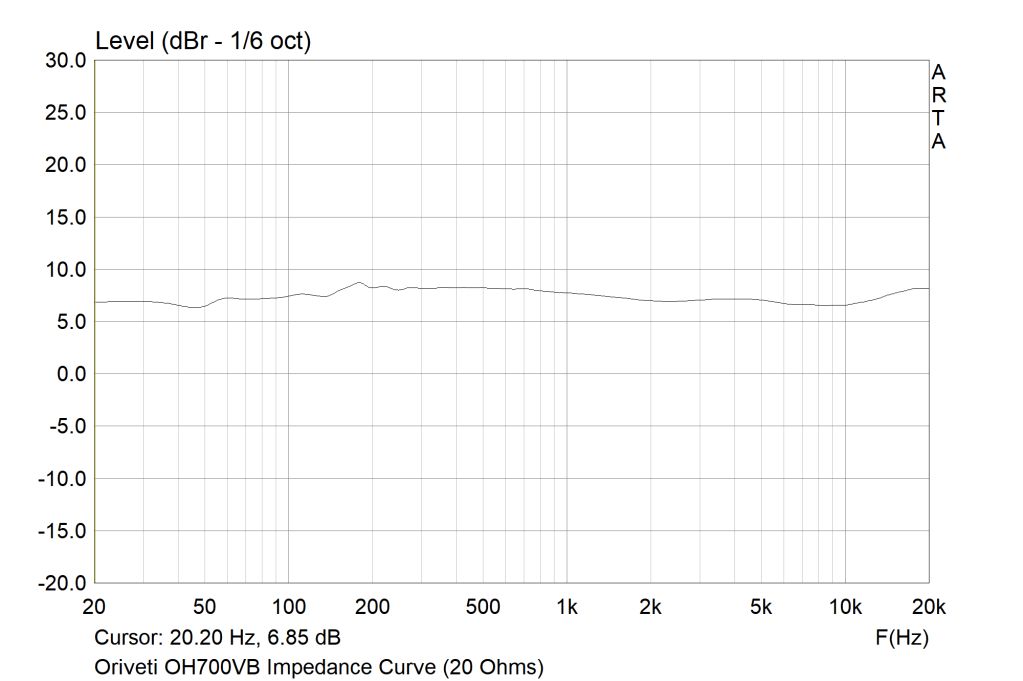
The impedance curve is effectively flat meaning the OH700VB will provide a consistent sound from a variety of sources. This is, of course, given that the source itself provides a linear output. In subjective testing, the sound is very similar albeit a little more compressed with the impedance adapter. This may be attributed to a loss of efficiency, otherwise, the sound signature was essentially identical.
Driving Power
The OH700VB showcases good efficiency being driven by portable sources to ear splitting volumes. Despite the low impedance, it isn’t too demanding of current either and the tuning helps with this impression as a loss of dynamics is no problem. In fact, comparing my desktop stack to the DITA Navigator revealed greater sub-bass emphasis on the DITA device alongside a slightly thinner midrange and treble, giving it an even more engaging and energetic sound. The desktop stack meanwhile provided a tighter and more controlled bass and a more coherent sound altogerher. While the OH700VB scales very nicely, a powerful isn’t necessary to provide an enjoyable sound.
Suggested Pair Ups
The OH700VB benefits from a warmer source that can provide a bit more body to the midrange. As the top-end is already quite energetic, a smoother source is of no consequence. Some may enjoy neutral sources as they provide the cleanest sub-bass, however, I found this came at the expense of overall naturalness. Output impedance is not a huge concern nor is background hiss. The OH700VB scales nicely with greater driving power but doesn’t absolutely require it.

Ryan Soo
Avid writer, passionate photographer and sleep-deprived medical student, Ryan has an ongoing desire to bring quality products to the regular reader.
 Everyday Listening