

Kinera URD Review – The Beauty & The Beast

Pros –
Jaw-dropping design, Excellent accessory selection, Nicely balanced sound profile, Warm and powerful midrange, Spacious soundstage, Controlled and textured bass
Cons –
Midrange may lack separation for some, Treble could be more articulate
Verdict –
The URD is a strong overall package that isn’t perfect but has an enticing blend of qualities suiting those wanting a coherent yet dynamic sound.,
About Kinera –
Kinera is a Chinese audio company founded in 2011. They began life as an OEM for other brands, mass manufacturing balanced armature drivers and later expanding to manufacture other driver types such as bone conduction drivers. In 2016, the company released their first IEM and entered the world of audio as its own brand. Since Kinera has kept up to date with cutting-edge technologies such as electrostatic and micro drivers in its designs. They have refined their approach using hand-crafted artisan IEM shells and more high-end models to suit the international market.
Introduction –
Kinera has greatly expanded its IEM range since I last reviewed one of its products. Much of this has been seen in the top end as the company is now making multi-thousand-dollar IEMs in the TOTL segment. The Imperial URD was released a few years back in 2022 and shares the midrange tier with the all-BA-based Imperial Skuld and hybrid Norn. It is the most premium offering of the three and boasts a more complex tribrid driver setup to suit. The URD also sports the world’s first 3D faceplate, using 3D printing technology to offer three-dimensional depth to its shell in a manner that is very reminiscent of artisan keycaps. Implementing dual Titanium coated dynamic driver woofers a Kinera custom midrange BA and dual Sonion EST tweeters, it promises a dynamic and detailed sound.
The URD is available for $650 USD. You can read all about it and treat yourself to a unit on Kinera’s website here.
Disclaimer –
I would like to thank Jin from Kinera very much for reaching out and organising a review of the URD. All words are my own and there is no monetary incentive for a positive review. Despite receiving the earphones free of cost, I will attempt to be as objective as possible in my evaluation.
Contents –
- Page 1: Intro, Unboxing, Design
- Page 2: Sound and Source Pairings
- Page 3: Comparisons & Verdict
Specifications –
- Drivers: 2x Ti-Coated Coaxial DD, 1x Customised Kinera BA, 2x Sonion EST
- Frequency Response: 5 Hz – 50 kHz
- Impedance: 20 Ohms
- Sensitivity: 107 dB
Behind the Design –
Dual Ti-Coated Dynamic Drivers
The lows are handled by not one, but two dynamic drivers as seen on certain high-end designs and also the new Moondrop Blessing 3. However, the setup is different to the Blessing 3 that uses opposing drivers as Kinera has placed them in a coaxial arrangement with one in front of the other. This is commonly referred to as an isobaric speaker configuration and enables cancellation of some distortion. It also permits a more powerful bass response as it reduces space requirements at the expense of losing some efficiency. The two drivers can create the same frequency response in half the housing volume that a single dynamic driver would require. This makes it a great choice for IEMs where space is limited but a powerful bass performance is still desired.
Custom Kinera BA
As aforementioned, Kinera started life manufacturing drivers. As such, the company is able to make their own drivers in-house to their specific preferences and needs. The 11021 is made just for the URD which optimizes ease of integration with the dual woofer and tweeter systems.
Sonion EST65DB01
Sonion’s electrostatic tweeters have made quite a buzz lately and have become a controversial topic of conversation. The DB01 replaces the first-generation DA01 and touts improved efficiency which was a common complaint with the first round of EST-based IEMs. This is also the dual variant that uses a push-pull array to further improve output. The EST drivers peak around 5kHz and 18kHz producing a crisp yet sparkly sound.
Modular Cable
The URD comes with a 6N OCC + Silver Plated OCC Copper + Gold Plated cable that sports a high efficiency and special shielding structure. In addition, the cable uses a 4-pin connector to offer modular terminations with 3.5mm single-ended and 2.5mm and 4.4mm balanced also included in the box.
Unboxing –
As with all of Kinera’s IEMs, the unboxing experience is a thing of beauty. The hexagonal box slides open to reveal the IEMs and accessories within a laser-cut foam inlet. The case comes in a coordinated baby blue with fabric exterior. It offers compact dimensions for a hard case and a solid skeleton that provides impact protection. Within the case is the gorgeous gold and silver plated cable and the extra connectors are within the foam inlet. Alongside are the ear tips including 5 pairs of Final Audio E Tips and 2 pairs of memory foam tips. There are also 7 pairs of Kinera custom ear tips and a cleaning brush for the user to experiment with.
Design –
As soon as you lay eyes on the URD it’s apparent that Kinera has elevated their resin-shell designs a step above the competition. The entire aesthetic provides a warm, beachy aesthetic that is mesmerizing to look at. While the base shell is a polished off white, the inner faces are adorned with a rustic sand yellow and a deep green blue on the front, rear and faceplates. Not only that, but there is also a hand-painted bubble texture marking the transition between each colour. The faceplates are the real headline attraction, adorned with a semi-transparent resin that provides a window into the depth of the 3D printed faceplates under the light. This is all topped off with a flawless high-polish finish and gold URD branding. Overall, it’s a stunning design that maximizes the aesthetic potential that is possible from a resin design.

Using 0.78mm 2-pin connectors, cable swapping is a breeze. The included cable is also very pleasing, sporting an internally braided structure with a 2-wire twist below the y-split and a single wire above. Despite this, microphonic noise is low dur to the over-ear fit and soft jacket. The cable has zero memory and it highly compliant. The transparent jacket showcases the gold and silver conductors, complementing the housings with aplomb. Gunmetal connectors top it off and the plug has a modular connector but no securing mechanism. The plug is rather large considering but provided reliable operation in my testing. The ear guides are quite long but provided a comfortable fit for my ears. Overall, Kinera has really made a statement with this IEM which is one of the most visually stunning designs on the market.
Fit & Isolation –
Alongside the unique designs, Kinera’s IEMs are all also shaped slightly differently which helps to set them apart. The URD showcases compact dimensions similar to the Skuld but has been stretched width-wise to accommodate the three-dimensional faceplates and longer nozzle. Overall, I found them comfortable due to their rounded shell design with ample space in my outer ear to prevent hotspots. Those with medium to medium-small ears should experience no hotspot formation over time either.
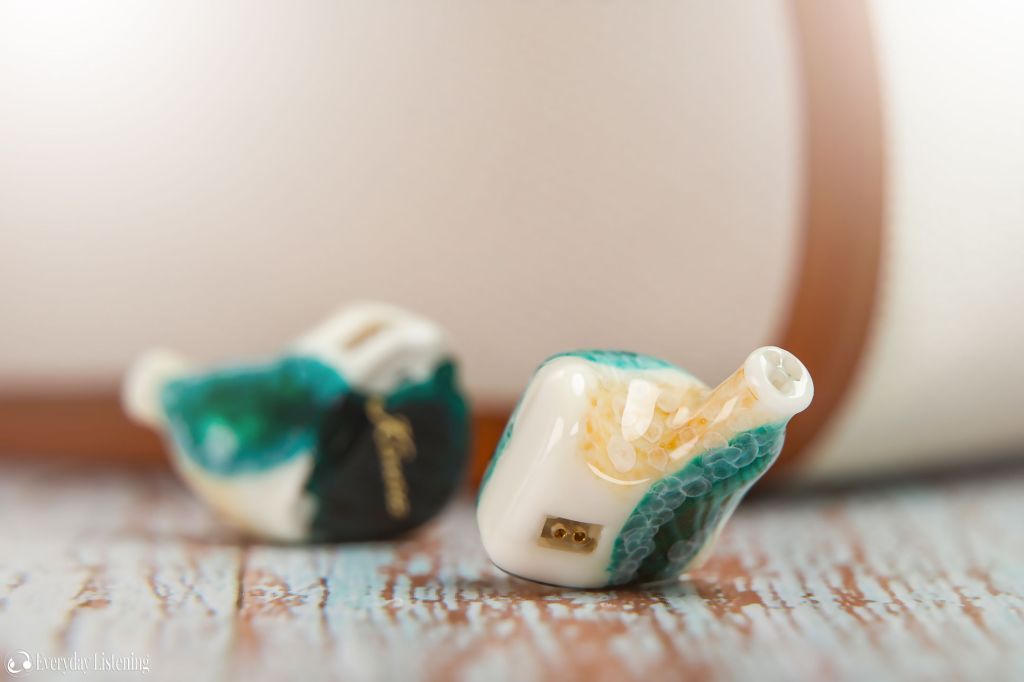
Due to the width of the housings, they do protrude somewhat from the ears so wind noise when outdoors can be pronounced, and they will not be suitable for side sleepers. The elongated nozzles promote a deeper fit and may require sizing down your ear tips. In return, the seal is excellent, and the fit is also very stable as a result of this. While there is some wearing pressure due to the simple depth of the fit, no driver flex was apparent to me. Passive noise isolation is just above average for a vented design and is easily sufficient for daily use and commute with silicone tips.

Ryan Soo
Avid writer, passionate photographer and sleep-deprived medical student, Ryan has an ongoing desire to bring quality products to the regular reader.
 Everyday Listening