

Kinera URD Review – The Beauty & The Beast

Sound –

Tonality –
The URD offers a very pleasing tonality that is coloured but overall upholds a pleasant and easygoing voicing that is genre versatile. It has a mild bass focus though it is executed in a clean and enjoyable manner. The treble errs on the smooth and dark side, retaining good headroom but never stealing the show. Meanwhile, the midrange showcases a medium warm and full character and just a slightly husky voicing. Though there is a small 3 kHz nadir, presence at 2.5 and 4 kHz redeems clarity and produces neutral presence but also enhanced vocal size giving the midrange quite a powerful voicing. Overall, the URD appears like a good alternative to the Moondrop Variations given the similarities in price, driver setup and broad tuning focus. The Variations has the cleaner midrange and a more balanced treble presence. While the URD has similar sub-bass presence but a cleaner mid-bass and a more forgiving but equally present midrange.
Bass –
If you enjoy a well-weighted bass response with just a light warmth, the URD is a delight. Though there is slightly too much bass for my preferences, the tuning is well-executed and the quality impresses. It has a predominant sub-bass focus followed by a linear drop-off towards the lower midrange. This gives it a structured voicing but prevents excessive sub-bass dominance and similarly, excessive warmth and spill into the midrange. I do personally prefer this over the tuning that many competitors have adopted which usually involves a steeper mid-bass cut. This way, you get more texture and preserve a more natural note timbre whilst still benefitting from heightened dynamics. Still, notes are full and bold and there remains a focus on power and slam.

Bloat or muddiness are not present which is aided by a well-controlled note delivery. The dual woofer array offers quality that is slightly better than many competitors but doesn’t stand out as a uniquely strong performer in class. Most notable is the level of control on display. Though relatively bass-heavy, separation is very good and complex passages are handled with relative ease. Decay is about average for a dynamic driver and note definition could be slightly higher as a result. However, attack is very concise, adding tactility to the sub-bass especially. While BA drivers are a lot faster, they can’t glimpse the dynamics on display. I have also heard a more detailed bass from other dynamic drivers albeit with vastly less bass quantity. Though the URD isn’t the most resolving on the market, it is an impressive performer especially when considering the level of bass on display.
Mids –
Kinera has been refining their approach to midrange tuning and have created some very pleasing models in recent years. The URD follows suit being fairly similar to many Harman-style earphones in voicing but notably coloured. Chiefly, it has a slightly more relaxed quality with a smoother articulation and a fuller note body. A light warmth is imbued by the bass and the overall mid-emphasis has been reduced by a few dB to achieve an easygoing, coherent character. However, as the midrange has a higher 4 kHz emphasis, clarity remains neutral as does vocal positioning, so I wouldn’t label this a laid-back earphone either. Instead, vocals are neutral, enlarged and voiced with a warmer hue.
This gives the midrange a structured and powerful voicing if also a little huskiness on tracks with an already warmer mastering style. Compared to Harman in-ears, the URD provides a more forgiving voicing at the expense of separation and definition. Overall resolving power is also lower than class average, especially with the warmer tuning that can mask fine details. There’s a bit more fuzz to the sound and vocals are less consistent in tone if still mostly consistent in positioning. The smoother articulation takes the edge off S’s and absolves the sound of sharpness. Though clarity remains sound, the URD ultimately appeals to those wanting a powerful and well-present but relaxed midrange without fatiguing properties.
Highs –
Though quite a few IEMs are using EST tweeters, they vary hugely with implementation. The URD is more representative of older implementations, offering a smooth and dark sound but also a smoothened note attack that gives it a very dainty quality. Notes are thin, light but agile and responsive. Compared to BA-based IEMs and even some other EST IEMs, the URD lacks that hard-edged note attack in the lower treble which is exacerbated by the small nadir in this region. However, it has abundant air and headroom above which helps to maintain an open image. The mid-treble isn’t exactly emphasized but has been placed in similar proportion to the upper midrange. This means you get a nice shimmer and detail presence but with zero sharpness.

At the same time, this smoothness can hamper detail retrieval. Notes lack body and texture due to their delicate nature. The EST drivers do excel at providing a refined sound that said. There isn’t any splashiness or brittleness to the sound but a delightful openness without excessive brightness. Extension is sound but not outstanding. Some sparkle is evident but minimal micro detail is apparent. Fine details and background details are brought forward, but again, the lack of bite does mean the better performers in this price class come across as more detailed. Still, I do know many find the 5-6kHz region to be grating on the ear, so the URD appears like a good solution as it upholds good extension and headroom despite its smooth voicing.
Soundstage –
The URD presents one of the larger soundstages around this asking price with good proportion between width and depth. It extends beyond the head in both axes providing an open and spacious impression. The imaging performance is also quite involving. Layering is nicely defined but does lack delineation in the midrange due to the thicker voicing. Directional cues could be sharper due to the smoother lower-treble so it lacks the pinpoint accuracy of some competitors. However, distance portrayal is also convincing which overall gives it a nice sense of dimension. Separation is also respectable, not the highest performer but adequate with some ether separating fine details.
Drivability –
EST drivers require a transformer and therefore, tend to be less sensitive than other driver types. As a result, earphones using these drivers tend to require more power than typical IEMs. The URD has a modest 20 Ohm impedance and a 107 dB sensitivity that make it reasonably efficient, especially among EST IEMs. This is only with concern to volume that said.
Output Impedance Sensitivity
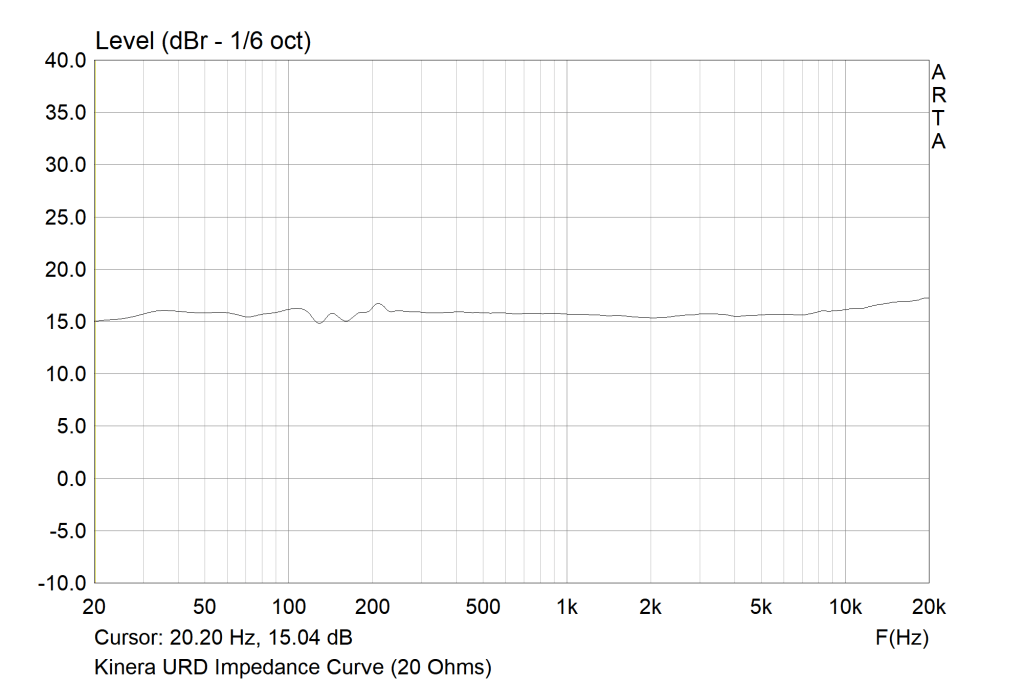
The URD measures relatively flat from a source with a 20-ohm output impedance suggesting minimal variation in sound signature from different sources. Subjectively, I did perceive a drop off in the bass giving an altogether leaner sound. That said, the overall balance was still pleasing so the URD can be enjoyed from a variety of sources even with higher output impedance.
Driving Power
Comparing a good portable source like the DITA Navigator to my desktop stack reveals that the URD prefers a more powerful source to extract its potential. I noticed a deeper-reaching and tighter bass from my desktop stack alongside a bit more energy in the highs. The Navigator was a bit softer around the edges which sapped detail and engagement from the sound. Tonally, there wasn’t a huge shift, but I did enjoy the more defined delivery provided by my desktop stack. The URD therefore, scales very well with better amplification especially.
Suggested Pair Ups
The URD isn’t overly sensitive to either background hiss or output impedance and provides a stable sound signature from a variety of sources. It does scale very well with amplification and thrives more than most IEMs with greater power output. In terms of synergy, I found the URD to benefit from a neutral-leaning source due to its smoother and warmer leaning sound. This maximizes detail retrieval and separation.

Ryan Soo
Avid writer, passionate photographer and sleep-deprived medical student, Ryan has an ongoing desire to bring quality products to the regular reader.
 Everyday Listening