

Fir Electron 12 (E12) Review – Dynamo
Sound –
Tonality –
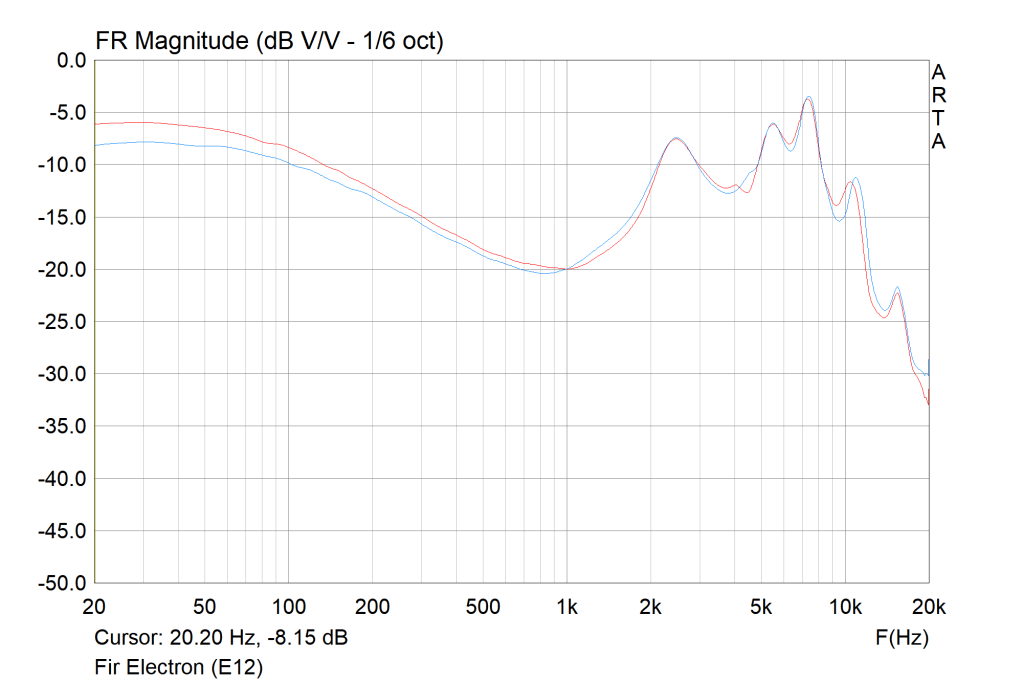
The E12 offers an engaging and high-contrast sound with a V-shaped character. It pairs a thick, meaty bass with a revealing upper-midrange and treble. Low-end emphasis centers around the deep-bass meaning notes are bold and voluminous. With a dip into the lower midrange, the midrange is neutrally toned despite the bass presence and upholds strong clarity and separation. A medium peak around 2.5kHz brings both male and female vocals forward whilst aiding vocal size and clarity. Treble offers dual 5 and 7 kHz peaks providing more bite in the foreground alongside retaining enjoyable air and headroom above. While it lacks the top-octave sparkle of many high-end hybrid designs, the E12 is defined by excellent tri-frequency separation and showcases a high level of detail capability through the rest of the frequency range.
Tip Pairings
The E12 comes stock with foam tips installed. Though smoother and warmer, these dampen the treble slightly and I found bass was on the cusp of my preferences pushing me towards silicone tips which offered more bass/treble balance to my ears. The whirlwind tips offer just this, a bit more clarity and treble air but also thinned out the sound. Final Audio’s E tips add too much mid-density and too much emphasis on sub-bass which lowers separation. JVC Spiral Dots were better but slightly brittle in the highs if enjoyable elsewhere. The Acoustune AET08 tips provided the most balanced sound with slightly more mid-presence and a more balanced bass. Despite this, I most enjoyed Spinfits and Azla’s Sednafit tips that provided the most honest character true to the V-shaped tuning but with a controlled treble and clear midrange. Of the two, the Sednafits sized half down to provide a deeper fit provided the most controlled treble whilst upholding a present midrange and textured bass. These are the tips I used for the sound analysis below.
Bass –
As compared to headphones, the low end is a region that many label as a weakness of IEMs. This makes sense given the limitations in space and how IEMs interact with less of the outer ear which contributes to the sensation of sub-bass. Manufacturers have addressed this in recent years by implementing bone conduction drivers and Fir’s method comes in the form of Kinetic Bass. As I’ve found with Fir’s other IEMs, the bass presentation is indeed somewhat different. Mostly this comes in the form of dynamics, which both the M-series and E12 provide in spades. The E12 exemplifies this more so, pumping out a deliciously palpable low-end with surprising heft behind each strike and a notch higher bass presence compared to their previous lineup. Bass now sits at the forefront of the presentation but still never overwhelms. Sub-bass steals the show with excellent, palpable slam and emphasis continues into the mid-bass granting full, rich and filled-in notes.
While I wouldn’t remotely label bass as muddy or bloated, notes are enlarged, emboldened, and highly weighted due to the deep-bass focused emphasis. Accordingly, those wanting a balanced sound will likely find the E12 a bit bombastic. However, it is an immensely satisfying sound if you like strong dynamics and impact especially. Moreover, the sensational dynamics don’t detract from the E12’s ability to resolve fine detail. Fir has extracted a great deal of control from the E12’s dynamic driver as lows are highly defined and quickly decaying, aiding enjoyable separation. Though responsive, the sheer size of the E12’s bass notes mean separation is likely its weakest link within the bass, lacking the cleanliness of less mid-bass heavy sets – it just sounds a bit thick at times. Besides this, the E12’s bass is simply a load of fun. Those craving a big, weighted bass response will enjoy the excellent tightness and detail retrieval on display alongside dare I say best-in-class dynamics and rhythm.
Mids –
Big bass can either be isolated or indulged and much of this is attributed to the lower-midrange tuning. Fir has opted for the former with a slightly scooped upper-bass and lower midrange that enhances bass-to-midrange separation. Combined with a 2.5kHz emphasis, the mid-bass doesn’t colour the midrange which enjoys an impressively neutral tonality and a slight focus on amply present and clearly expressed vocals. The pulled-back lower midrange also reduces vocal size and note body and, as the midrange hump is lower in magnitude than both bass and highs, the E12 does have a slightly laid-back midrange overall. Still, it never comes across as thin or metallic nor overly mid-recessed due to its energetic and slightly revealing voicing. As there is plenty of bass presence providing richness to the sound in addition to an uptick of density around the 3-4kHz region, this is achieved without detriment to listenability and coherence.
Undoubtedly the star of the show is vocal definition which is further enhanced by the articulate lower treble response that draws small details to the fore. Separation and definition both perform at a high standard and the E12 showcases strong clarity within its midrange despite its large bass. Resolving power is also an admiral performer but does lack in the way of layering and micro detail relative to hybrid or BA earphones in its premium price bracket. Still, the detail performance is convincing, and this impression is augmented by the revealing method of tuning. I do agree with Fir’s decision to bring the midrange positioning back a few steps as the energetic voicing combined with the brighter treble may have worn on the ear with intensity otherwise. While the timbre isn’t perfectly accurate, and I wouldn’t expect especially high coherence, the E12 embraces its revealing voicing which permits its midrange to be expressed clearly whilst still permitting a spotlight on the bass and highs.
Highs –
In tune with its V-shaped signature, the E12 sees a moderate treble emphasis providing clarity and definition to its high end. I can definitely see the resemblance with their hybrid models with regards to raw tuning besides upper treble tuning which is neutral with a slight roll-off rather than emphasized. Instead, Fir has given the E12 a mid-treble bump, so it still comes across as open and airy but not holographic and sparkly. While sensitivity at the utmost top-end isn’t as high as some high-end hybrid designs, the level of treble extension is still very impressive and can keep up with many hybrid designs barring those with EST or specialized tubeless driver systems.
The lower-treble bump also injects a good level of crispness into its foreground with a keen emphasis on note attack. Alongside an agile transient response, the E12 delivers well-separated highs that are crisp, highly defined and very resolving. While treble does sit in front of the midrange, it never overpowers the sound. The bass is arguably slightly more present in the mix which does help with overall fatigue and intensity levels; this can be further adjusted with tip pairings too. The voicing is certainly on the coloured side yet with an exacting character that enthralls. The combination of lower and mid-treble emphases provides excellent top-end clarity.
Note body is somewhat thin but never sharp nor brittle as the dynamic driver smooths over the response a little as compared to balanced armatures of similar tuning. At the same time, Fir has done an excellent job at extracting a high level of foreground and background details which are both brought almost equally to the fore. This gives a very dense presentation that highlights small nuances in the track. Sparkle isn’t emphasized and some micro details present on models like the M4 aren’t quite as clearly defined here. In addition, the density does mean that treble instrument separation isn’t quite as good as more balanced IEMs. However, it is staggeringly good resolution from a single dynamic driver with a fun yet likeable tuning.
Soundstage –
The strong top-end extension, despite not being the most sparkly on the market, does contribute to a massive soundstage especially in conjunction with the semi-open ATOM modules. The E12 is quite an airy monitor and these aforementioned qualities augment this to provide an excellent level of both width and depth that extends easily beyond the head. Imaging is also sharp due to defined directional cues. Layering does leave to be desired as room presence is decreased and the mid-treble is too forward to create necessary foreground/background separation.
As a result, you don’t get that sense of pinpoint precise distance projection as on more balanced monitors but a generally expansive image with slightly vaguer z-axis positioning. Separation, however, is quite impressive, especially given the robust bass tuning. It certainly isn’t the highest but was never a limiting factor even on complex tracks. There is a palpable ether between elements that makes fine detail easier to discern. The bass and treble ranges lack that last iota of separation found at the highest end of balance and technical ability, but this doesn’t strike as a weakness unless in direct comparison.
Drivability –
The E12 has a 16 Ohm impedance and an unspecified sensitivity. In testing, it appears to be quite sensitive similar to their hybrid models and this equally applies to its ability to pick up on source noise.
Output Impedance Sensitivity
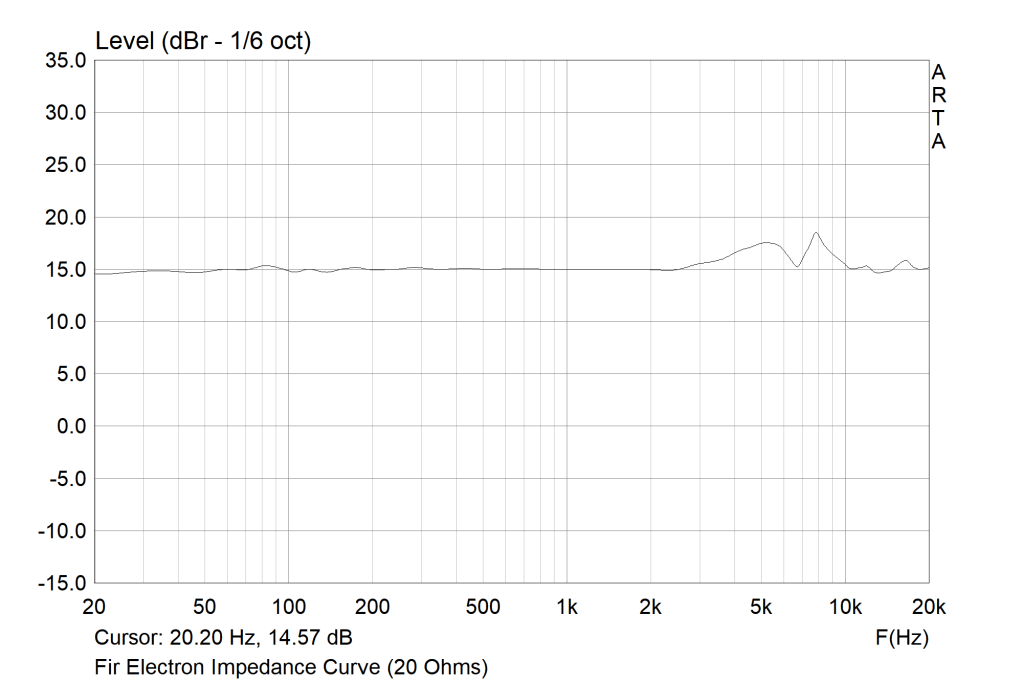
Given the single-driver design, one would expect a mostly linear impedance curve, and in my testing, this has been the case. The E12 provides a stable output tested at up to a 20-Ohm output impedance. This means you will get a very consistent sound profile from the E12 so long as the source itself has a linear output.
Driving Power
The E12 is a low-impedance design with a subjectively high sensitivity. This makes it very efficient and able to achieve ear-splitting volumes even from portable sources. It also picks up on source noise so a low noise floor is desirable to enjoy the highest dynamic range. Comparing the DITA Navigator to my desktop stack revealed a tighter and deeper bass on the desktop stack in addition to a noticeably larger stage. While the sound was otherwise very similar and still very detailed, a good source is recommended. Conversely, the E12 scales very well with a quality source and dedicated amplification.
Suggested Pair Ups
The E12 is tolerant of output impedance and provides a consistent sound profile from most sources. It is hiss sensitive benefitting from a low noise floor and a resolving source with good current output too due to its low impedance design. In terms of colouration, the E12 benefits most from a clean source due to its powerful and well-structured bass, aiding separation. However, I wouldn’t necessarily advise a bright source due to the energetic top-end that may wear on the ear if over-emphasized.

Ryan Soo
Avid writer, passionate photographer and sleep-deprived medical student, Ryan has an ongoing desire to bring quality products to the regular reader.
 Everyday Listening