

Craft Ears Omnium Review – New Kid In Town
Sound –
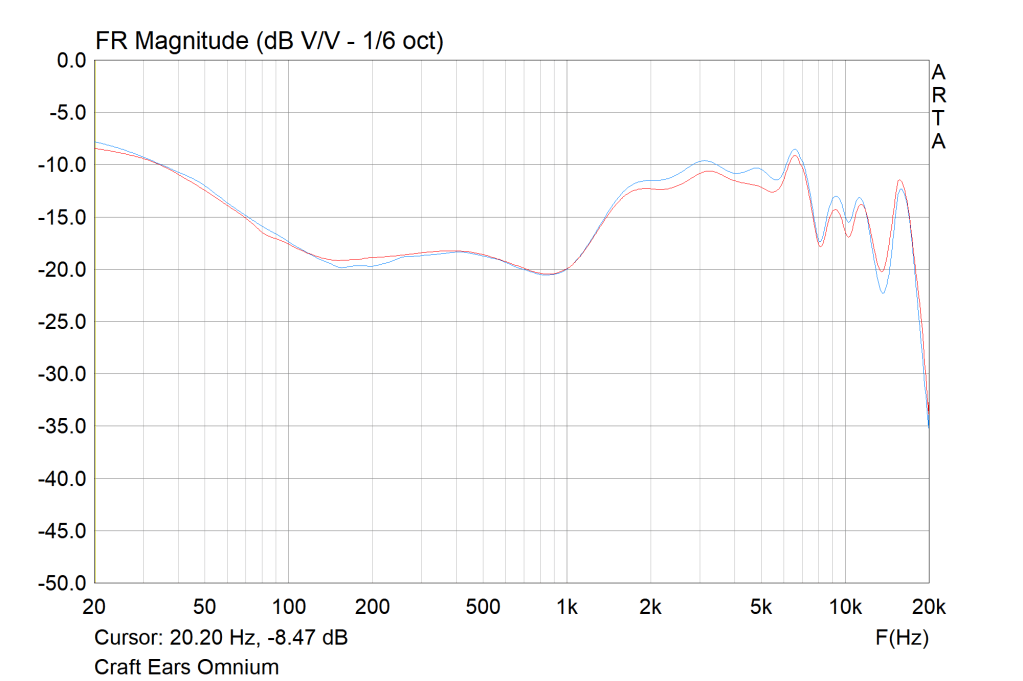
Testing Methodology: Measured using Arta via IEC 711 coupler to Startech external sound card. 7-9KHz peaks may be artifacts/emphasized due to my measurement setup which I found to be the case here. Measurements besides channel balance are volume-matched at 1KHz. Fit depth normalized to my best abilities to reduce coupler resonance. Still, due to these factors, my measurements may not accurately reflect the earphones or measurements taken by others.
Tonality –
Much like its predecessors, the Omnium delivers a clean and balanced sound that represents a faithful albeit energetic interpretation of neutral. As a flagship should, it takes Craft Ear’s house sound and dials the transparency up to 11 due to a notably more linear treble response and superior technical performance. It has excellent balance throughout and smooth transitions between the core frequency bands. There’s a mild sub-bass shelf and a center-midrange hump that injects additional dynamics and vocal power into the sound. At the very top, treble showcases an enhanced sparkle and crispness but otherwise, demonstrates commendable linearity. It is for this reason that those sensitive to treble may find the Omnium a little hot, however, I did not. The Omnium also delivers top-level technical chops as expected from a TOTL product. However, ironically it stands out more for its transparent and balanced tuning in a market sector that tends to cater more towards the unique and niche. The Omnium represents the epitome of an all-rounder and this will no doubt make it a crowdpleaser when combined with its superb technical ability.
Ear Tips –
The stock silicone ear tips are a wonderful complement to the Omnium so despite testing several other pairings, these are ultimately what I used during the review. My gripe is that they have quite a soft jacket that can deform when inserted, causing them to lose seal. The Final E-tips were first up and delivered a slightly smoother treble and a slightly warmer, more focused bass. However, they also sapped openness from the midrange and produced a small stage. These will be a good choice if you find the Omnium too bright.
The Acoustune AET07 tips sounded less dynamic with a more mid-centric sound but I didn’t enjoy the loss of sub-bass. The Spinfit CP100’s were a good complement, adding some bass presence whilst keeping the midrange spacious and clear. They did slightly increase mid-treble presence leading to a more engaging overall sound. The JVC Spiral Dots were my favorites besides the stock tips. They make the stage a touch more intimate but add some warmth in the bass and slightly smoothen the treble for those wanting a slightly more coherent sound profile.
Bass –
While the single LSR dynamic driver doesn’t receive much attention in CE’s marketing, it shouldn’t be considered a weakness of this earphone. The bass is delightfully tuned with a mild sub-bass focus and a wicked clean, agile mid and upper bass. The mild and progressive emphasis ensures that the sub-bass doesn’t overpower the sound with its energy but rather provides enhanced structure and weight alongside a delightfully defined and palpable rumble. These qualities service electronic and rock music especially well and inject engagement over more vanilla flat bass tuning methods. I do find the downside to sub-bass-focused tunings comes down to consistency. You will encounter certain tracks mastered with minimal sub-bass that will sound a bit lean. While this isn’t a fault of the earphone itself, mid-bass forward earphones tend to be a bit more consistent in their bass level between tracks albeit this tuning also comes with its own pros and cons.
Otherwise, notes are overall well-structured without being overly thick, and the bass showcases a well-balanced character in summary. The timbre isn’t perfectly accurate due to an increase in said thickness and weight at the very bottom as the Omnium focuses more on balancing dynamics, tonal cleanliness, and technical performance over pure authenticity. What stands out immediately is the sheer definition of the sub-bass. Bass is extremely responsive and well-separated, especially with the cleaner tuning. While it lacks the thick, rich texturing showcased by more mid-bass forward sounds and the note attack isn’t quite as aggressive as some other high-end IEMs, the dynamic driver presents a natural attack and decay that doesn’t pound the head with pressure. It also boasts standout definition and strong detail retrieval throughout. The light-footed approach to mid-bass tuning does give the Omnium a focus on pace and dynamics over texture and richness. However, the Omnium ultimately provides a satisfying sub-bass-focused bass response that is perfectly clean and dissects complex tracks with ease.
Mids –
One of the most unique aspects of the Omnium is its use of a planar magnetic midrange driver. Planar drivers are more typically used as tweeters owing to their fast transient response. Despite this, I find that the chief appeal of the Omnium is a combination of superb tuning and exceptional detail retrieval and layering. The tuning and technical ability of the unique planar driver surely contribute to this impression. With that said, I don’t hear the driver type delivering a note timbre that is distinctly different from others. What it does provide is excellent resolution and low-level detail. Booting up a track from Billie Eilish for example, reveals a highly layered presentation with abundant, clearly expressed fine detail and excellent delineation between each layer.
Tonally, the Omnium showcases excellent tonal transparency and a slightly empowered voicing. Accordingly, it isn’t perfectly neutral as a mild center midrange bump enlarges its vocals and brings them slightly forward. Its larger vocals contribute to a greater sense of naturalness as it counteracts the strain and stridence that can occur with greater upper midrange presence in the absence of low-end warmth. In turn, vocals do take some precedence over midrange instruments but never overwhelm with intensity or forwardness – it’s a very mild effect. The Omnium has a slightly leaner note body due to the low-end tuning but boasts excellent separation and definition in return. It helps that the treble tuning is broadly linear which results in an articulate and detailed sound that nonetheless avoids over-sharpening and sibilance.
I should address that despite offering superb balance, the Omnium will not suit all. This applies especially to those wanting a more easygoing listen and are perhaps already accustomed to a more laid-back sound. In this case, you may still find the Omnium to be lean and bright. Coming from Harman-target in-ears, I didn’t personally find this to be the case, but the contrast can be jarring if coming from something laid-back like the Dita Perpetua (the same goes vice versa). So long as expectations are in order and you understand your previous point of reference, I find the Omnium to provide a very pleasant interpretation of neutral. it doesn’t strike as especially forgiving but isn’t a remotely fatiguing earphone either. The top-class resolving power and clean tuning work hand-in-hand to deliver an effortlessly delicate, spacious, and complex midrange.
Highs –
The Omnium is a slightly bright leaning earphone but this can be tweaked with tip choice, output impedance, and fit depth. Sizing down ear tips to achieve a deeper fit resulted in a smoother lower treble and a better impression of balance for me. If you don’t mind a mildly bright treble, the tuning itself leaves little to be desired as it showcases good linearity with only slight bumps and dips adding some flavour. While treble as a whole sits slightly forward, the actual tuning can’t be faulted and I find myself resorting to descriptors such as “slightly” and “a tad” frequently during this review. That surely speaks well for the level of refinement that Craft Ears was able to achieve, and this is perhaps best exemplified within the treble. Many earphones religiously adhere to popular reference curves but fall apart in the treble department. Craft Ears was able to achieve a very linear treble response all the way into the top octave.
Accordingly, the highlight is the note presentation that beautifully balances attack, sustain, and decay whilst showcasing exceptional definition. Indeed, a rapid transient response is enabled by the tubeless tweeter system and the extension is exceptional, no less than the best competing TOTL IEMs. Some of these models are brighter and by extension highlight their technical chops more. The Omnium is even-handed in its presentation, delivering almost everything in equal proportion. The lower treble does have a small bump which highlights percussion and gives a bit more bite to the leading edge of notes, but it is hardly thin or over-sharpened. Notes have a realistic sense of body and shimmer and decay naturally thereafter with no truncation or, on the flipside, glare or brittleness. The subtly boosted and very well-extended upper treble injects headroom and micro detail into the sound without overly affecting the timbre.
While notes occasionally pick up a hint of grain and sizzle from the upper-treble boost, this doesn’t mire the overall presentation nor fatigue. The mid-treble sits at a roughly neutral level as the Omnium is able to achieve air and openness with its extension instead. The background is, in turn, clean, and a layered presentation is preserved. Due to the high level of note definition, separation is terrific and detail retrieval is a top-class performer. I was very impressed by the bountiful texture of high hats especially which tend to sound a little splashy on most earphones. Complex passages also don’t sound too busy as the treble hasn’t been over-brightened in any one area. There is a beautiful combination of foreground and background detail in appropriate measure with a boost to micro-detail adding engagement. Overall, the Omnium is a fine technical achievement but more than that it showcases a masterful and balanced tuning with just a hint of additional sparkle for that bonafide high-end IEM experience.
Soundstage –
The Omnium presents a hugely spacious soundstage that is further enhanced by its excellent separation, producing some of the best imaging I’ve heard from any IEM. Width impresses especially, stretching well beyond the head on most tracks. By comparison, the forward vocal range results in a more intimate sense of depth but there is a nice sense of projection when called for. Layering performs very well, aided by the even tuning. Not only are there defined foreground and background layers but many in-between and all are clearly delineated. This gives the presentation an organized, multi-dimensional quality with an accurate, immersive sense of distance projection. Directional cues are sharp and overall, the soundstage presentation is very enthralling. This is aided by the strong separation imbued by the neutral note size and clean tonality throughout. The strong separation further showcases the level of space on display and exacerbates the effect of openness. There is abundant ether surrounding each note which highlights fine details to the listener and makes them easy to discern.
Drivability –
The Omnium has a 12 ohm impedance and unspecified sensitivity. Testing would suggest an average overall efficiency meaning they aren’t to hiss-prone but also don’t necessitate the need for a powerful dedicated amplifier. The Omnium happily achieves high listening volumes even from dongle-style sources and other portable devices.
Output Impedance Sensitivity
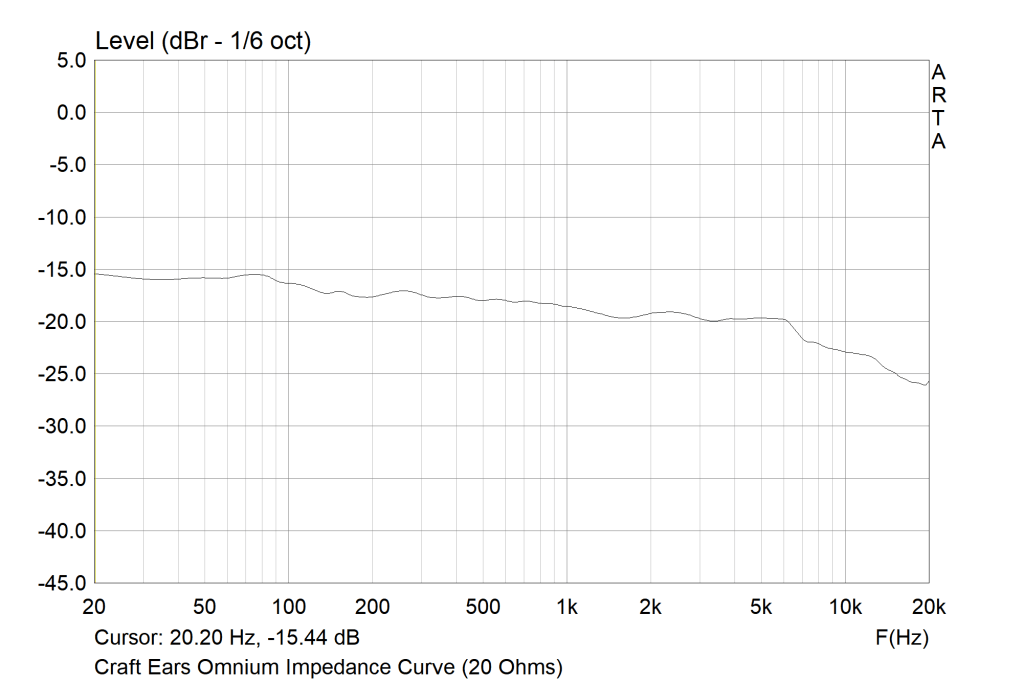
Craft Ears touts their True Load technology that promises a more consistent sound from sources of differing output impedance. I have found that their past models offer a stable frequency response, but the more complex Omnium does actually sound a little different when the output impedance is raised. Specifically, the entire frequency response becomes progressively darker resulting in a fuller and smoother sound. As a result, it is best to pair the omnium with a low output impedance source below 1.5 ohms to ensure you are getting Craft Ear’s intended frequency response. Otherwise, impedance adaptors or source matching can serve as a tool to tune the earphone to your liking. If you find them a bit bright out of the box, even a few ohms will produce a slightly darker sound.
Driving Power
Despite this, I found the Omnium to be efficient and otherwise very easy to drive. It sounded balanced and dynamic from my portable sources and was consistent between them so long as the output impedance wasn’t vastly different. Comparing the DITA Navigator to my desktop stack revealed minimal change to dynamics but a larger stage and greater sparkle on my THX amp. The Omnium isn’t especially sensitive to hiss either and overall is easy to drive without needing a dedicated amp. It does scale well in terms of resolution and soundstage from higher end sources so this is best if you want to get the most immersive listening experience possible out of them.
Suggested Pair Ups
The Omnium isn’t overly hiss sensitive but does benefit from a low output impedance from 0.1-1.5 Ohms. It doesn’t demand too much power and is notably more efficient than the EST-touting Aurum before it. If you prefer a smoother sound, this is easily achieved by increasing the output impedance either via a specific source pairing or impedance adaptors. I did personally prefer slightly smoother and fuller-sounding sources like the DITA Navigator. The Navigator has a low output impedance so pairings such as this offer a more fine grain level of sound adjustment than adjusting the output impedance. The Omnium has a very transparent sound which reflects the colour of the source clearly, so it is an IEM that benefits greatly from curated source pairings to personal preference.

Ryan Soo
Avid writer, passionate photographer and sleep-deprived medical student, Ryan has an ongoing desire to bring quality products to the regular reader.
 Everyday Listening