

Jomo Instinct Emerald Review – Force of Nature
Sound –
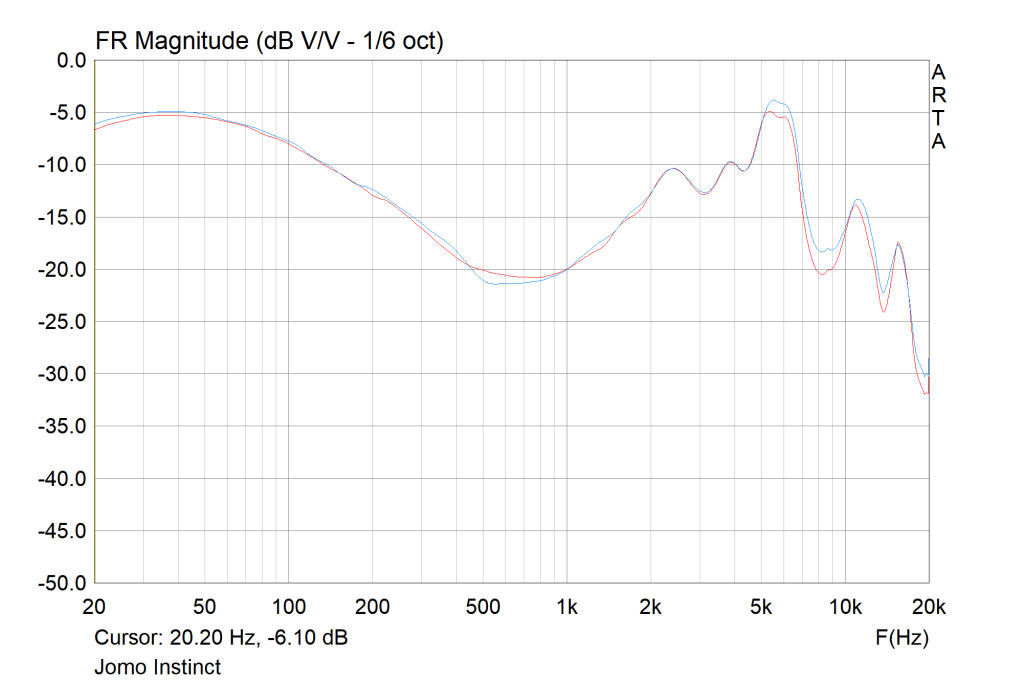
Testing Methodology: Measured using Arta via IEC 711 coupler to Startech external sound card. 7-9KHz peaks may be artifacts/emphasized due to my measurement setup which I found to be the case here. Measurements besides channel balance are volume-matched at 1KHz. Fit depth normalized to my best abilities to reduce coupler resonance. Still, due to these factors, my measurements may not accurately reflect the earphones or measurements taken by others.
Tonality –
I recall reading that the Alpha Ti offers a balanced sound profile, so I was surprised when listening to the Instinct that it had a notably V-shaped tuning. After discussion with Joseph, this was indeed his intention with the Instinct having a bigger bass and brighter top-end. It does remind me a little of MMR’s high-end designs, specifically the Thummim and Balmung which should come as no surprise given that Joseph spearheads both brands. This means you get a high contrast, warm-hued sound stemming from a powerful deep and mid-bass emphasis alongside a crisp, airy and well-extended treble. The midrange is laid-back compared to those models but avoids veil by pulling back the upper bass alongside a sharper climb to dual 3 and 4kHz prominence.
While the Instinct will never be labelled as anything but warm and full, it retains adequate cleanliness and clarity. The spacious soundstage, highly detailed top-end and warmer tonality make the Instinct a masterclass for jazz and acoustic tracks whilst retaining enough energy for alt-rock and pop. However, the copious bass can overwhelm during faster, more complex or already bassy tracks that suffer from the loss to separation. What Joseph has achieved here is a unique tonality that is still naturally voiced but has a rich, bigger-than-life character. The complex driver platform hasn’t been used as an instrument to maximize technical performance but rather to realize a unique tuning whilst minimizing loss to separation and detail retrieval.
Ear Tips
The Instinct comes with the Whirlwind tips from factory, and these are generally a good choice for this earphone. Specifically, they offer the most open soundscape and a slightly more vibrant top-end. However, those wanting a bit more balance and mid-presence can consider the Acoustune AET07 tips which will do just that if at the expense of a slightly more intimate soundstage. The Final E tips were too dense and warm, not a good pairing in my books. Meanwhile, JVC Spiral Dots and CP100 Spinfits are a nice complement too, resulting in a slightly smoother treble albeit with a laid-back midrange. I opted for the included whirlwind tips as they felt most faithful to Jomo’s vision.
A Note on Mods –
In addition to ear tip selection, those craving a more balanced sound may think about blocking off the top port near the 2-pin connectors. Blocking the rear-driver port results in a drop in low-frequency sensitivity, in this instance leading to reduced bass presence and an improvement in overall tonal balance. The downside is an increase in wearing pressure and a reduction in overall dynamics and pressurization – the dynamic drivers just don’t sound as clean and free-moving. The soundstage also becomes more intimate. As a result, this does not appear to be an effective method of tuning the IEM so digital eQ is a better avenue. Clearly, Jomo had a specific vision in mind and the meticulous acoustic design reflects that.
Bass –
The low-end is the most present frequency range on the Instinct and injects a rich, warm hue into the presentation. Extension is unsurprisingly excellent, delivering a tight, well-weighted sub-bass and excellent dynamics. Though not as highlighted as on something like Fir’s tactile bass IEMs, the sub-bass is tight and offers a highly defined slam and rumble. With that said, the focus centres more around the mid-bass meaning notes are big and weighted but also rounded and somewhat tubby. Despite a cut through the upper bass, the mid-bass emphasis results in a full and plump expression with just ample separation. Accordingly, don’t expect tonal cleanliness or balance here. Joseph’s use of two dynamic drivers serves to uphold pace and permit excellent control despite the large emphasis as opposed to maximizing dynamics and instrument separation.
Even in comparison to other high-end DD IEMs, the Instinct offers rapid decay and very high note definition that combats the separation loss due to the fuller tuning well. However, though fast and controlled, the dual woofers still can’t match the decay speed of a similarly bassy balanced-armature IEMs (think Balmung) and, in so doing, relinquish separation and some fine detail during complex passages by comparison. The timbre isn’t especially natural either due to the large shelf and dip. However, this response is well suited towards older albums that are enriched by a lovely warmth and the copious and natural textures on display. The Instinct is ultimately very technically adept but highly coloured. Its rich bass response is best suited towards slower-paced genres of music but can be enjoyed universally by those wanting dollops of high-quality bass with a warm tonality due to its excellent note definition.
Mids –
Though the high-end market has moved towards more balanced approaches to tuning, the Instinct instead goes for a clearly V-shaped sound with a notably pulled-back midrange. Despite this, the midrange retains clarity and openness through reduction of upper bass warmth and by increasing 4kHz presence in equal measure to the usual 3kHz emphasis. The high contrast sound means you still get a clearly warm and full midrange due to the colouration from the low-end but a more revealing upper half due to the upper-mid gain and articulate lower treble. The Instinct isn’t an energetic V-shaped IEM like the recently reviewed Fir E12 but upholds commendable clarity and definition considering its warmth. It embraces its coloured tone to deliver a syrupy, full, and coherent midrange albeit at the expense of reducing separation and intricate layering. Male vocals sound husky and present whilst female vocals sound organic but warmed in lesser proportion.
The headliner here is surely the sense of space on display as the Instinct portrays top-level width and depth. While its similarly voluminous notes fill its large stage resulting in limited separation and some loss of fine detail, the Instinct crafts a nicely layered presentation with a defined and highly delineated foreground and background – if lacking the complexity of some competitors in between. This is in opposition to many width-biased IEMs, as the Instinct achieves a more multi-dimensional character as a result of pulling its vocals to achieve a more evenly proportioned stage. Otherwise, the voicing is natural even coming from far more neutrally tuned IEMs. The Instinct’s midrange notes aren’t veiled nor diminished but appropriately sized according to its laid-back positioning. Jomo has masterfully balanced fullness and clarity to permit a midrange that is warm but still free of veil, clear and detailed. The specialty is surely the sense of space, richness and texture that are all uniquely highlighted to the listener.
Highs –
The top end appears quite present on measurement but doesn’t steal the show in listening. Rather, it sits clearly behind the bass and just in front of the midrange. In turn, the Instinct doesn’t overwhelm with energy and brightness giving it an overall more laid-back and relaxed character. This impression is reinforced by the dark and immaculately clean background whilst articulation and detail presence are upheld with a clear foreground detail presentation. There’s a balanced lower-treble presence achieved through 5-6kHz emphasis before a mid-treble dip that snuffs out any chance of sibilance, glare, or fatigue. Above, emphasis climbs a little in the upper treble, aiding headroom, sparkle, and micro-detail presence. The excellent treble extension aids spaciousness and ensures that, despite the dark background, details are still abundant. So, beyond the tuning, the technical performance really brings the sound together.
The complex driver system isn’t just for show and the PZT tweeter adds a very pleasing speed and definition to the leading edge of notes. It also showcases a much more ear-pleasing timbre than previous implementations that could sound somewhat thin and plastic due to their narrow-band nature. I suspect Joseph may be using some clever augmentation here using the BA drivers as well, and I was very impressed by the level of texture and body that bests most BA monitors I’ve tested. The Instinct boasts top-level definition, fine detail retrieval and separation in the foreground but also a pleasant note body and decay thereafter. Shimmer tends to sound a little dampened due to the darker mid-treble tuning and some small background details are not as prevalent as on brighter monitors. However, air and sparkle are clearly portrayed without overly affecting note timbre or introducing any semblance of fatigue due to the excellent extension. This isn’t a bright monitor but a highly detailed one featuring top-level foreground note definition set to a clean background and smooth, linearly extending top octave.
Soundstage –
Joseph’s IEMs always deliver a solid soundstage performance, and the Instinct is no different. I briefly delved into depth in the midrange section, and this is surely one of the most notable aspects of the staging. Not only does the Instinct stretch wide, but it also projects well too, granting a well-rounded and proportioned stage. This gives the imaging a very multidimensional feel and aids distance portrayal. Imaging is also quite a strong performer. The background is dark and distant while the foreground is nicely defined. Layers are well delineated and defined which keeps the stage organized.
Directional cues are sharp as treble is defined and swift, but it lacks brightness to achieve holography. One of the weakest aspects of this earphone is separation, especially evident in the bass and midrange. There is barely any space left for room and ether around each note due to their size. As a result, complex and fast-paced tracks can sound a bit busy and individual layers aren’t as delineated as on more neutral IEMs. However, the resolving power and note definition means the Instinct still performs decently in this category where a lesser IEM may have succumbed to congestion.
Drivability –
The Instinct has a 9 Ohm impedance and unspecified sensitivity though during testing I found it to be above average in terms of efficiency but not overly sensitive overall.
Output Impedance Sensitivity
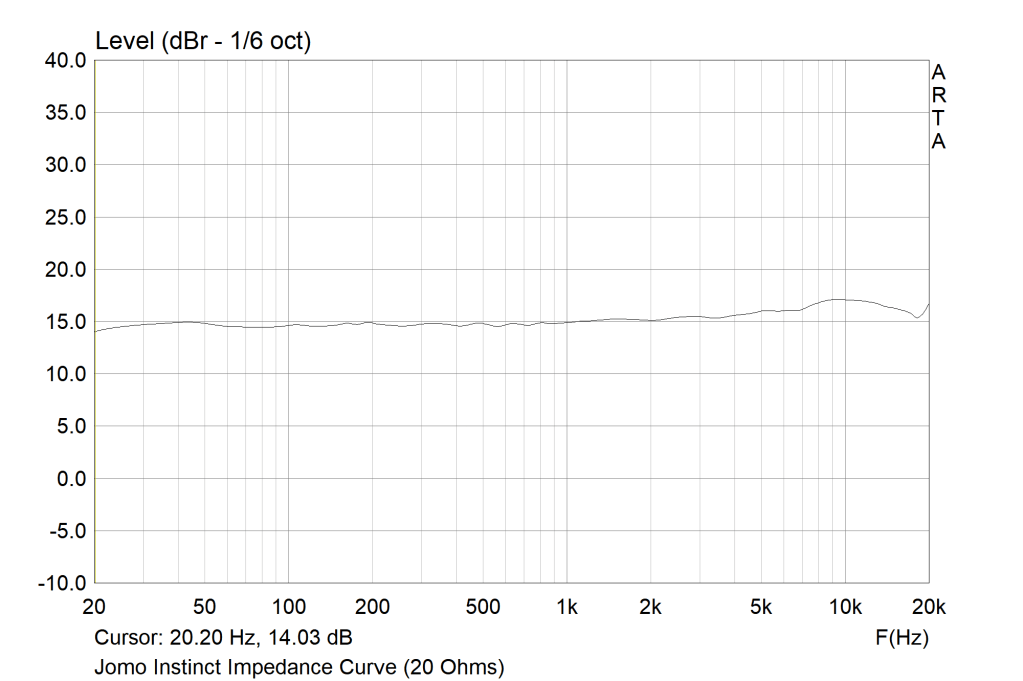
Despite its extensive driver setup, the Instinct showcases a mostly flat impedance curve tested at up to 20 Ohms. This means it will have a consistent sound profile so long as the source has a linear output itself. Subjective testing with in-line impedance adaptors showcased similar findings. The Instinct’s sound signature didn’t vary much when increasing the effective output impedance meaning it can be enjoyed from a variety of modern sources.
Driving Power
The Instinct is an efficient earphone that doesn’t require a heap of voltage to achieve high listening volumes. It also isn’t too sensitive to hiss either so noise floor isn’t a huge concern as on some high-end multi-driver IEMs. The driver setup is, however, somewhat resource-intense as far as current output is concerned. The most notable differences were the bass and treble. Comparing between the DITA Navigator and my desktop THX AMP revealed a more controlled bass on the desktop amp and a larger stage with a more defined treble. The portable source sounded noticeably bassier but lacked the same mid-bass control and had a smoother top-end. As a result, dedicated amplification or a beefier source is recommended to extract the maximum technical performance and tonal balance from the Instinct.
Suggested Pair Ups
The Instinct benefits from powerful and transparent sources such as THX and NFCA devices. I did not enjoy sources that introduced additional warmth as the Instinct requires sources that enhance definition and separation. The output impedance is not vital as the earphones showcase a stable profile but they do benefit from greater driving power. Similarly, hiss is not a huge concern. Overall, a neutral or brighter source with good driving power presents the best pairing with the Instinct.

Ryan Soo
Avid writer, passionate photographer and sleep-deprived medical student, Ryan has an ongoing desire to bring quality products to the regular reader.
 Everyday Listening