

Campfire Audio Fathom Review – Cleanliness Is Next To Godliness
Sound –
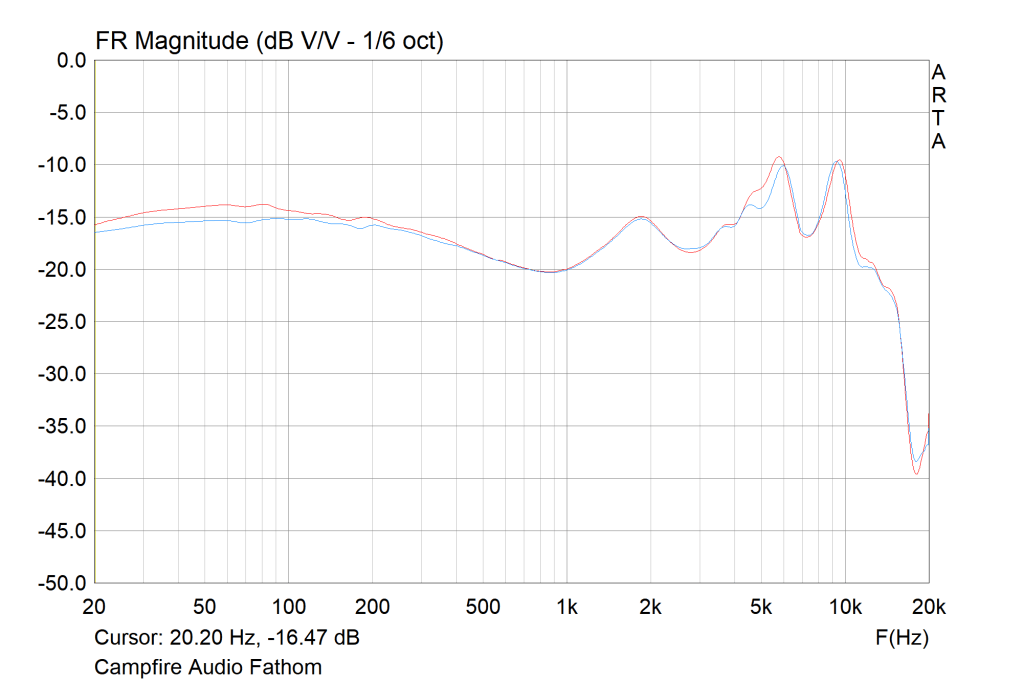
Testing Methodology: Measured using Arta via IEC 711 coupler to Startech external sound card. 7-9KHz peaks may be artifacts/emphasized due to my measurement setup which I found to be the case here. Measurements besides channel balance are volume-matched at 1KHz. Fit depth normalized to my best abilities to reduce coupler resonance. Still, due to these factors, my measurements may not accurately reflect the earphones or measurements taken by others.
Tonality –
Those disappointed by the larger tonal changes made by the Emerald Sea will find the Fathom an alluring package that is very reminiscent of the original Andromedas in terms of its overall character. This is a warm yet articulate IEM offering a pleasing combo of richness and clarity that proved to be a popular formula for its forebearers. As compared to the 2020 Andromeda, the two measure identically up to 2kHz above which the Fathom introduces a slightly smoother upper-midrange and a more articulate lower treble in its stead. It dials back the mid-treble to bring the two treble emphases on par and upper treble extension is slightly improved. Altogether, this gives the Fathom a slightly cleaner midrange, a notably darker background, and a more authentic treble note timbre than the highly energetic Andro. It represents a small technical bump across the range in addition to the reworked tuning but will be very familiar for those coming from the Andromeda range.
Bass –
I lauded the Emerald Sea for its powerful and deep-reaching bass performance and the Fathom continues this legacy. However, it does so with a more balanced tuning similar to the 2020 Andromeda. In turn, bass doesn’t colour the sound as overtly and the note timbre is more natural. There’s a moderate mid-bass rise that continues through the upper bass, producing a mild warm tone. However, overall bass avoids bloat well. The Fathom unsurprisingly sounds a lot like the Andromeda here meaning you get just a hint of tubbiness in the upper bass but otherwise, a nice, musical performance with enough bass to satisfy every genre but not too much that it interferes with the midrange. The chief difference between the two is bass extension with the Fathom offering noticeably more depth and weight at the very bottom.
It’s not a huge difference that vastly affects the note timbre nor would the Fathom be mistaken for a dynamic driver. However, there is now a palpable slam here that is a nice step up from the lighter-footed Andromeda and more in line with the Emerald Sea. Above, the mid-bass is very quickly decaying and controlled, showcasing a nice balance between fullness and separation. This extra mid-bass gives the Fathom a bit more texture than your typical BA IEMs while the decay speed retains excellent note definition and fine detail retrieval. The Fathom represents a nice step up from the Andromeda, retaining a familiar tonality with improved dynamics and just a hint more structure behind its notes.
Mids –
Despite the reasonable amount of change in measurement, the Fathom once again greatly resembles the Andromeda in its overall voicing and colouration. That means you get a medium warm voicing and full-bodied voicing balanced out by a clear and articulate top-end. Overall, this provides a higher contrast sound that is clear and engaging but still relatively coherent and consistent in its voicing. The Fathom introduces a slightly larger dip around 3kHz but a similar 4kHz presence in addition to a more present lower treble. This is an interesting change and I found that track to track, the Fathom could either sound slightly cleaner and more defined than the Andromeda or slightly smaller and more laid-back. Regardless, it is still a warm and full-sounding IEM, and the actual voicing is very similar.
The Fathom has more top-end clarity giving it a generally more open, extended voicing with a bit more delicacy to its female vocals especially. Vocals are a touch more neutrally sized than on the Andromeda but are positioned similarly and instruments sound very equivalent between the two as well. The Fathom sounds a touch more natural to my ears with the Andromeda sounding slightly fuller and roomier, the Fathom being slightly more transparent and liquid. The Fathom also has a noticeably darker and cleaner background which gives it a better staging and layering performance alongside a stronger center image. Despite the jump to dual midrange drivers as opposed to the single driver on the Andromeda, the two are far more alike than different and the detail performance is very similar.
Highs –
Once again, Campfire Audio delivers a crisp and detailed earphone with generous sparkle and headroom. Despite the more even upper-midrange and lower-treble tuning on the Andromeda, I actually found its larger, more isolated 9-10kHz peak gives it a more pronounced treble than the Fathom. By comparison, the Fathom sounds more focused and has a more natural note timbre. Its treble doesn’t stand out as significantly in its sound whilst retaining strong clarity and separation. This is the largest differentiator between the two as the Andromeda boasts higher note clarity and sounds more energetic overall. However, its notes are also noticeably thinner and wispier if set to greater air and vibrance.
The Fathom is more natural and balanced. It has a more defined leading edge giving it a more focused foreground detail presentation. In turn, its notes are more textured and its note body is more accurate if still on the thinner side. While it has less air and shimmer it also has less grain with a much smoother, cleaner background that benefits its layering performance. Both sound sparkly and have copious micro-detail but the Andromeda highlights this more due to its brighter tuning. Where the Andromeda brings background details more to the fore, the Fathom better balances foreground and background detail, sounding more authentic as a result. It shares a very fast transient response applied to a more natural if still energetic and crisp tuning.
Soundstage –
A hallmark of Campfire Audio’s IEMs is their impressive staging, and the Fathom shares this trait. In fact, its darker background gives it a slightly improved sense of space both with regards to width and depth albeit not by a huge degree. The main difference between the Fathom and Andromeda is the style of imaging. The Andromeda sounds holographic, bright, and detail-forward giving it a more upfront image. The Fathom has better contrast and more delineated layers. It sounds more organized overall and conveys distance more accurately. However, it is also less holographic due to the reduction in brightness. The Fathom, as a result, boasts superior separation. This is especially so on busy, treble-heavy tracks where the Andromeda could sound a bit busy. The Fathom showcases better balance and better foreground/background separation that helps the listener pick out and appreciate the finer details.
Drivability –
The Fathom sports a very low 9-ohm impedance and is very sensitive similar to preceding CFA IEMs. It represents the older Andromeda models more in this respect, making it more sensitive and also more hiss-prone than both the Emerald Sea and the 2020 Andro revision.
Output Impedance Sensitivity
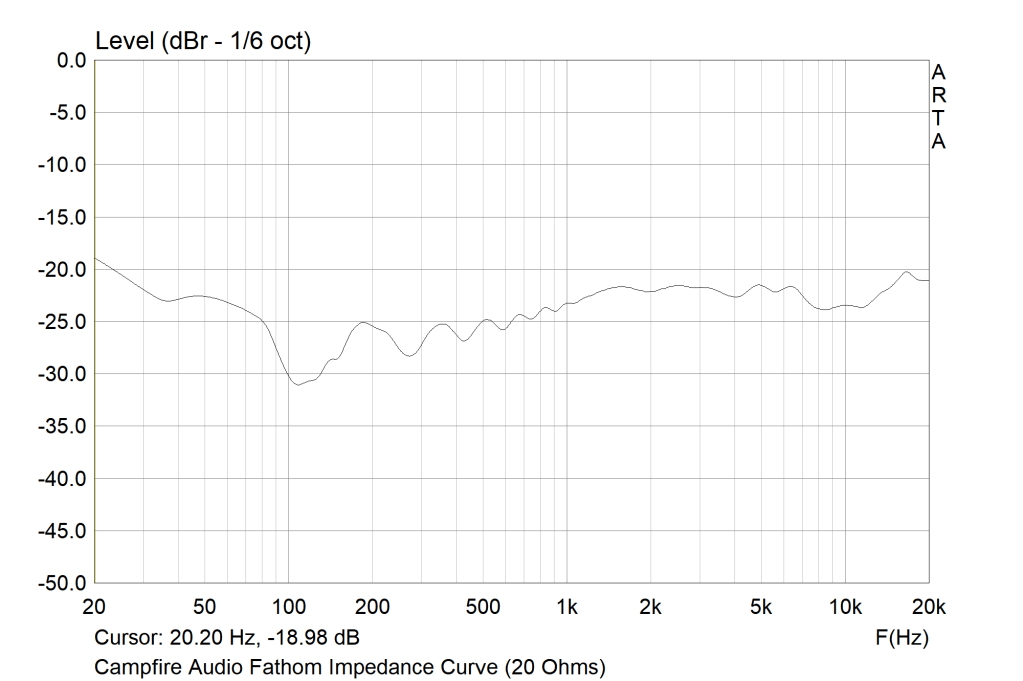
Campfire Audio has notoriously struggled with this, but recent models have stabilized the impedance curve somewhat. The Fathom continues this trend though it does experience a loss in bass presence resulting in a thinner overall sound. As a result, it is best to pair the Fathom with a 1-ohm or sub-1-ohm source to get the most balanced sound possible.
Driving Power
The Fathom is very efficient and sensitive and can therefore achieve very high listening volumes even from portable sources. So long as the output impedance and noise floor are both low, the Fathom is easily driven and achieves a balanced sound. Comparing the DITA Navigator to my Desktop THX stack, I did note that the Fathom scales nicely in terms of soundstage size and detail, but its dynamics and tonal balance were consistent between sources. Unfortunately, it did pick up hiss on both sources if a relatively small amount. An in-line device such as the iFi iEMatch can provide a solution to both hiss and OI problems.
Suggested Pair Ups
Output impedance and noise floor are the most pivotal concerns here with regard to source pairings as the Fathom is very efficient and doesn’t require much driving power. Besides this, it is forgiving on source colouration and can be paired with both bright, lean sources and warmer ones. I preferred neutral and dynamic sources as I found smoother sources could sound a bit mellow in the midrange. However, this is just my preference and it is overall more important to nail the noise floor and OI first before considering source colouration.

Ryan Soo
Avid writer, passionate photographer and sleep-deprived medical student, Ryan has an ongoing desire to bring quality products to the regular reader.
 Everyday Listening
Hi,
Nice review. How does the Fathom compare to the Ara?
Thanks.
Ben
LikeLike
I have the same question as Ben above, as the Fathom seems to be a successor to the Ara. Although I don’t understand why the price is lower than Andromeda ES, while Fathom has 1 more driver?
My guess is that CA used old drivers instead of new ones for this Fathom.
LikeLike
Hey there,
The Fathom is not intended as an Ara successor but replaces the 2020 Andromeda – with the Emerald Sea offering a different sound signature.
The drivers have been updated. There are now two dual-diaphram Knowles woofers, dual Sonions mid drivers and dual Knowles tweeters.
The dual diaphragm Knowles drivers were only released by Knowles in 2023 and offer superior performance to previous BA-based CFA IEMs from my experience.
Best,
Ryan
LikeLike
Hey Ben,
Glad you enjoyed the read!
As compared to the Ara, the Fathom is warmer and fuller, subjectively a bit more balanced. The Ara is brighter but more tonally transparent as it’s bass tuning is flatter, the Fathom having more warmth and fullness that also colours it’s midrange.
Despite this, the Fathom has a more dynamic bass and it also has a cleaner background. The Ara is airier and brighter with higher clarity and separation. The Fathom has a deeper stage while the Ara is wider. The Fathom is more forgiving and the Ara is more revealing in summary.
Of note, the Fathom is also notably easier to drive as the physical crossover on the Ara makes it especially sensitivity to output impedance. This gives it an inconsistent character between sources and is primarily why some call is lean and some are more than satisfied with the bass presence.
Best,
Ryan.
LikeLike