

Oriveti bleqk Dynabird Review – Underachiever
Sound –
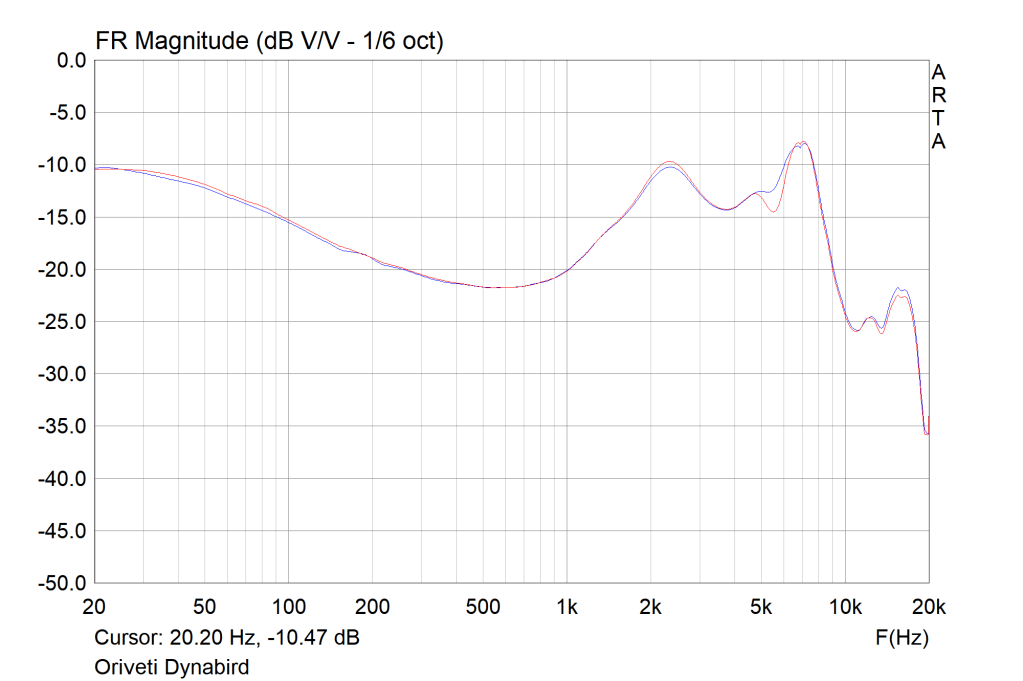
Testing Methodology: Measured using Arta via IEC 711 coupler to Startech external sound card. 7-9KHz peaks may be artefacts/emphasised due to my measurement setup which I found to be the case here. Measurements besides channel balance are volume-matched at 1KHz. Fit depth normalised to my best abilities to reduce coupler resonance. Still, due to these factors, my measurements may not accurately reflect the earphone or measurements taken by others. I have the Dynabird 100 hours of burn-in prior to evaluation.
Tonality –
Oriveti promises a dynamic and powerful sound and this is what the Dynabird delivers in most respects. It is a V-shaped monitor that pairs a powerful sub-bass-focused low-end with a scooped lower midrange and clear, moderately present midrange. The treble is crisp with good clarity and air but overall, the earphones leave to be desired from a technical performance perspective. With that said, this isn’t uncommon in the budget price range. This ultimately means that though the Dynabird offers a bit more dynamic range than the OD100, it is more of a technical sidegrade despite a moderate increase in asking price.
Bass –
Responsible for the first half of its name, the low end is defined by a sub-bass focus preceding progressive fall off into a recessed lower midrange. This gives the earphones a powerful, weighted low-end albeit at some expense to mid-bass texture and richness. It’s a moderately bassy earphone, laying the foundation for its engaging character, but also has some solid definition and control backing up that impression too. The uneven bass tuning won’t suit those wanting accuracy and sub-bass can sound just a little boomy due to its sheer emphasis on already bassy tracks. However, the earphones never overwhelm with dynamics.

Perhaps some may be disappointed that the sub-bass boost is more audible than visceral as slam and pressure are more modest in listening than measurements may suggest. Notes showcase respectable detail retrieval but lack some texture when compared to more linearly tuned in-ears. The driver isn’t the most aggressive out there, meaning note attack isn’t especially well defined but decay is well paced and separation is quite good considering the level of presence. It has good control enabling the earphones to rein in the larger sub-bass and prevent muddiness. Don’t expect the most assertive impact but, for a cheaper earphone, the Dynabird successfully delivers a powerful and deep-reaching bass. It does so with plenty of definition to achieve a satisfying listening experience.
Mids –
The midrange is slightly laid-back and diminished especially in direct comparison to the bass. As the treble tuning is quite even, density and articulation sound appropriate and avoid overly colouring the voicing. The main issue is the lack of lower midrange body which produces a small vocal size and a lack of warmth. This results in a lean and cool voicing. Male vocals especially can sound strained and slightly nasal at times, exacerbated also by the lower 2.5kHz peak which reduces extension.
Accordingly, though definition is respectable, clarity is just average. While this does help to avoid intensity and fatigue, vocals are only acceptable in terms of voicing and offer class-average resolving power. The Dynabird’s midrange doesn’t do much to differentiate it from the pack. They perform at an ample level in all aspects with no overt faults but no standout qualities either. Unfortunately, the modern market has become increasingly competitive and many similarly affordable earphones offer noticeably better midrange tuning and resolving power.
Highs –
Overall treble tuning is quite agreeable with an even shelf through the upper-midrange and lower-treble set to a modest 7kHz peak. This is a sort of middle-of-the-road emphasis that provides enhanced note clarity and air but not too much brightness. The foundation in the lower treble means you get a decent bite and crispness in the foreground and notes aren’t overly thinned out. In fact, texturing is quite good overall and one of the better performers I’ve heard in class.

While the Dynabird has solid clarity and foreground detail retrieval, it once again is just mediocre when it comes to background detail and overall resolving power. It lacks extension above that 7kHz peak which robs soundstage dimension and openness from the sound. There’s a decent amount of air but not much space and atmosphere nor the cleanest background due to the higher emphasis. This makes the Dynabird a crisp, energetic earphone but also a relatively superficial listening experience that lacks nuance and layering.
Soundstage –
As a flow-on effect from the top-end performance, the Dynabird offers an intimate soundstage that is contained within the head. It is, nonetheless, well proportioned, balancing width and depth well. Imaging is accurate and sharp but one-dimensional. I was disappointed by the layering performance as you don’t get a nice defined sense of layering nor much dimension, but stereo cues are defined and clear. Separation is nothing to write home about either.
Drivability –
With a 16Ohm impedance and a 105dB sensitivity, the Dynabird is efficient and easy to drive. Source pairing is a breeze due to the stable single dynamic driver setup.
Output Impedance Sensitivity
With a single driver design, one would expect a flat impedance curve and this is what is delivered. The Dynabird has an effectively flat impedance curve when measured from a 20 Ohm source indicating the sound will be consistent from high impedance sources. This is of course, given that the source output itself is linear.
Driving Power
Comparing my desktop stack to DITA’s Navigator revealed minimal differences in terms of dynamics and driver control. The Dynabird is easy to drive and most portable sources including dongles and entry-level DAPs will extract the potential from these drivers. Though efficient and able to achieve high listening volumes from portable sources, the Dynabird isn’t excessively sensitive to hiss either.
Suggested Pair Ups
The Dynabird suits warmer sources which help to balance out its mid-bass and bolster the midrange. The treble is quite innocuous, so brighter sources don’t push the earphone remotely close to fatiguing levels. Driving power and output impedance aren’t much of a concern meaning users shouldn’t feel that they are missing out by not investing more into a higher-end source.

Ryan Soo
Avid writer, passionate photographer and sleep-deprived medical student, Ryan has an ongoing desire to bring quality products to the regular reader.
 Everyday Listening