

Campfire Audio Astrolith Review – Putting the Awe in Awesome
Pros –
Hugely satisfying bass depth and definition, Highly detailed top-end, Spacious and holographic soundstaging, Comfortable and highly isolating design, Excellent accessory set, Dead flat impedance curve
Cons –
Some sibilance on occasion, Lower treble could offer higher definition, Needs proper amping
Verdict –
The Astrolith isn’t perfectly versatile, offering nothing but a fun, engaging listen with technical ability on the highest level.
About Campfire Audio –
Campfire Audio is a boutique audio company from Portland, Oregon that started life as ALO Audio in 2015. Their team consists of audio engineers, designers, and craftspeople giving them a well-rounded skill mix. At the time, the chief focus was on AMPs and cables but this soon grew to include IEMs as well where the name Campfire Audio was born. Campfire Audio partners with local companies and have expended efforts to improve the sustainability of their products. With a focus on acoustics, materials, and meticulous attention to fine-tuning, the company aims to deliver artisan earphones catering to all tastes and preferences.
Introduction –
Campfire Audio have tried their hand at a few planar magnetic designs and the driver type in general has become immensely popular in the modern IEM market. This is for very good reason, as planar drivers offer very favourable mechanical properties which explains their dominance amongst over-ear headphone designs. The Astrolith is CFA’s latest and greatest, representing the company’s first truly TOTL planar-based IEM. It implements not one but two planar magnetic drivers representing a first for the in-ear platform. Both drivers have been custom designed in-house over a painstaking 8-month long period and so too have the surrounding acoustics been optimized to draw the best properties of these drivers out. All the while, the company maintains the legendary build quality and aesthetic design they have become renowned for.
The Astrolith is available for $2199 at the time of writing. You can read more about it and secure one for yourself at Campfire Audio!
Disclaimer –
I would like to thank Chris very much for reaching out to organise a review of the new Astrolith. All words are my own and there is no monetary incentive for a positive review. Despite receiving the earphones free of cost, I will attempt to be as objective as possible in my evaluation.
Contents –
- Page 1: Intro, Unboxing, Design
- Page 2: Sound and Source Pairings
- Page 3: Comparisons & Verdict
Specs –
- Drivers: 14.2mm customized planar, 6mm customized planar
- Crossover: Mechanical, ultra-flat impedance
- Frequency Response: 5 Hz – 25kHz
- THD: Less than .3%
- Impedance: 8.2Ω
- Sensitivity: 94 dB
Behind the Design –
Dual Planar Driver Setup
The goal when creating the Astrolith was to deliver an ultra-fast, technical and impressive sound. To that end, the company has chosen in-house ground-up designed planar magnetic drivers that offer many inherent advantages over the more conventional BA/DD drivers seen in most IEMs. Planar drivers exert uniform motor force over the diaphragm, reducing distortion. Due to this, diaphragm rigidity also becomes less important, so a lighter material can be used, resulting in superior responsiveness. Campfire Audio sent a press article out prior to the official release detailing how proud they are of the driver speed and impulse response. In addition, THD is incredibly low, and the impedance curve is dead flat despite the multi-driver design.
Wavefront + Particle Phase Resonator
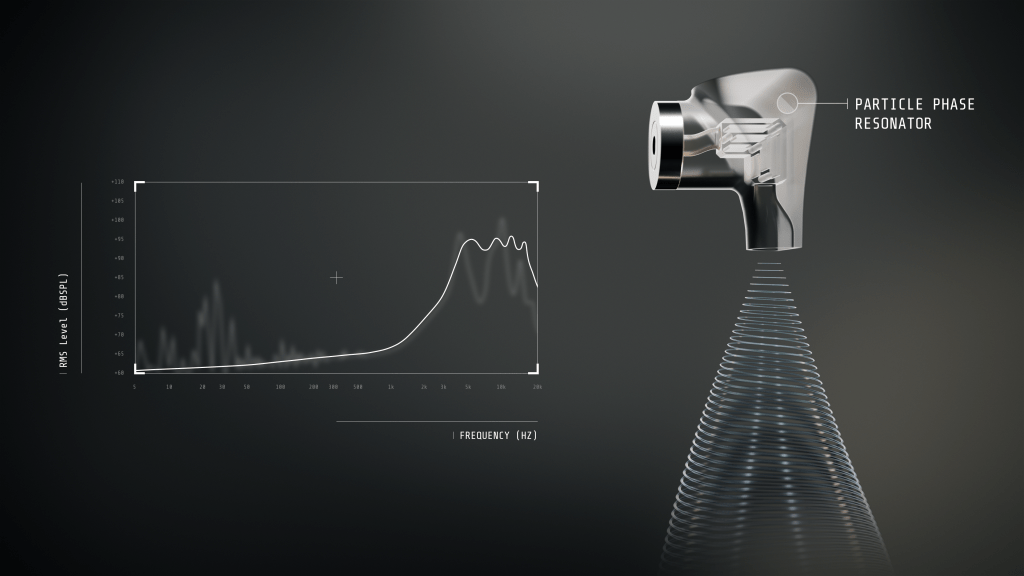
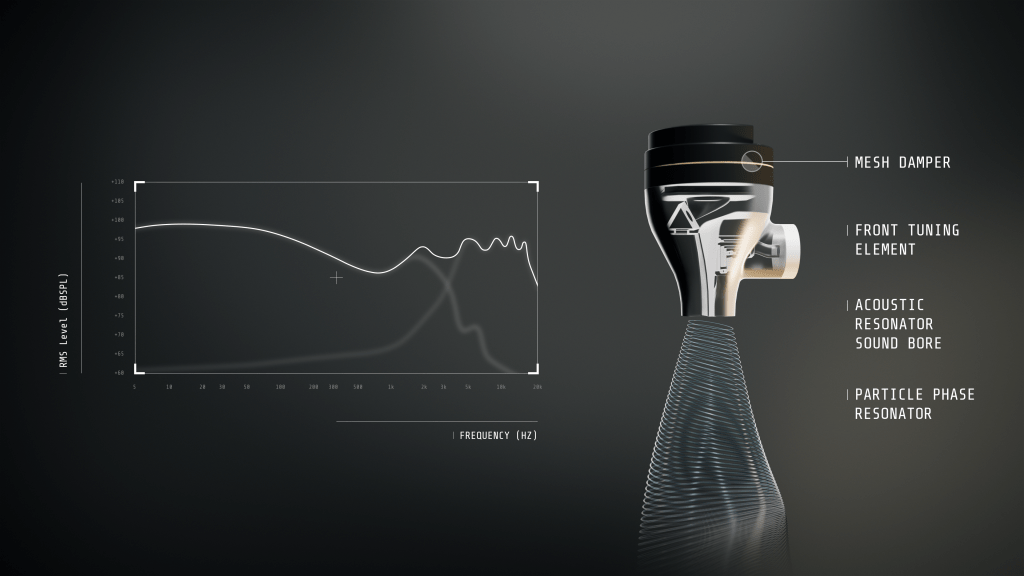
With an increased driver count comes increased complexity. The planar drivers in the Astrolith propagate a flat wavefront. This is said to improve the acoustic interaction of the sound output with the anatomy of the ear. CFA has paired the drivers with PPR which is an acoustic structure that enables the IEM to achieve phase coherence, thereby producing the lowest possible distortion alongside the best high-frequency reproduction possible. As this is a physical structure, the Astrolith is actually a crossover-less design like the Ara. PPR extends to dual chambers in front of and behind the 14.2mm woofer.
Stainless Steel Shells
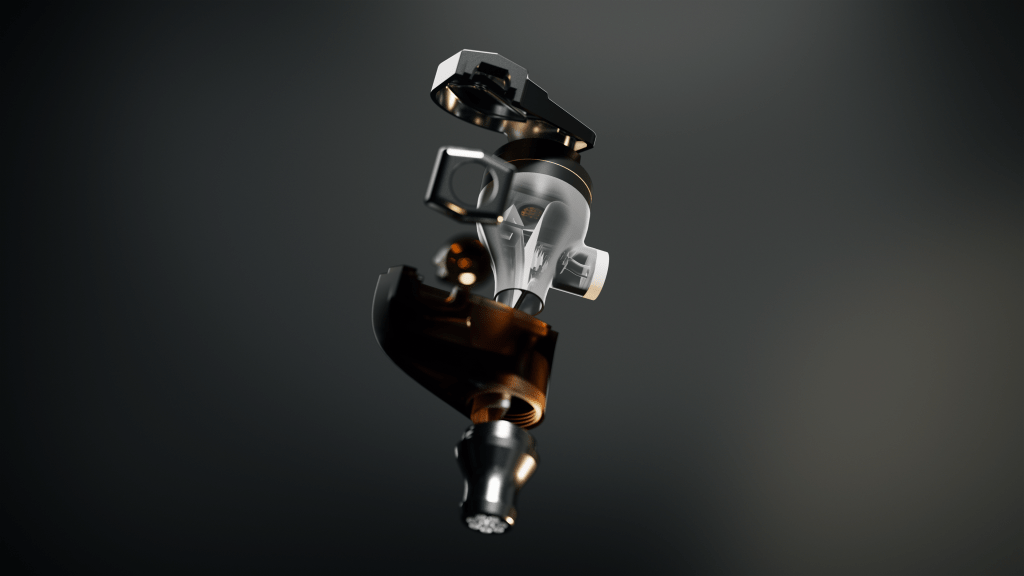
Of course, it wouldn’t be a Campfire Audio without mention of premium build quality and design. The Astrolith uses AAOI standing for additive acoustic optical inclusion. What this translates to is a solid body housing design with in-built acoustic geometries throughout and a transparent exterior that provides a window into its intricacies. This is paired with billet stainless steel faceplates that complete the look with a hand polished chrome finish.
Unboxing –
Campfire Audio sticks with a similar unboxing and accessory set as seen on their latest generation of releases. That means you get a rectangular folding box with vibrant space-themed art and a wealth of premium goodies inside. Making a return is a magnetic leather case which contains the earphones connected to a 3.5mm terminated Timestream cable. The case has an authentic leather aroma and grain with soft suede interior.
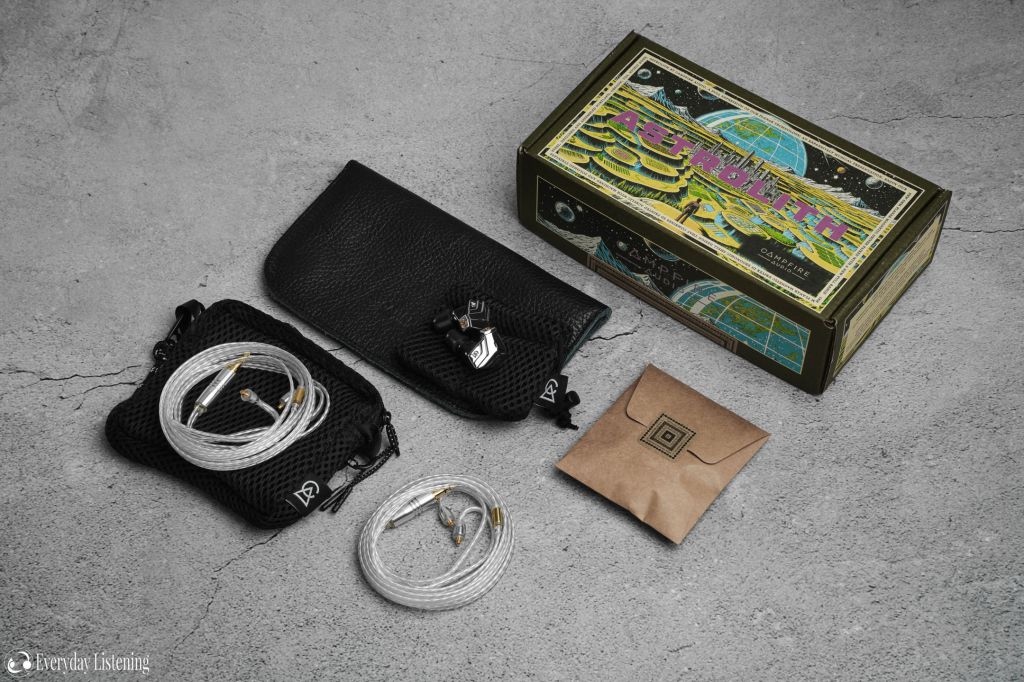
The Astrolith also comes with the Breezy Bag carrying case, which is a padded mesh zipper bag with elastic neck/shoulder strap for easy transport. Within is a second Timestream cable terminated with a 4.4mm balanced connector. Also included is a Breezy Bag Micro which is the signature two pocket bag seen on past models. It doesn’t accommodate the cable but houses each earpiece individually to prevent them from scratching each other.
Of note, though the photographed mesh bags are black, retail units will come with a bronze colour instead. Campfire Audio provides 3 pairs of eartips in both silicone and memory foam. A cleaning tool and CFA pin are nice additions, rounding off a premium and charming package.
Design –
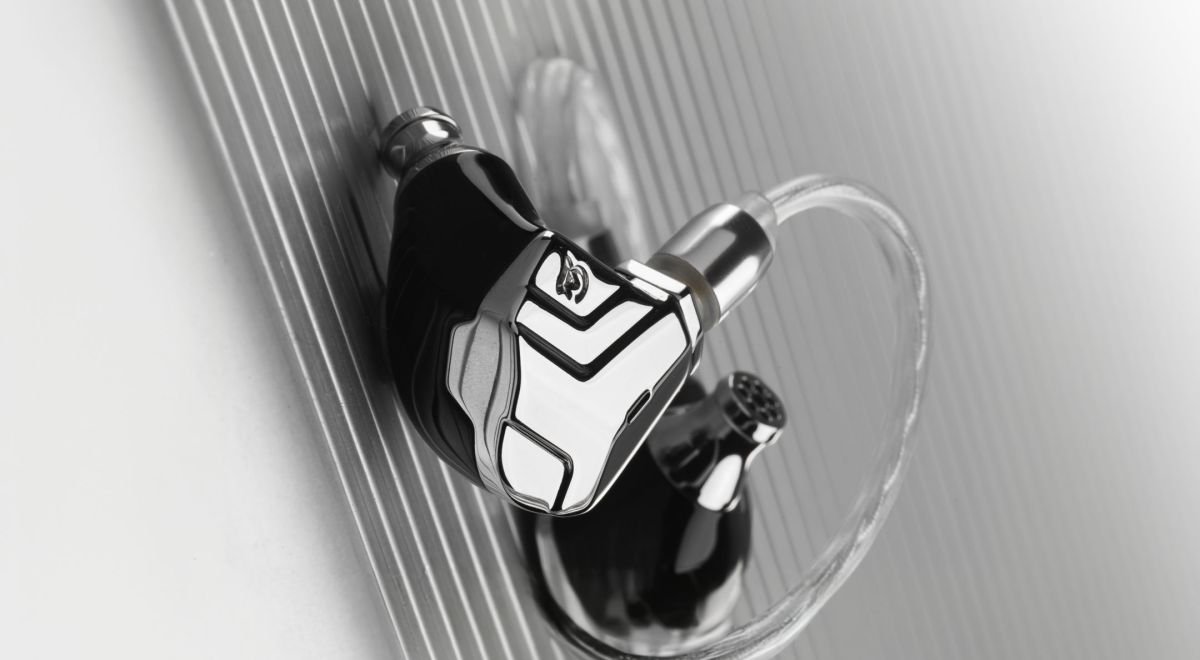
When I received a personal email from Ken Ball himself, I knew the Astrolith was going to be something special. This is immediately embodied by the new housing design that most resembles a beefed-up incarnation of their Chromatic series housings. In pursuing a more sophisticated internal design, CFA has employed a solid-body resin shell in a handsome smoke colourway. This enables the earphone to be more ergonomic and smoothly formed. It also boasts a semi-transparent design, showcasing the acoustic wizardry inside when viewed under focused lighting. The stainless-steel ridged faceplates and nozzle sandwich the resin shell, resulting in a design that is equal parts modern and muscular. All are united by impeccable tolerances with miniscule, even seams and metal components reinforcing all stress points.
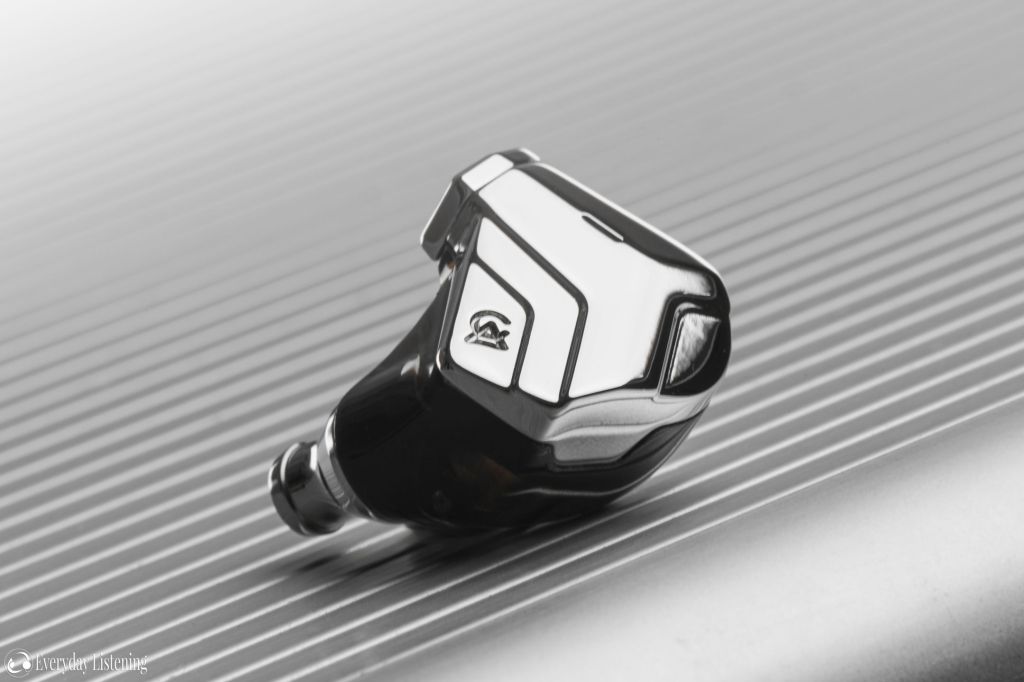
We also see the return of the company’s signature Beryllium MMCX connector system. All IEM’s I’ve tested using these connectors have really stood the test of time – even my 7-year-old Jupiter unit is still providing reliable crackle-free audio. They have impressively even tension and a very affirmative connection. The Timestream cables make a return and once again, I have mixed feelings. At its heart are 8 silver-plated copper conductors laminated in a soft TPU jacket. Microphonic noise transmission is low and the pre-moulded ear guides have perfect shaping. However, the flat design does mean care must be taken when coiling to avoid twists and tangles. I also worry about the cables separating in the centre beneath the y-split. Besides this, the Astrolith is a very charismatic IEM that is easy to live with and certainly has a lot of presence.
Fit & Isolation –
As opposed to their metal shells, the Astrolith is smoothly formed and completely lacks hard edges on its internal face. This gives it excellent ergonomics alongside its more squarish proportions which avoids placing pressure on any one area of the ear. It is a slightly larger shell but will fit anyone with average or larger-sized ears without issue. Those with smaller ears may want to look elsewhere as the Astrolith has definitely been designed with a deeper fit depth in mind.
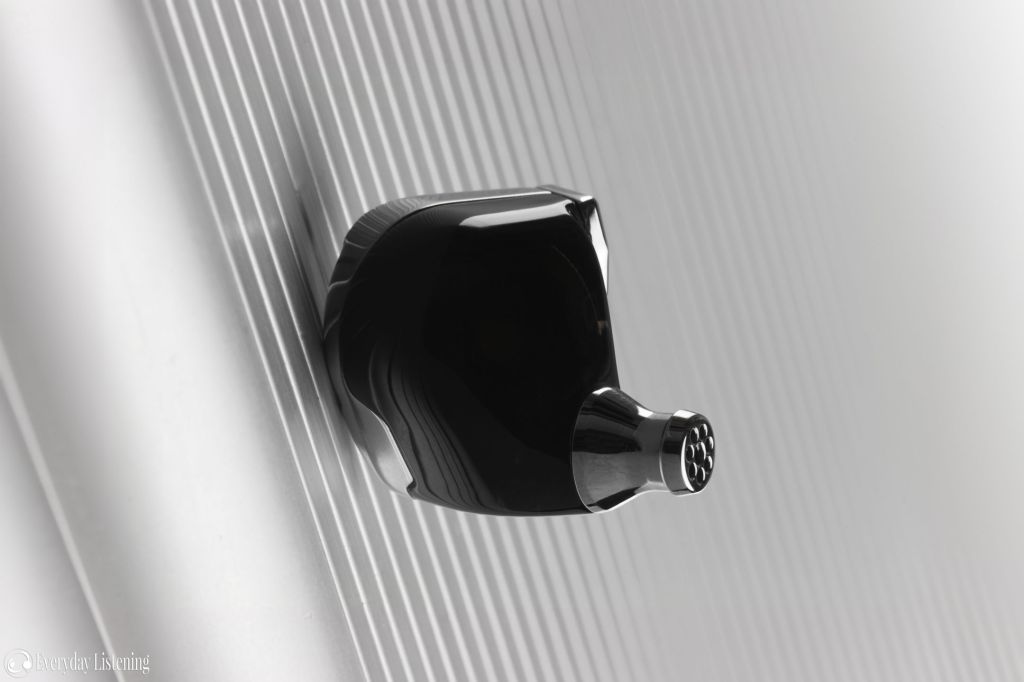
If achieved, they provide a low-profile fit on account of their slim and well-angled nozzles. As a result, wind noise isn’t too much of an issue when wearing outdoors and stability is excellent. Some may find them comfortable to sleep on. There’s just a hint of driver flex but I’ve experienced no issues throughout my years reviewing because of this. Despite some venting being apparent on the faceplates, passive noise isolation is excellent. These are up there with the best, especially with memory foam ear tips.

Ryan Soo
Avid writer, passionate photographer and sleep-deprived medical student, Ryan has an ongoing desire to bring quality products to the regular reader.
 Everyday Listening
hi how you compare with bonneville?:)
LikeLike
Hey there,
I don’t have experience with the Bonnieville for comparison sorry. Guy has written a good comparison over at THL 🙂
Warm regards,
Ryan.
LikeLike