

Campfire Audio Astrolith Review – Putting the Awe in Awesome
Sound –
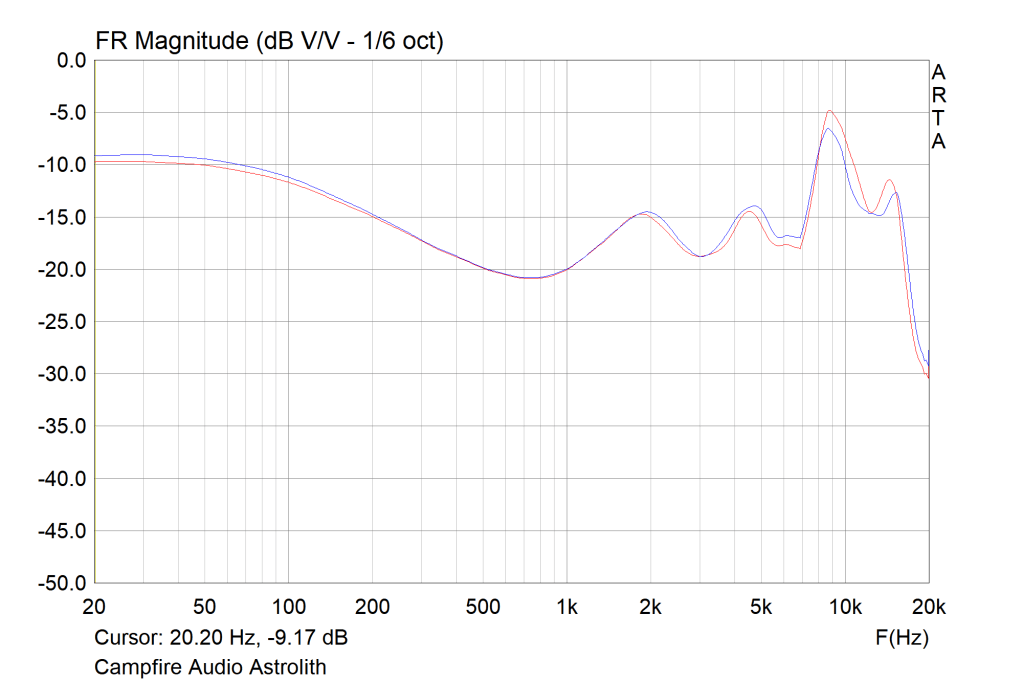
Testing Methodology: Measured using Arta via IEC 711 coupler to Startech external sound card. 7-9KHz peaks may be artifacts/emphasized due to my measurement setup which I found to be the case here. Measurements besides channel balance are volume-matched at 1KHz. Fit depth normalized to my best abilities to reduce coupler resonance. Still, due to these factors, my measurements may not accurately reflect the earphones or measurements taken by others. I gave the Astrolith 100hrs of burn-in prior to evaluation.
Tonality –
The folks at Campfire Audio mentioned to me that the Astrolith was designed to be fun, engaging and technical with no pretense of balance or neutrality. To that end, I feel the company has achieved great success and I find the midrange is surprisingly natural all considered. It has a V-shaped character that is slightly biased towards the high-end. The overall tuning resembles the Andromeda 2020 yet with higher contrast, equating to a cleaner tone and enhanced treble extension. Bass also assumes a bolder sub-bass focus but with a sharper fall off through the mid and upper bass to uphold cleanliness. The midrange has dual emphases at 2 and 4 kHz, with a 3kHz nadir between. In turn, vocals are clear and relatively clean, but also sit a little further back in the mix. It enables them to be revealing yet never intense. Treble is crisp, energetic and open. It will likely be the most polarizing aspect of this earphone. It is for this reason, Ken recommends pairing them with a foam ear tip and a deeper fit which helps greatly to tone down sibilance and glare.
Bass –
A 14.2mm planar woofer sets up some expectations and the listening experience certainly delivers. The Astrolith delivers a fun and likeable tuning alongside excellent technical properties. This starts with a moderate sub-bass focused boost that also extends partway into the mid-bass before a progressive slope into the lower-mids. While bass has a light warm tone, the Astrolith’s low-end is more defined by the added weight and structure in the sub-bass that gives notes a bold, thick over round and tubby voicing. Still, as there is a bit more mid-bass than is usually present on sub-bassy IEMs, I find the timbre is still quite natural with solid balance between dynamics and texturing. And, unlike the Moonrover, that massive woofer driver provides prodigious power and excellent depth here yielding a big, palpable pressure and a superbly well-defined rumble.

To nitpick, bass isn’t quite as tight and assertive as a good dynamic at the very bottom. But this is in comparison to the very, very best. Besides this, bass is very articulate and rapidly decaying, resulting in highly defined notes. It showcases excellent control through the mid-bass despite the emphasis on display. In addition, I never found that slam overwhelmed the finer nuances above. Separation remains strong if not exaggerated as on leaner earphones due to the thicker note structure; small details are all apparent, if not quite as well isolated as one some competitors. The Astrolith delivers a highly engaging bass performance with a detailed, texture mid-bass augmented by awesome sub-bass depth lacking only that last iota of tightness.
Mids –
It’s no secret that Campfire Audio isn’t known for tuning the most authentic midrange but certainly a coloured one executed to prioritize musical enjoyment. The Astrolith diverges from the Moonrover and delivers just that, something more in line with the beloved colouration of their balanced armature in-ears. To that tune, the Astrolith’s midrange strikes as slightly laid-back, full-bodied but also clear and articulate. It doesn’t have as much warmth as something like the Andromeda Emerald Sea or even the Fathom. The larger lower-mid nadir and more toned back upper bass contribute to a more defined and separated sound altogether. At the same time, its vocals have plenty of gusto and power on account of the solid bass presence and dual midrange emphases.
Vocals are well sized despite being laid-back, avoiding any semblance of strain. Of note, there’s a slight bias towards male over female vocals. This isn’t a bad thing for male vocals boast outstanding definition and an overall robust yet natural expression. If I have a main complaint, it’s to do with the top half of the midrange. The nadir at 3kHz does somewhat impact female vocal extension which can sound a little nasal on certain tracks. In addition, the sizable mid-treble boost means sibilance does creep in here and there – a good example being Thom’s drawn out S’s in Radiohead’s Creep. While I wouldn’t label the Astrolith as an outright sibilant IEM, even with a deep fit and foam tips, I did find some sibilance issues were apparent and this will be something to consider if you’re sensitive to that type of thing.
Besides this, the midrange is clearly coloured but overall, well compensated. The voicing sounds natural and the full-bodied nature helps to counteract breathiness and brightness when combined with the laid-back positioning. The upper-midrange boost enhances clarity contributing to strong definition and detail retrieval. The planar driver also delivers an excellent layering performance and resolving power on top. If you can deal with a little hotness at times, the Astrolith delivers a rich yet revealing midrange with better tonal cleanliness than past offering and solid consistency across multiple genres.
Highs –
Ironically, it’s within the midrange that the top-end tuning most bothers as highs sound likeable when taken in isolation. Again, it isn’t the most linear tuning and again, this was never the intention. There’s a small bump at 5kHz extending on from the upper-mids before a dip at 6kHz and a peak in the mid-treble around 8kHz. This lends the Astrolith a smooth foreground note presentation whilst retaining ample bite and crispness. The mid-treble tuning means notes sound thin but clear and highly defined. Background details are brought to the fore and the top-end is rife with energy and openness. It isn’t a piercing earphone but certainly on the brighter side – something to consider for those sensitive to treble. As with the Moonrover, I don’t find the planar driver to have that incisive quality BA drivers possess and, in turn, it doesn’t sound quite as sharp as the measurements might suggest.
Perhaps owing to the lower-treble dip, percussion doesn’t quite have the same definition on the Astrolith as other TOTL IEMs but its notes are no less defined above. Though erring on the thinner side, the planar tweeter lends a surprising amount of texture and authenticity to notes. Cymbal’s crash and shimmer in a natural manner, sounding just a little exaggerated due to their forward positioning. At the very top there’s a nice, balanced sparkle that is apparent and audible but doesn’t overstep. Notes are delicate, detailed and airy. There isn’t too much glare nor any splashiness if a little thinness. Extension performs at a very high level just short of the very best. All of this yields huge benefit when it comes to staging whilst crafting an immensely satisfying listen on complex tracks able to draw out the technical chops of the Astrolith.
Soundstage –
The Astrolith delivers a very sizeable soundstage with excellent proportion between width and depth. It extends beyond the head in both dimensions, with the spherical stage shape aiding a very immersive quality. Despite the size, its never sparse or diffuse, imaging is tack sharp. Vocals are solidly anchored to the centre while instruments spread out laterally. Layering performance is quite good despite the mid-treble boost, each layer is defined and delineated. Vocal harmonizations especially sound fabulous. The imaging is very immersive and holographic. Separation operates at a high level despite the fuller and more engaging tuning. Compared to a neutral earphone, there is less ether surrounding each note and fine detail, but each can still be pinpointed and perceived with ease. The Astrolith remains composed and organized during complex passages.
Drivability –
Output Impedance Sensitivity
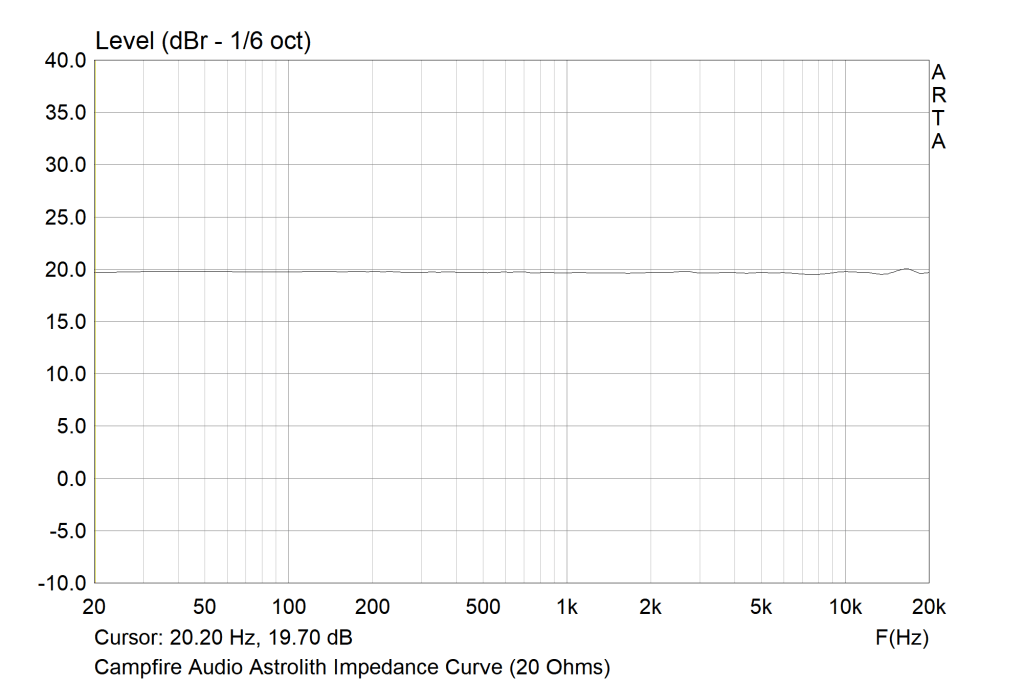
Despite the dual planar setup and crossover-less design, Campfire Audio promises a dead flat impedance curve and my measurements back this up. The impedance curve at 20 ohms is ruler flat, meaning the Astrolith will sound consistent from sources with a higher output impedance so long as the audio output itself is linear. In subjective testing, I found this to be the case which aids overall consistency source to source and opens up a wider range of pairings.
Driving Power
Planar drivers are renowned for being easy to drive as they are quite efficient with a low impedance, reaching high volumes with minimal voltage. However, they do thrive with current meaning a good solid-state source is best. This is doubly so given the dual crossover-less planar setup here. Comparing my desktop THX amplifier to the 4.4mm output of DITA’s portable Navigator revealed a likeable tonality that was a bit more bass leaning on the portable player. I noticed bass was bigger but also not quite as defined and textured. The same goes for treble which was crisp and clear but lacked the fine detail and control seen when driven by a balanced desktop amplifier. Overall, the Astrolith sounds solid from a portable source but thrives with good amplification.
Suggested Pair Ups
The Astrolith to me has quite a forgiving sound and that means it is quite forgiving of source pairings. So long as you have sound amplification, the Astrolith happily accepts both greater warmth and brightness without being pushed too far in any direction. This will ultimately mean colouration comes down to personal preference. Personally, I found the sharp, technical THX stack to be a delightful match, really capitalizing on the technical chops of the dual planar setup. Beyond this, output impedance has zero effect and high volumes are achieved from meagre sources. Background hiss isn’t a huge concern and isn’t nearly as apparent as on CFA’s BA IEMs.

Ryan Soo
Avid writer, passionate photographer and sleep-deprived medical student, Ryan has an ongoing desire to bring quality products to the regular reader.
 Everyday Listening
hi how you compare with bonneville?:)
LikeLike
Hey there,
I don’t have experience with the Bonnieville for comparison sorry. Guy has written a good comparison over at THL 🙂
Warm regards,
Ryan.
LikeLike