

Binary Acoustics Dynaquattro Review – Unison
Sound –
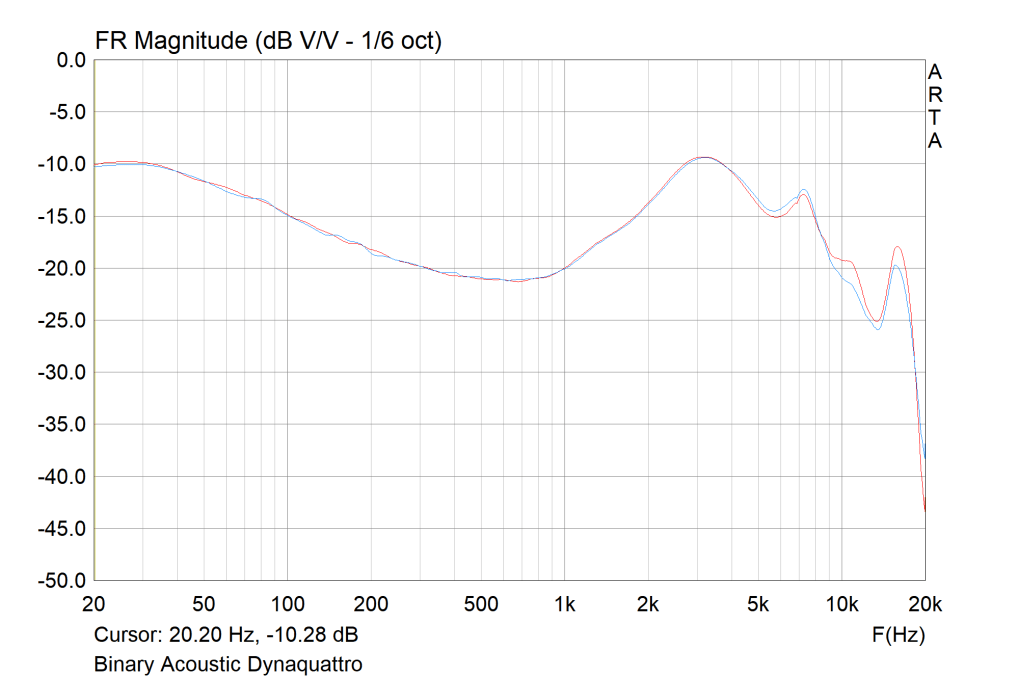
Testing Methodology: Measured using Arta via IEC 711 coupler to Startech external sound card. 7-9KHz peaks may be artifacts/emphasized due to my measurement setup which I found to be the case here. Measurements besides channel balance are volume-matched at 1KHz. Fit depth normalized to my best abilities to reduce coupler resonance. Still, due to these factors, my measurements may not accurately reflect the earphones or measurements taken by others. I gave the Dynaquattro 100hrs of burn-in prior to evaluation.
Tonality –
What do you get when you combine a triple dynamic driver setup with a passive radiator. The answer is a pleasantly balanced-sounding IEM with a smooth top-end and natural note timbre. Indeed, though radical in design, the Dynaquattro is a solid all-rounder. The tonality represents a slight L-shape with a modest sub-bass emphasis and clean, smooth midrange just behind. Treble is darker with a hint of additional crispness in the lower treble redeeming engagement and presence. While technical ability at the very top doesn’t strike as outstanding, the appeal here is the smooth, naturally decaying note presentation in the bass and midrange alongside a terrifically extended and textured bass performance.
Bass –
Undoubtedly the highlight of the show, the bass performance of the Dynaquattro deserves special mention. This starts with a well-considered tuning that both suits the tastes of modern listeners and upholds enough balance to achieve genre versatility. There’s a moderate sub-bass focus and progressive slope downwards through the mid and upper bass. This gives bass excellent structure with ample body and richness whilst retaining a clean tone and good bass/midrange separation. To top it off, extension and slam are both outstanding performers, giving the low-end a visceral feel. The note presentation is deep and thick, not overly bold, tubby or boomy. What also intrigues is the note presentation as the bass is distinctly slowly decaying yet controlled and defined.
In comparison even to other dynamic driver IEMs, bass notes really linger out which emphasizes texture and rumble. Despite this, I found the low-end quite controlled as it was never overly slow or sloppy, and notes were always clearly defined even on faster tracks. Accordingly, texture is the star of the show, with the thick tuning and rippling notes emphasizing each oscillation. The downside to this is that bass notes have a slightly softer-edged quality, lacking a super tight, affirmative attack, prioritizing pressure, body and decay; a quality I can only attribute to the use of the passive radiator. While there are more detailed IEMS, the Dynaquattro has a fun low-end tuning that sets itself apart from the crowd with its unique portrayal of textures.
Mids –
Sitting just behind the bass, mids are fairly clean and are well-portrayed with no polarizing qualities. The raw tuning is well-considered, picking up following the dip in the lower midrange and peaking in the natural 3kHz range before gently falling off once more. This gives vocals good presence and size without excessive brightness or intensity. The added bass provides a hint of additional body and warmth but overall, mids showcase solid tonal cleanliness. Vocals have a slight uptick of articulation that balances out the richness to create a midrange that is subtly coloured and enjoyable but never overly stressed.

Clarity isn’t the highest but never lacks and likewise, definition is ample, but the earphones tend to favour a smoother and more forgiving voicing over a revealing one. Resolving power isn’t the highest in turn, and fine textures within the midrange can be smoothed over. They have sound layering with a defined foreground and nicely delineated background behind. However, those that tend to focus in on midrange details and each individual layer will still be left wanting. Ultimately, the strength is surely the smooth and likeable tuning and forgiving presentation rather than the technical performance. This enables the earphones to put a spotlight on its sensational bass whilst still retaining an enjoyable midrange voicing.
Highs –
Despite measurements suggesting a relatively dark treble, I found the lower treble and mid-treble to a degree to be nicely balanced within the overall sound. Treble does fall off through the mid-treble so it will never be characterized as a bright IEM. However, treble is never overshadowed either. The lower treble sits just behind the midrange and showcases ample linearity. There’s a small peak around 7kHz that aids crispness and note clarity. As usual, this is a solid all-rounder emphasis zone that both increases incisiveness in the foreground and also brings background details to the fore. The Dynaquattro is granted a balanced foreground instrument portrayal in turn and has sound body and texture to back it up.
It has great crispness and fine detail retrieval, percussion is defined but not overly sharpened. Cymbals decay naturally and impress with their body and shimmer with a complete lack of splashiness or other fatiguing properties. The background showcases solid detail retrieval too. There’s a bit of sparkle and background details are present if not highlighted. Despite the dark background and slightly laid-back positioning, I was quite impressed by the detail retrieval and note timbre. Other IEMs do retrieve more background detail and extend further though within this price range often at the expense of timbre and texture.
Soundstage –
The soundstage showcases solid width and depth that are both represented in equal proportion providing a well-rounded stage. While raw dimensions fall into the good and not great category, the dark background does help to draw the best out of most tracks. Layering performance is moderate. You get a well-defined foreground with well-centred vocals and a distant background behind. However, the IEMs do lack midrange resolution to finely delineate between each individual layer. In turn, directional cues are sharp but lack precise distance portrayal. Separation is ample, above average, and able to discern small details within each track but there isn’t much space between each note. Small details aren’t difficult to pick out but also aren’t highlighted to the listener as on more separated IEMs.
Drivability –
With a 23 Ohm impedance and a 111dB sensitivity, the Dynaquattro offers sound efficiency suitable for portable devices.
Output Impedance Sensitivity

Given the quad driver setup and physical crossover, the Dyanquattro is more source-sensitive than most IEMs. On measurement, we can observe a downward slope that increases in magnitude as the output impedance of the source increases. In turn, expect a more bass-forward, darker sound from sources with a higher output impedance. For those wanting the most balanced sound, a low output impedance source is best.
Driving Power
Despite its high sensitivity, I’ve found that the Dynaquattro benefits from solid amplification. Comparing the DITA Navigator to my desktop stack with THX amplifier revealed a deeper reaching and tighter bass on the desktop stack. While the portable source was still balanced and spacious, the bass performance was a notable step up with dedicated amplification.
Suggested Pair Ups
The Dynaquattro benefits from a low output impedance and dedicated amplifier to achieve the most balanced, dynamic sound. Besides this, source colouration will be mostly up to personal preference as they otherwise showcase a forgiving and balanced nature. The Dynaquattro is also relatively resistant to source noise, widening source pairings. For my personal tastes, I preferred a brighter source to bring the most out of their top-end and maximise separation.

Ryan Soo
Avid writer, passionate photographer and sleep-deprived medical student, Ryan has an ongoing desire to bring quality products to the regular reader.
 Everyday Listening