

Jomo Audio Nautilus Review – Heavy Hitter
Sound –
Tonality –
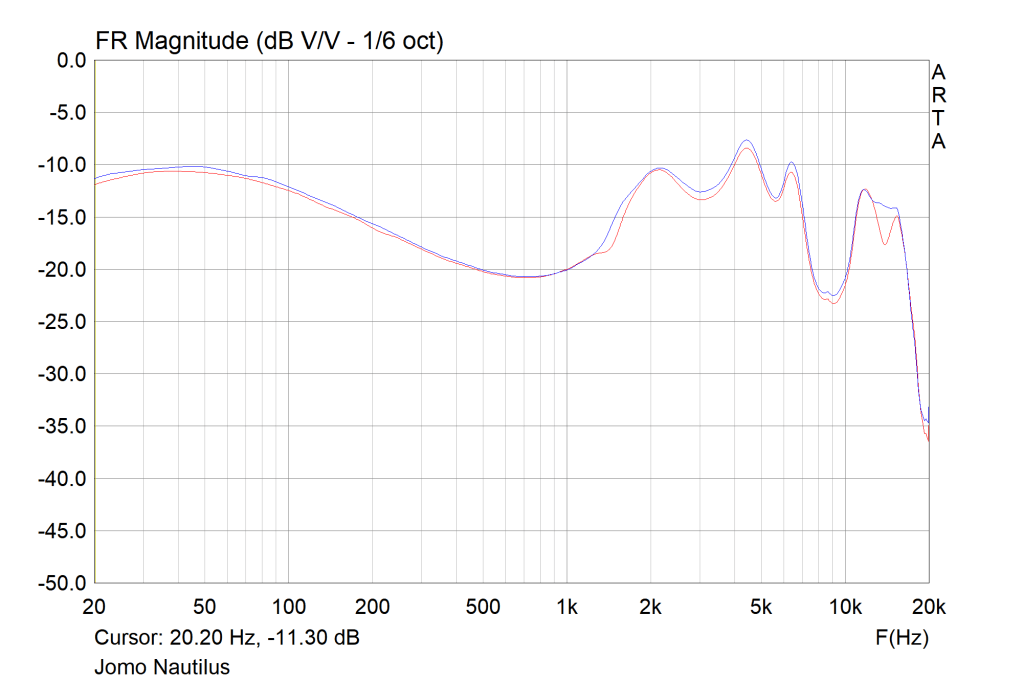
The Nautilus is a well-balanced monitor with a powerful, engaging yet clearly expressed voicing. It achieves these qualities through increased separation between the core frequency bands that provide a W-shaped character at some expense to coherence. Well-metered emphases and a light warm, euphonic tone help to avoid intensity and thinness. Bass creates this foundation with its thick and weighted nature. Meanwhile, mids are articulate and present with large, powerful vocals while the top-end, true to many planar designs, showcases excellent extension, sparkle and detail retrieval. The top-end is energetic in nature yet not overly sharpened in the low and mid-treble, enabling a smoother note delivery and dark background that minimises fatigue during longer listening. Overall, the Nautilus is defined equally by boldness and power as it is by tri-frequency balance and resolving power, crafting an engaging mix of versatility and complexity.
Bass –
A sure strength of this IEM, bass showcases a bold and weighted character alongside excellent responsiveness and texture. In my experience, metal shelled IEMs seem to offer a particular style of bass response that differs from resin IEMs. The Nautilus exemplifies this effect with an especially hefty enclosure translating to a controlled, well-damped and generally low-resonance listening experience.

The tuning is deep bass-focused yet still packs a sizeable mid-bass wallop, imbuing lows with a sense of fullness and body to match. In accordance, sub-bass sits in balance, meaning bass is rich but not overly round, tubby nor sparse through the mid-bass. It has increased weight, note thickness and very good structure without overwhelming the mix. Note attack is strong and tight, granting lows a physical nature and PRAT resultantly performs at a very high level. Though not as clean as more sub-bass-focused sets, the Nautilus prides itself on its balance of texture and power.
Separation is surprisingly excellent nonetheless and overall bass quality exceeds the asking price. Bass is exceptionally tight, controlled and decays swiftly. Each note is very defined with excellent texture through the mid-bass though the call to fame is surely its impact and slam properties that enable delightfully tight and visceral notes. Bass is highly responsive, keeping pace with quick and complex tracks despite its richness. The very best IEMs differ mostly in tuning and offer slightly better note definition. While micro-details aren’t quite as clearly expressed as on these sets, the Nautilus has a powerful and satisfying tuning with quality that is almost as outstanding.
Mids –
I’ve always enjoyed the way Joe tunes the midrange on his IEMs. I can see a clear preference for earlier 2kHz peaks for pinna gain which subjectively provides a bit more vocal power and balance between male and female. He also tends to tone down the upper midrange more, granting a dense, laid-back character. The Nautilus doesn’t stray too far from this house sound but is one of his most balanced takes yet. Specifically, the lower midrange has a slight dip granting better separation and definition. The upper mids are a touch laid-back before ramping up again in the lower treble. There’s a bit more extension here than usual. It isn’t to the extent that I would consider the Nautilus revealing, but it is a clearly expressed IEM that avoids the nasal characteristic earlier peaks can imbue.
It should be noted that, depending on fit depth, the IEM can sound quite different due to the location of the peaks and troughs. I personally advise wearing them with a deep fit to tone down the problematic 4 and 6-kHz ranges and maximize the contribution of the bone conduction drivers. After doing so, vocals are defined by a powerful, enlarged character. They are slightly forward, neutral in body and lightly warm in tone. Voicing is very natural throughout. Joe has beautifully balanced between warmth and articulation and as a result, coherence doesn’t lack despite an increase in clarity and detail presence. Despite this, I wouldn’t say this is the earphone’s strongest point, coming across as distinctly more engaging and coloured as opposed to integrated and linear.
Still, note definition and separation are also strong performers due to the neutral note body. While separation isn’t quite as good as more neutral sets again, it is far from boxy or overly warmed. More neutral IEMs have more sense of space in the midrange but the Nautilus retains excellent layering due to its foreground to background contrast, and each vocal harmonization can still be pinpointed. Vocals are large and filled in, taking precedence over instruments to some degree. Those preferring genres requiring instrument presence may find the set more V-shaped than W-shaped as a result. The Nautilus is an IEM that focuses on big, powerful vocals, showcasing excellent technical chops and layering, but its engaging, contrasted tuning does sacrifice an iota of coherence.
Highs –
Despite its energetic character, Jomo has avoided a peaky and fatiguing top-end. There are small bumps and nadirs, specifically at 5 and 7 kHz but they are well-controlled and far from grating. The lower emphasis grants a bit more presence to percussion and the general leading edge of notes while the 7kHz bump adds air, shimmer and general atmosphere. The planar driver showcases excellent extension and a sizable upper-treble elevation granting the earphone a light, esoteric treble presentation. Between is a large mid-treble nadir crafting a jet-black background that enhances the contrast between layers and vastly lowers the general feeling of brightness and glare.
I find the 5kHz emphasis is pivotal to the success of this tuning as it isn’t as sharp and brittle sounding as higher 6kHz emphases which tend to be more common. The lower peak gives treble notes a bit more body and more of a smooth and organic sound whilst still retaining presence. Indeed, earphones with a higher peak have a bit more crunch and bite to their sound but at the expense of introducing fatigue. The Nautilus isn’t quite as separated but showcases all of the same detail, just in a less aggressive fashion. Above, notes shimmer and decay naturally, showcasing plenty of texture. The mid-treble dip does mean some background details are lost; brighter earphones do come across as more detailed albeit with less sense of space and lower long-term listenability.
The upper-treble bump helps greatly to retain openness and space in this context. Micro details are abundant as is sparkle. It doesn’t overwhelm but those sensitive to these ranges may find the jump to be quite pronounced as the treble is otherwise, not overly emphasized. I personally enjoy the combination of abundant micro detail and smooth, organic foreground that grant the IEM plenty of nuance yet without much fatigue and intensity. Brighter IEMs deliver more abundant background and fine detail but the Nautilus does well considering its relative lack of foreground brightness and excellent background blackness.
Soundstage –
Combining excellent top-end extension with BCD tech, the Nautilus crafts a very out-of-the-head listening experience. This is especially apparent on songs that have lots of spatial info such as The Cure’s “Close To Me”. It isn’t as expanded as TOTL monitors but isn’t far off either. Nautilus offers a good balance of depth and width giving its stage a multi-dimensional feel. The highlight is the imaging which has standout precision. Directional cues are tack sharp and distance portrayal is very accurate also. In turn, layers are abundant and defined allowing the listener to delineate between each and locate each element in a more pinpoint precise fashion. Separation is solid, ample enough to never impede detail retrieval and perception. However, it also isn’t a standout due to the generally enlarged note size and powerful voicing. Regardless, it is impressive given the tuning.
Drivability –
The Nautilus offers an 11-ohm impedance and unspecified sensitivity. Overall, it offers average efficiency for a high-end hybrid IEM similar which makes it quite sensitive in the grand scheme of things.
Output Impedance Sensitivity
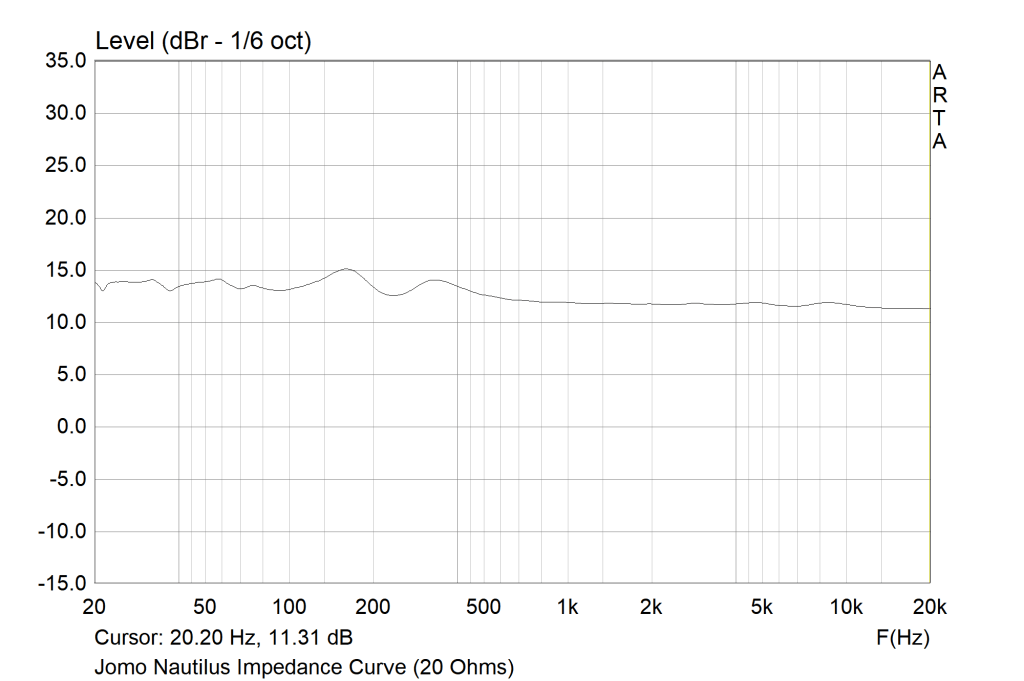
The Nautilus has a relatively flat impedance curve but still benefits from a sub-2-ohm impedance source. With an output impedance of 20 Ohms, I experienced a notable drop in treble presence creating more of an L-shaped tonality. Given that the earphone is so pleasantly balanced, a low-impedance source tends to work best.
Driving Power
Comparing my desktop stack with THX amplifier to a portable source like the DITA Navigator reveals the Nautilus really thrives with good amplification. The desktop source was notably more dynamic with better, tighter slam and a more defined note presentation throughout. From the portable source, the Nautilus sounded warmer and less separated. While it wasn’t a huge difference, the Nautilus scales very well with more powerful sources.
Suggested Pair Ups
The Nautilus benefits most from a powerful, low impedance source. In terms of colouration, I found additional warmth could upset the tonal balance, and given its thicker sound it is more forgiving of brighter and thinner sources. While a neutral source is a good pairing, some may also prefer more revealing sources in order to maximise separation.

Ryan Soo
Avid writer, passionate photographer and sleep-deprived medical student, Ryan has an ongoing desire to bring quality products to the regular reader.
 Everyday Listening