

Forte Ears Macbeth Review – Perfection in Imperfection
Sound –

Tonality –
The Macbeth is equally about tonality as it is about technical brilliance. And yet, Riccardo has achieved a very balanced and flexible tuning here that doesn’t stray too far from neutral whilst adding heaps of engagement all the same. At its core, this is a W-shaped tuning with equal emphasis between the three core frequency bands and heightened separation between them adding dynamic contrast. Bass sees predominate emphasis in the sub-bass region with a lick of sustain into the mid-bass that helps to retain texture and body. The bass response is very tasteful as it is structured and powerful but still retains a natural note timbre. Mids tell a similar story, with modest pinna gain and a slightly boosted upper-midrange and articulation.
They are defined by excellent transparency with a hint of gloss and colour that draws focus to the intricacies. Treble has broad emphasis in each region lower, mid, and upper. It isn’t the most linear overall but certainly less peaky than most. It also isn’t the most aggressive treble boost, as the overall level never overwhelms the surrounding frequencies. As no particular region sits too far back, all details are presented with parity, enhancing retrieval and perception. Of course, the tonality only tells a small fraction of the story, much of the appeal of the Macbeth comes down to sensational and broad out-of-the-head imaging and its ability to reproduce fine textures with near-unmatched lucidity.
Bass –
Riccardo set out to deliver extension down to 10Hz and a balanced tuning that prioritizes texture and cleanliness. The Diablo drivers were born to create just this, and I’d say Riccardo has achieved great success. Incidentally, when running sine sweeps through my coupler, the tuning reminded me of the Hyla CE-5. This was one of the first IEMs popularising the modern trend of sub-bassy tunings and was once considered to offer the best bass response on the market. The Macbeth makes further refinements in all aspects. Starting with the tuning, the sub-bass sits ever so slightly at the fore with sustain into the mid-bass to retain balance and texture. It slightly cleans up this region relative to the Hyla, lacking tubbiness or bloom in turn yet without overshadowing mid-bass body, texture, and fullness. The Macbeth also lacks the sparseness some sub-bass-focused IEMs suffer from.
The low-end also blends evenly into the higher frequencies due to a neutral upper bass and lower midrange upholding strong coherence. The result of this tuning is an addictive sense of power, slam, and rumble with slightly emboldened notes and a subtle, musical warmth and fuzz. Bass is well-present with an excellent balance between sub-bass rumble and mid-bass punch. It is articulate, perfectly separated at all times, and able to sit behind the other frequencies when needed. If the driver setup wasn’t disclosed, I posit many would never guess this low-end is being delivered by a BA driver. It isn’t the most visceral or aggressive in its attack but the texture and extension are no less impressive than many high-end dynamic driver IEMs and delivers rumble that is heard and felt. And yet, the typical ultra-high definition, responsiveness and separation offered by BA woofers remain.
Decay is a little longer than a typical BA which perhaps lends to the authenticity of its textures. Indeed, this is what the Macbeth is all about for though its extension and definition are venerable, the mid-bass texturing on display I would consider nothing less than market-leading. Boot up ”Crosshairs” by MF DOOM and the rapid descending bass notes are delivered with superlative texture throughout with a hint of emphasis in the rumble and slam domains. Each bass note reverberates in dare I say an analogue fashion, tight and highly defined yet retaining the soul of their lo-fi fuzz. The Macbeth isn’t a bass-focused IEM nor is it perfectly balanced, yet the special attention the Diablo system receives hasn’t been without merit. The tonality is gorgeous and genre flexible, textures are abundant, and notes are vivid with tangible verisimilitude.
Mids –
While usually I speak more of the tonal qualities of the midrange, the unique driver setup of the Macbeth requires a broader perspective. The midrange speaks equally through its gorgeous voicing and excellent transparency as it does through its separated, spacious, and articulate nature. The W-shaped tonality provides excellent balance with mids bearing a dead neutral position. Subjectively, the midrange itself is tuned with near-perfect accuracy, only being coloured by the surrounding frequencies. There’s a hint of clarity enhancement derived from a small bump in the upper midrange and the pronounced lower treble is responsible for the boost in articulation and fine detail presence. A whisper of bass warmth alongside the neutral lower-mid and body means the Macbeth never sounds cool or sparse. I am personally a fan of the smoother and denser midrange tunings out there however, incidentally, I didn’t find the upper midrange to overstep at all.
In fact, I find them to be tremendously transparent and adaptable. The Macbeth can sound clear and revealing or dense and saturated depending on the track. Laufey’s “From The Start” sounds rich, warm, and smooth whilst Timberlake and Jackson’s vocals in “Love Never Felt So Good” sound highly resolved and revealing. Whilst this can mostly be attributed to the mastering style of each track, many IEMs tend to skew each in either direction with the Macbeth flawlessly elucidating their underlying character – a hallmark of a well-tuned IEM. What is less tangible is the effects of the bone conduction drivers, often lauded for their ability to create a spacious sound and retain vocal clarity in the presence of ambient noise. The Macbeth has quite a potent implementation as the shells physically vibrate, resonating through the cartilage of the outer ear. Add to that top-tier treble extension and you get an unprecedented level of spaciousness and layering. This enables the Macbeth to deliver truly out-of-the-head imaging yet without introducing any funkiness into the tuning to achieve it.
It must be said that, though transparent, the Macbeth doesn’t possess an absolutely accurate midrange voicing, being a touch vibrant, nor the best resolving power I’ve experienced if still close to it. IEMs that combine top-tier resolving power with a more forward, revealing tuning do offer a hair more clarity to fine details. Still, the Macbeth’s midrange sounds enormous, highly separated, and well-layered. Fine details are clearly defined, and the spatial resolution enables the portrayal of an enthralling sense of dimension. Once again, I return to the term texture as there is a certain grit to vocals that isn’t apparent on other IEMs I’ve tested perhaps owing to the BCD implementation or perhaps that vintage copper coil Riccardo has implemented. Irrespective, Macbeth isn’t for those wanting the most upfront, crystal-clear midrange nor a warm or laid-back one. It is for those wanting something just a little north of neutral with top-tier resolving power, excellent transparency, and superb spaciousness.
Highs –
The top end plays a strong complement to the rest of the sound. It lacks any outstanding properties like the bass and midrange however, even upon first listen, it was apparent that this was a proper TOTL treble response. Extension, sparkle, and micro detail are all present in abundance. What stands out is the equality between the representation of foreground and background details. This means all details are apparent clearly without either being shoved too far forward into the listener’s face. Many high-end IEMs have a dazzling treble equally derived from resolving power and treble presence. The Macbeth has some enhancements but overall is quite reserved in its presentation relative to many competitors. Still, it isn’t to the extent of some early EST implementations that offered a sensation of openness but lacked audible hard-etched micro detail. The Macbeth is far from this, with real audible sparkle and micro detail, just in measured moderation.
Most notable is the small 5kHz bump responsible for introducing greater articulation within the midrange in addition to emphasizing the leading edge of notes in the treble. Indeed, treble is crisp and clearly defined. As opposed to a 6kHz emphasis, sibilance isn’t overtly apparent, yet notes are still present and well-etched. There is a slightly organic note presentation on display, avoiding over-sharpening. Notes have a convincing body and a good amount of texture if lacking an iota relative to more linear performers. Nonetheless, this has not come at the sacrifice of fine details which are always apparent due to the sensation speed and definition of each note. Above is a dark and clean background that is injected with additional energy and air around the 8kHz region before extending linearly through the upper treble.
Sparkle isn’t enhanced but is clearly audible and the overall sense of space and atmosphere are awe-inspiring. Switching over to a similarly strong performer in the form of the CE Omnium and it’s apparent that both are performing at a similar echelon. Yet where the Omnium is more vibrant in its performance, the Macbeth tones things down slightly, offering a gentler note presentation that minimizes fatigue. On the flip side, a laid-back in-ear like the DITA Perpetua offers even greater smoothness and background darkness yet lacks the same information in the top octave and background. The Macbeth is a rare IEM in that it is able to offer no less complexity than its esteemed peers yet in a manner that permits all-day fatigue-free listening.
Soundstage –
One of the strongest aspects of this IEM, the sense of space on display is world-class. It’s still an IEM, and you shouldn’t expect a similar imaging performance as a TOTL open-back headphone in turn. However, for an IEM, this is certainly a master craft. Indeed, the stage extends broadly in all aspects and the Macbeth was able to draw out this space on nearly every track I tested, delivering a highly immersive and holographic experience. Imaging is tack sharp and layering is defined and delineated. Directional cues are pinpoint precise, yet the Macbeth takes this a step further by portraying distance, creating more sense of dimension than your typical IEM. Separation is also extremely strong which contributes to this impression. Though coloured by bits of warmth and crispness here and there, note body is mostly neutral giving huge space between each note within its equally enormous stage. This heightens the perception of spaciousness whilst ensuring complex passages sound organized and small details are easy to perceive.
Driveability –
With a low 7.3ohm impedance and a 104dB sensitivity, the Macbeth is an efficient IEM on par with most other high-end monitors. Despite having a strong EST implementation, the IEM doesn’t require huge amounts of juice to reach ear-splitting volumes which works well in the context of portable listening. Despite this, there is no mention of a flat impedance curve, and therefore, the output impedance will be a key variable to consider for source pairings.
Output Impedance Sensitivity
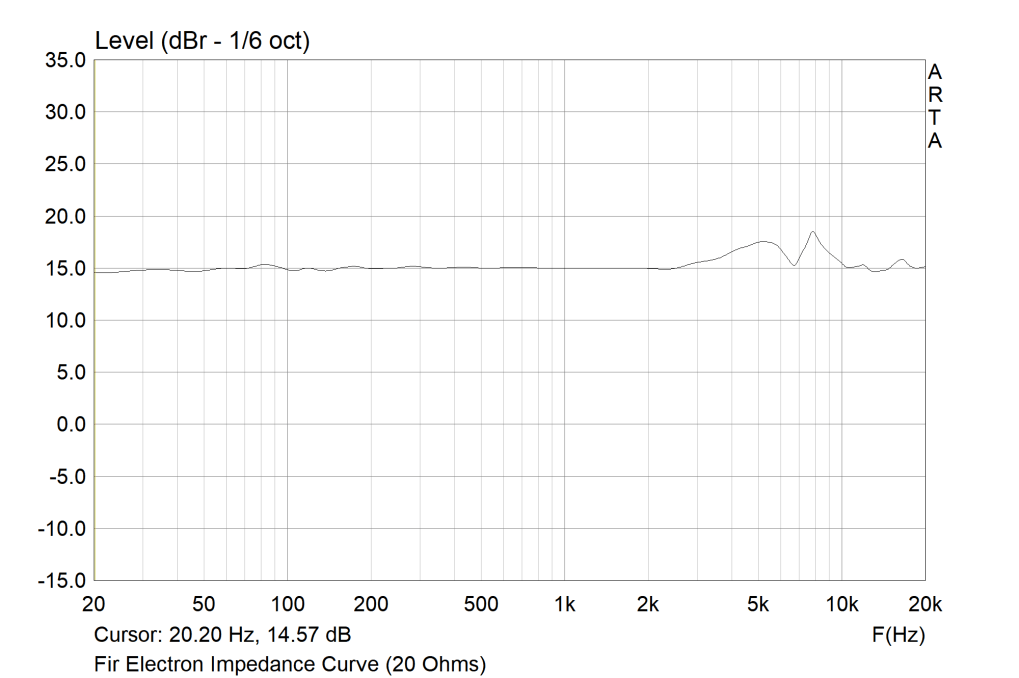
According to the rule of eighths, the ideal output impedance for the Macbeth would be under 1 ohm. However, the curve is relatively linear at 20 ohms meaning the differences between a sub 1 ohm and 1 ohm source would be minimal. With that said, the Macbeth will likely sound best from the lowest output impedance possible as any increase in output impedance brings a reduction in lower-midrange presence and a boost to the treble. This creates a brighter and leaner sound signature. Some may prefer this; I’d argue it removes some of the magic of the intended tuning.
Driving Power
The Macbeth very clearly scales with better sources. A key benefit of using a BA bass driver is that it is markedly easier to drive than a dynamic driver. Comparing my THX desktop stack to the DITA Navigator and indeed, bass is equally powerful and tight on the DITA. The midrange too is balanced and spacious. However, it’s the treble where the most pronounced difference can be heard as the THX stack is noticeably more energetic and extended. The desktop amp also provides a notably more spacious and separated sound, complex passages especially sound far more organized. Overall, a good source is a must to extract the best overall performance from the Macbeth.
Suggested Pair Ups
The Macbeth is very forgiving of source pairings and its transparent nature means it reflects the colouration of the source well. I enjoyed the THX pairing as the tone is most neutral. It brings out a little more power and structure in the bass and slightly sharpens the lower treble. However, even warmer sources sounded quite pleasant, introducing a bit more mid-bass and toning down the presence region. For my personal preferences, brighter sources were the worst pairing. Some may want to draw out more treble presence but for me, this slightly thinned out the sound and detracted from coherence. The Macbeth pairs best with a neutral to warm source with as low an output impedance as possible and thrives with good amplification.

Ryan Soo
Avid writer, passionate photographer and sleep-deprived medical student, Ryan has an ongoing desire to bring quality products to the regular reader.
 Everyday Listening