

Noble Audio FoKus Rex 5 Review – Aberration

Sound –
Tonality –
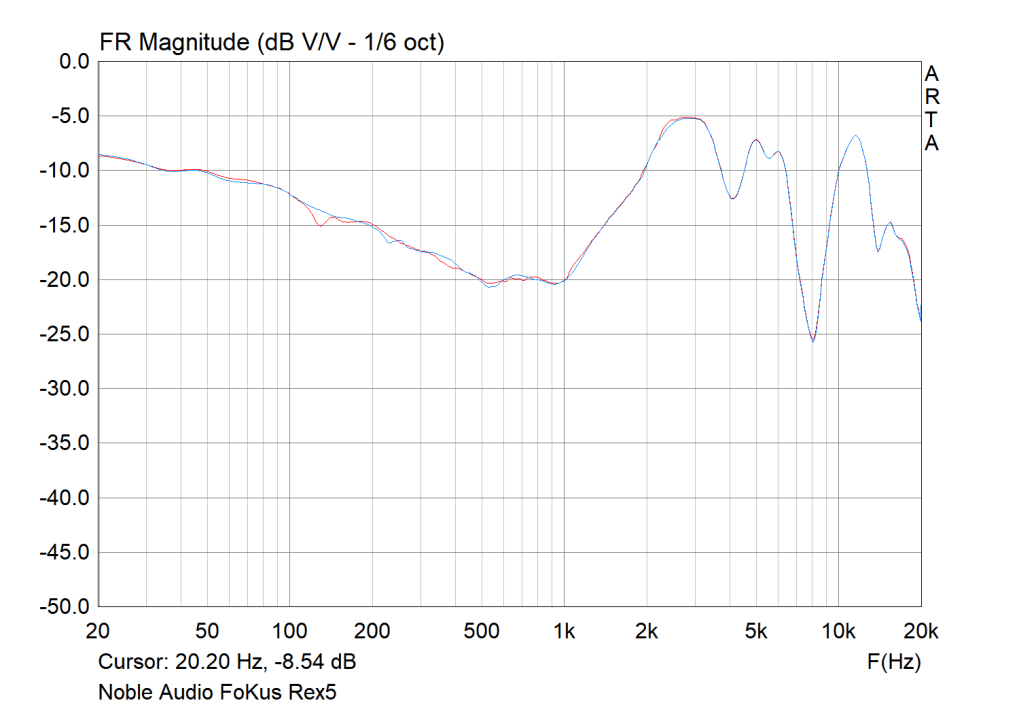
Noble has a good command over IEM tuning and I’ve found all of the earphones I’ve tested from the brand very appealing. The Rex5 thankfully, falls into the same echelon, being broadly balanced and well-voiced. It has a W-shaped tonality prioritizing the sub-bass and lower treble giving it an impactful, weighted yet crisp and articulate sound. It errs on the vivid and revealing side over the usual warm, smooth and laid-back voicing of most competitors. Despite this, Noble’s offering doesn’t come across as ostentatious due to tasteful restraint and a very capable eQ system should anything irk the listener.
The midrange between has a slight vocal bias and an articulate voicing on behalf of the treble tuning. And this is perhaps the most impressive aspect of this earphone as the Rex5 has easily the most desirable treble of any TWS earphone I’ve tested. The limitations of the form factor are still apparent, but rarely do I find a TWS earphone with a real treble response, detail and extension. The Rex5 is shockingly well defined all considered.
It also has noteworthy imaging that again, doesn’t match a wired model of equivalent price, but provides a notable jump in dimension and involvement over competitors. This is most evident with ANC off with some loss to instrument separation and note texture apparent with ANC on. However, thankfully ANC doesn’t alter the volume or tonality either, so it is altogether quite a sonically innocuous implementation.
Tips
Noble provides 3 ear tips to achieve the best sound and fit. Of course, fit is of the highest priority and to that end, I was unable to enjoy the dual flange tips at all. This left me with the choice between the single flange silicone tips and the memory foam ones. I found both provided excellent comfort and seal with the foam tips providing better isolation. The ANC algorithm works well with both, meaning the foam tips offer slightly higher overall attenuation. They are also a touch more stable fitting and have a mesh filter that helps to protect against ear wax buildup.
Sonically, both are surprisingly similar. As you may expect, the silicone tips offer a bit more clarity while the foam tips have a smoother, warmer sound, but it isn’t a night and day difference. Given the energetic top-end, I found the foam tips were more to my preference and helped to add a bit more body and coherence to the otherwise more revealing sound – these are the tips I used for the sound analysis below. The silicone tips will suit those wanting the best detail retrieval and note definition while the foam tips add a more forgiving quality to the sound.
Bass –
The low-end has a pleasantly balanced tuning that suits the wants of modern listeners. It definitely has more of an “audiophile” tuning that is more similar to wired IEMs than what we have come to expect from TWS offerings; a refreshing experience. Specifically, Noble has implemented a sub-bass focus with progressive fall-off into the lower midrange. This sets the stage for a sound with strong separation and restrained tonal colouration yet with a bass that still feels quite large. The moderate sub-bass emphasis provides good presence and drive that heightens engagement. Notes are bold, structured and weighted with a physical slam and rumble. While the mid-bass isn’t sparse, it is apparent that the sub-bass sits in front which won’t suit those wanting the fullest, richest and warmest low end.
Nevertheless, if you enjoy a dynamic, clean and still well-present bass, this is a very tasteful execution. On the subject of bass quality, I find this is an area where TWS earphones tend to suffer likely due to wireless SOC’s targeting efficiency over performance. BT receivers paired with wired IEMs tend to offer impressive quality as do Hifiman’s TWS IEMs with discrete amplifiers. Noble circumvents this weakness by minimizing the demand on the DD woofer by pairing it with more sensitive driver types to improve efficiency. The result is indeed impressive quality if still worse than the aforementioned solutions.
Bass is tight with a good amount of slam and defined rumble; it is notably more nuanced and dynamic than consumer high-end TWS earphones. The tuning aids this impression as the mid-bass is especially clean and separated. It isn’t perfect, however, as the Rex5 doesn’t have the most affirmative, snappy attack and the mid-bass can sound a touch sparse at times which saps texture. But the chief upside to the capable multi-driver setup is surely the minimal quality loss with ANC activated as the burden becomes shared. Some loss to instrument separation and bass definition is apparent but it’s only notable under scrutiny. The Rex5 in totality offers impressive dynamics and an appealing, versatile tuning that is bold yet clean.
Mids –
Following the steady sloping bass, mids see an inverse rise from 1kHz to 2.5kHz before sustaining until 3kHz. Noble’s tuning showcases impressive linearity and overall good character and balance with the surrounding frequencies. The broader shelf creates slightly more present, enlarged vocals and also improved balance between male and female vocals. In addition, the overall voicing is mostly natural and slightly vivid with strong tonal transparency, separation and definition. The Rex5 avoids intensity and thinness with a small dip at 4kHz that serves to enhance note body, smoothness and density. Accordingly, although vocals and mids on a whole are quite present, they are never skewed bright or fatiguing. A rise in articulation above upholds clarity, definition and fine detail retrieval.
This isn’t a flat, reference earphone but a clean yet engaging one. Like the bass, contrast between the core frequency bands is increased which puts an emphasis on separation. And, once again, the Rex5 excels due to a combination of good raw resolving power combined with great tuning. The result is imaging that is a notable step up from the rest and more equivalent to a wired IEM. It lacks the same nuance and holography of the very best of course, but there are real layers, excellent foreground/background separation and overall, an involving sense of dimension. The Rex5 succeeds due to its vibrant yet natural voicing that is further enhanced by class-leading resolving power.
Highs –
Planar IEMs have made a huge splash recently and most of this comes down to the level of treble extension and resolution they are able to provide at a low price. Hybrid planar tweeter implementations are becoming increasingly popular for that very reason. The Rex5 true to this legacy, provides an impressive, defined and extended treble. Again, this is nothing that would rival a similarly priced wired model but for a TWS earphone, it is genuinely amazing. There’s a mild lower-treble bump providing good crispness and a clear, defined note attack. Percussion and cymbals have a detailed, incisive quality. To my ears, the treble is slightly over-sharpened with a slight loss of body and texture, but the clarity and fine detail retrieval is excellent. Above is a darker background before a notable upper-treble bump for air, openness and sparkle.
There isn’t huge audible micro-detail perhaps due to limitations of the wireless connection, however, background details are still abundant which aids dimension and layering. Overall, the foreground detail retrieval is very impressive and the resolving power above injects an additional dimension over your typical TWS IEM. Sparkle isn’t huge but overall air and soundstage space are impressive all the same. You definitely get that sense of planar speed and definition that popularized the driver type if not quite the same extension in this form factor. With that said, the Rex5 blows the competition out of the water in terms of raw resolution and refinement of its tuning. Audiophiles can rejoice that they finally have a portable package with a full suite of convenience features that also touts a nuanced and well-present treble response.
Soundstage –
The Rex5 crafts a convincing sense of space that extends just beyond the head. It isn’t an esoteric out-of-the-head experience but a well-rounded stage with very solid imaging. I was especially impressed by the layering on display, the Rex5 offers sharp directional cues and some distance portrayal which gives its stage a three-dimensional quality lacked entirely by competitors. This is an experience that I’ve only experienced from wired in-ears until now, it was a refreshing experience to have this level of imaging nuance on display from a compact wireless IEM.
The excellent separation aids this impression as notes are neutrally sized throughout. There is an aether between each note that heightens the perception of small details and maximizes the sense of space. Do note that with ANC activated, the background isn’t as black due to the introduction of a slight hiss and separation is notably reduced. Imaging is still accurate but not quite as involving as with this feature turned off. Once again, this is something that is mostly notable under scrutiny and AB comparison but is worth mentioning to set expectations.

Ryan Soo
Avid writer, passionate photographer and sleep-deprived medical student, Ryan has an ongoing desire to bring quality products to the regular reader.
 Everyday Listening
Your website Ryan is easily one of the most beautiful one’s out there. I love the black background and the darker tones you take with the pictures. Everything looks like it’s coming from Bronze age:). Very artistic and dreamy.
LikeLike
Thank you MJ! Made my day 🙂
LikeLike
I must wonder if you have actually used xm5’s. There is in no way a comparison in any form of bass between rex5 and xm5,absolutely none. I really wonder what kind of kick back sony gives you.
LikeLike
Hi there,
Always appreciate feedback!
I personally own the XM5 unit, they are photographed in this review and were purchased with my own $$$.
No brands are allowed to pay me as per my reviewer policy which is outlined in the disclaimer.
As far as comparison goes, I think my comments speak for themselves:
“The Rex5 is more dynamic, it has better impact, slam and rumble. It also has higher driver quality with notably better definition”
I’m not sure where you’re picking up an agenda on my end. A large part of reviewing is setting up realistic expectations, it is easy to dramatize and it has always been my intention to be as honest and frank as possible when writing.
I hope this clears up any misconceptions.
Best,
Ryan.
LikeLike