

Shokz OpenSwim Pro Review – Perfectly Adapted
Usability –
Connectivity
The OpenSwim Pro sports the latest BT 5.4 standard but no high resolution or low latency codecs, limited to only SBAC and AAC. Usage is as on the Run models, holding volume up functions to power on and enter pairing mode when held for an additional 2s. Voice prompts narrate the remaining battery on power up and confirm the actions of the user with long holds. Once again, the sound quality is limited more by the driver tech than by the connectivity here but the chief point to consider will be latency which is noticeable but not overly obtrusive.
Lip sync issues are apparent under scrutiny but are sufficient for watching videos and movies. I would look elsewhere for gaming that demands greater immediacy that said. Multipoint connectivity is also present here meaning you can simultaneously connect to two devices and the headphones automatically switch between the two depending on which is playing audio. It works well here and never felt obtrusive during my testing.
Bluetooth range is solid, you can leave your phone a few rooms away and sound will still stream reliably. The larger chassis definitely offers stronger connectivity than TWS designs. When listening in crowded environments, I experienced no dropouts or artefacts. They do stay connected to BT while swimming, but your phone needs to be very close to the pool and they will drop out about ¾ of the way down a 25m pool. For home pools I’d imagine BT would suffice but submerge in any capacity and connection is lost. The addition of media player functionality was very sensible in this regard and a must for use in full-size public pools.
Media Player Mode
A big change between the OpenRun and OpenSwim range is the addition of an inbuilt media player. This is because Bluetooth connectivity cannot pass through water and the rated 10m range won’t cover a full-length swimming pool making wireless connectivity a poor choice when swimming. It’s quite a capable unit too with wide file support including lossless FLAC files. The increase in storage is notable as 2 GB is very limited. Using the included cable, the OpenSwim Pro can be accessed like a flash drive and then adding music is as simple as drag and drop.
You don’t need to install any software nor do folders affect playback. Some may lament this as on the non-Pro version, you can switch between folders which allows for better organization. The app can be used to switch between normal playback, shuffle and repeat but there is no other control beyond this. The controls all work identically to BT mode, skip track, volume and play/pause are all available. In swim mode, a swimming-specific eQ is available which is a great addition for use when your ears are full of water or stuffed with the included plugs.
I found the media player mode was useful beyond swimming too. Going for walks or runs without my phone but not wanting to churn through the already paltry battery life on my Pixel Watch. I am still able to enjoy some music albeit with limited control over playback whilst leaving my wearables to track health metrics.
Controls & Charging
The control scheme is identical to that on the OpenRun Pro and other models. The left speaker pod has a side-facing MFB button controlling playback with the right side module having a bottom-facing volume rocker that doubles as a power/pairing button. The main difference is the tactile feel as the buttons here are a little stiffer than on the Run models likely due to the weather sealing at play. Regardless as the left side button pushes into the skull and the right module can be pinched, the pressure required to actuate the buttons never affects the fit. I found them easy to identify and use even when underwater.
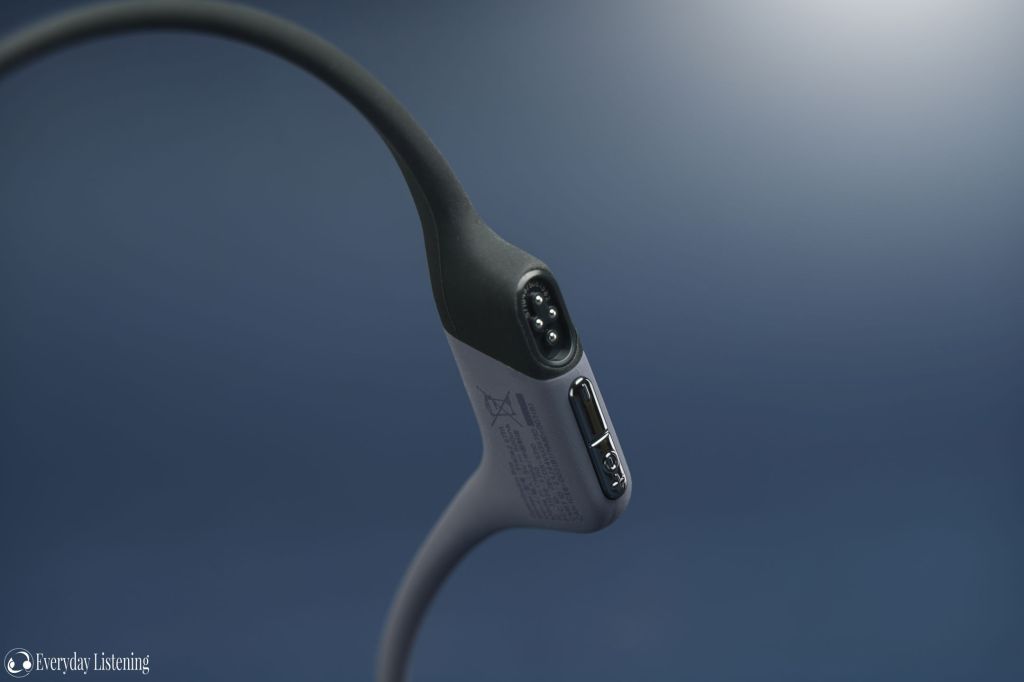
The OpenSwim Pro uses the magnetic charging cable rather than the more ubiquitous Type-C port found on the new OpenRun Pro 2. Whilst not nearly as convenient, this was likely done to maximize ingress protection. I find the cable offers a reliable connection even if the proprietary standard is aggravating in a pinch. The upside is the lack of sealing flap which is one less thing to fail and worry about. I should note that the cable is not interchangeable with the cable on the Run models due to the addition of 2 extra pins for data transmission. This permits copying files to the internal storage from a PC. This does add some anxiety that should the cable fail, there is no other way to copy music to and from the headphones. Shokz replacements come in at $29 AUD before shipping whilst aftermarket options are about half that albeit command a long wait for shipping and are not guaranteed to work or last.
Call Quality
Dual noise-cancelling microphones make a return on the OpenSwim Pro promising clear calls even in noisy environments. Unlike the OpenRun Pro 2, I found volume during calls was far more agreeable if still worse than you can expect from a canal bud or over-ear headphone. The OpenSwim Pro doesn’t feature the same AI algorithm but still cancels background noise quite well. Especially noisy environments and calls when cycling with abundant wind noise are understandably beyond this headset as most others.
However, when commuting or simply calling in an office, they offer a far more comfortable talking experience than sealing in ears. Recipients noted I sounded audible if lacking clarity and volume. Background noise was filtered out to some degree albeit at the expense of sounding quite robotic. The OpenSwim Pro isn’t the best choice for those predominately wanting to call but will be suitable for use in quieter environments and feels more natural to wear than other form factors.
Batterylife & Volume
The Pro picks up an additional hour of listening time over the OpenSwim coming in at a rated 9 hours of listening over Bluetooth. This does, however, drop to just 6 hours when using the inbuilt media player which should still be sufficient for most activities. Charging takes 90 minutes up from 60 minutes on the OpenRun Pro 2 but this is a huge improvement over the Swim which doesn’t feature fast charging at all. During my weeks of testing, I was experiencing a consistent 4-5 days of use which is about what is promised by the company.
The 12-hour rated OpenRun Pro 2 would last through the entire week by comparison. Volume output is similar to the other models. For me as a low-volume listener, I would sit within the 60-70% range when out and about. The bone conduction buzz becomes quite pronounced above 80% volume, however, this is to be expected given the physics of the design. The upside to bone conduction is that clarity is retained in louder environments. Though perfect clarity and range are lost in ambient noise, voices are always clearly expressed, so the headphones are well-suited towards vocals and podcasts. Those who love cranking the volume may want to look into a sealing in-ear instead but for the majority, the OpenSwim Pro should offer ample volume in most scenarios.
App Integration
Shokz app is one of my favourites as it is streamlined and reliable. It connects immediately to the headset and can connect to multiple headsets, allowing the user to manually pick which they’d like to use. Upon first launch, I was met with a firmware update, using version R_12_20241012 for this review. Unlike the more audio-focused OpenRun Pro 2, the Swim model has a more functional settings menu. Only 2 EQ presets are available, standard and vocal. Without the air conduction drivers, I found the vocal setting made the sound even more anemic and echoey during regular use so the standard setting was preferrable to my ears. It is, however, likely the best choice when using the headphones in tandem with earplugs as I’ll detail in the next page. You also cannot create your own eQ profiles as the DSP chip is not present in this model. What you get instead is control customization which enables the user to pick how they would like to toggle between media player mode (mp3 mode) and BT mode. You can also adjust this in the app.

Ryan Soo
Avid writer, passionate photographer and sleep-deprived medical student, Ryan has an ongoing desire to bring quality products to the regular reader.
 Everyday Listening