

Kinera Thorking Review – Flat Plus
Sound –

Testing Methodology: Measured using Arta via IEC 711 coupler to Startech external sound card. 7-9KHz peaks may be artifacts/emphasized due to my measurement setup which I found to be the case here. Measurements besides channel balance are volume-matched at 1KHz. Fit depth normalized to my best abilities to reduce coupler resonance. Still, due to these factors, my measurements may not accurately reflect the earphones or measurements taken by others. I gave the Thorking 100 hours of burn-in before evaluation.
Tonality –
Kinera has targetted a rich and detailed sound signature. With those expectations, I found that Kinera had only succeeded in one dimension. The Thorking is a detailed and revealing earphone with a transparent, slightly treble-focused sound signature and a focus on excellent bite and definition throughout. Accordingly, those wanting richness and warmth will be disappointed. The Thorking appeals to a similar crowd as earphones from the Eytmotic line-up bearing somewhat of a diffuse-field neutral tuning comprising a broadly flat bass that smoothly transitions to a gentle pinna gain. Accordingly, it is relatively lean by modern standards.
With that said, like those earphones, the voicing sounds natural and upholds commendable coherence with a lack of potent intensity or brightness. This is due mostly to its lower contrast nature; unorthodox in this day and age where high-end IEMs are dominated by W-shaped tonalities. The Thorking’s tuning instead sports a relatively beefed up lower-midrange and more modest pinna gain. The upper-midrange and lower treble lie on the smoother side. Mids and bass therefore sit on equal footing with the mid and upper treble sitting just in front. As has been my enduring experience, the EST tweeters deliver a smoother quality that takes the edge off its otherwise prominent treble, granting heaps of air and headroom all with minimal sharpness.
Tip Choice
I found the Thorking to be very responsive to ear tip choice. Thankfully you get a smorgasbord of selections out of the box. I found the standard silicone tips didn’t give me a good seal which left me with the CP100 Spinfits and Final E-tips. The CP100’s provided a slightly more V-shaped sound but sucked out the lower midrange. Those wanting a bit more engagement and a more vivid sound will enjoy these. However, the midrange did become a little thin for my liking. The E-tips were a fantastic match. They provided the most impactful, textured bass and a slightly more coherent midrange voicing. The treble was extended but slightly aggressive in the lower treble. For those wanting the flattest sound possible, Eletech’s baroque tips offered the best fit for me and evened out the treble nicely. However, they also created a leaner bass which detracted from genre versatility. I used the E-tips for the following analysis.
Bass –
Kinera has typically provided quite an engaging bass response, so I was surprised by the Thorking’s nigh ruler flat bass response. The Thorking has a very modest 3dB of bass lift in the sub-bass which progressively falls off into the lower midrange. Accordingly, the tone is clean, and notes are clear-cut and highly separated. Bass is the epitome of transparency. On thicker tracks like MF Doom’s Crosshairs, the Thorking sounds surprisingly authoritarian and saturated while leaner tracks like Gorrilaz Silent Running sound neutral and energetic. The DD provides a natural texture, decay and timbre but doesn’t emphasize visceral slam and rumble at the very bottom like many high-end IEMs. It is clearly a dynamic driver if not exemplifying the qualities attributed to such; bass is well extended but there is only a slight pressurization that is felt in the sub-bass. Due mostly to the tuning, the Thorking is light-footed, prioritising tightness, separation and detail presentation over dynamics.

There is ample sub and deep bass to engage but a relative lack of mid-bass punch makes them more detail orientated over boasting huge musical enjoyment. Those who like a bit more low-end robustness may find the Thorking to be too lean in turn. Besides this, the quality inspires if not standing out at the premium price tag. Bass is agile and responsive, emphasized by the clean tuning which contributes to high-note definition. It isn’t quite as textured as the very best nor is it especially dynamic. Chiefly, the Thorking doesn’t sport the most assertive note attack, but bass is nonetheless well structured, delivering a tight impact and strong detail retrieval. The standout is surely the excellent level of separation on display which enables the Thorking to dissect complex passages with aplomb. Ultimately, the Thorking’s bass will be one of its most polarising qualities. It remains a unique proposition for boasting BA-like separation and responsiveness yet with the extension and natural texturing of a dynamic driver.
Mids –
While my feelings on the low end are mixed, I adore the midrange entirely. There is a lack of any tonal colouration making mids highly defined and transparent, yet they also lack intensity entirely. A lot of this comes down to the linear bass to midrange transition where the relative lack of bass makes sense. The lower midrange is quite present which adds fundamental structure and coherence to the sound. As the bass itself is so clean, mids suffer from no colouration or bleed. Additionally, the modest 5-6dB of pinna gain prevents the midrange from overshadowing the low-end, sitting in good balance and drawing a bit more focus to the bass which enhances the perception of overall balance. Clarity is redeemed by the monitor’s articulate nature yet as the upper midrange is slightly smooth and dense, the midrange still errs on the side of structure and coherence and avoids sharpness and sibilance.
The result is a very well-compensated voicing that is natural, neutral and with excellent separation that works in tandem with strong imaging. It isn’t lean or cool due to the added density and lower-midrange body but I wouldn’t posit rich or warm are ample descriptors either. Male and female vocals sit in balance with each other and with midrange instruments which is pivotal to note as many competitors have a notable vocal bias. The voicing is just a touch full-bodied to my ears, but devoid of veil, chestiness or roominess. The midrange has terrific resolving power too. Texture and fine detail retrieval are standouts. Layering in particular performs at a very impressive level, which is highlighted by the tuning. Tracks with multiple layers of vocal harmonizations sound especially mesmerizing with each being clearly defined and positioned. The Thorking’s midrange strikes the perfect balance, maximising definition and separation but without sacrificing coherence or a natural voicing.
Highs –
The most notably coloured part of the Thorking’s sound, the treble has a little extra zest and zing that aids engagement and helps bring details to the fore. The emphasis isn’t huge but apparent with treble being moderately more prominent than the frequencies below. There is a small plateau in the lower treble with a larger mid and upper treble peak above. Accordingly, though treble has a nicely defined initial bite, chief emphasis is on air, shimmer and headroom. It isn’t the most linear tuning meaning this does come at some sacrifice of note body and texture. While it is still a respectable performer in this regard, the treble errs on the clear and crisp over the natural and organic side which gives the treble a more revealing overall voicing.

The more retrained lower treble in tandem with the EST driver’s smooth notes delivery is in good taste as it helps to avoid over-sharpening. This aids long-term listenability for though the treble is clear, it is never piercing. Above, background and fine detail are brought to the fore. The background isn’t the cleanest but doesn’t suffer from glare as it isn’t a broadband mid-treble emphasis. There is a good amount of sparkle and excellent airiness which elevates the Thorking over your usual DF neutral IEM which tends to be quite intimate with many older single-BA examples rolling off much sooner too. Kinera’s take is considerably more expansive and highlighting of nuances. It avoids the overly wispy presentation that plagues many EST-based monitors whilst still benefitting from their superb headroom and sparkle.
Soundstage –
The Thorking presents quite a large stage with a notable width bias. It presents a very broad lateral spread that extends well beyond the head with more intimate vocals strongly centred. While it does have the ability to project depth to a good degree, mids tend to steal the spotlight and sit closer to the listener. Imaging is a highlight. Directional cues are tack sharp which is aided by the standout separation on display. Each note is clearly isolated and surrounded by ether which makes small details very easy to discern and process. Layering performs at a high level with a spread of multiple layers that are all defined and well-delineated. The Thorking projects distance well albeit biased to the sides rather than front to back which adds dimension to its stage. It is also quite tall, aiding the overall impression of openness and air.
Drivability –
The Thorking has a low 14.7 Ohm impedance and a higher 110dB sensitivity rating that makes it about as efficient as your average high-end IEM. In turn, it will reach very high listening volumes even from low-power portable sources. Despite the addition of EST tweeters and relatively potent treble response, it is well above average in overall efficiency.
Output Impedance Sensitivity
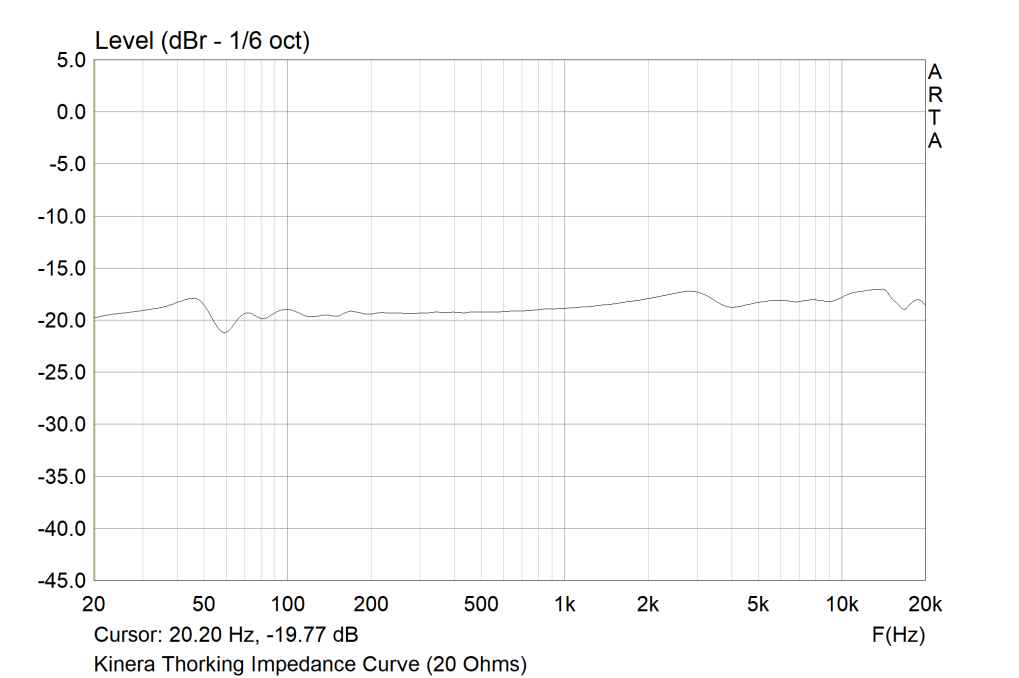
Despite its intricate design, the Thorking boasts an impressively flat impedance curve measured at a 20-ohm output impedance. In subjective listening, there was just a small drop in bass impact but otherwise, minimal tonal changes relative to a 1-ohm source. This means the Thorking will uphold a consistent sound from a wide range of sources so long as the source itself sports a linear output.
Driving Power
Comparing my desktop stack with THX amplifier to a portable dongle-style source such as the DITA Navigator reveals that the Thorking does like a bit of power. The most notable changes came at either extremity, with the portable source delivering a slightly more present but also less controlled bass and less treble extension and atmosphere up top. The desktop source notably improved soundstage space and micro detail. Overall these monitors scale very well with a good amplifier but still sound nicely balanced from portable sources.
Suggested Pair Ups
Perhaps my ears have adjusted to the onslaught of bass-heavier high-end IEMs but to me, the Thorking thrives with warmer, bassier or darker sources. Neutral and energetic sources like those from THX deliver the best transparency but the monitors can lack forgiveness which limits versatility. Adding a bit of warmth and smoothness helps to offer a bit more subjective balance whilst still benefiting from excellent separation and imaging.

Ryan Soo
Avid writer, passionate photographer and sleep-deprived medical student, Ryan has an ongoing desire to bring quality products to the regular reader.
 Everyday Listening