

Unique Melody MEST Jet Black Review – Bright & Brilliant
Sound –
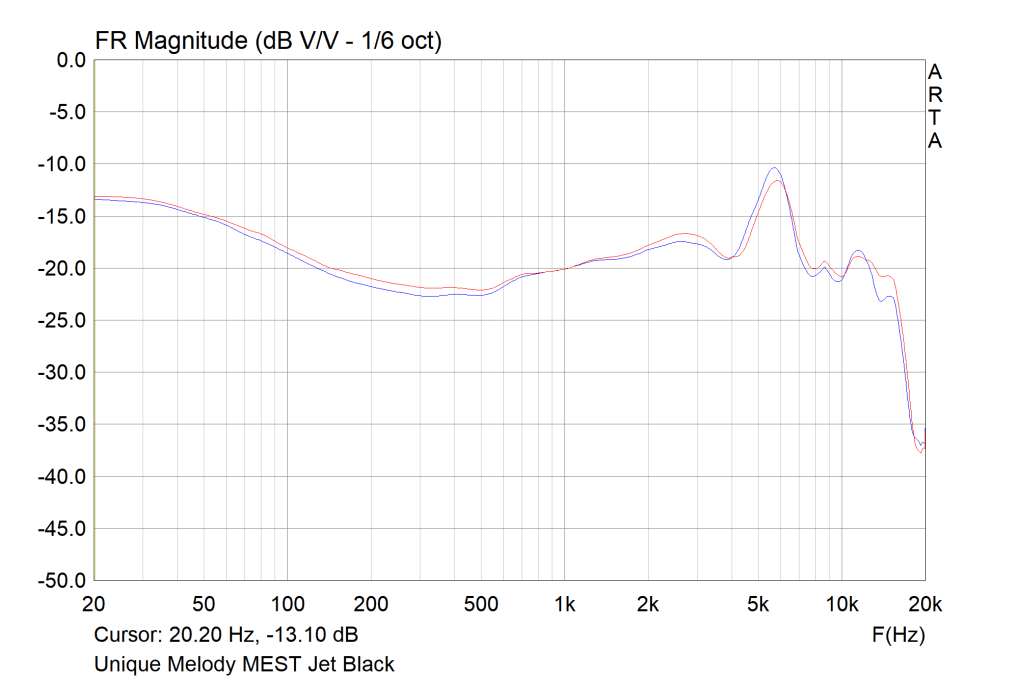
Testing Methodology: Measured using Arta via IEC 711 coupler to Startech external sound card. 7-9KHz peaks may be artifacts/emphasised due to my measurement setup. Measurements besides channel balance are volume-matched at 1KHz. Fit depth normalised to my best abilities to reduce coupler resonance. Still, due to these factors, my measurements may not accurately reflect the earphones or measurements taken by others. I gave MJB 100-hrs of burn-in prior to review.
Tonality –
I wasn’t sure what to expect with MJB as UM’s IEMs have only become available recently in Australia. Out of the box, MJB is broadly balanced with a bright tilt. It has a neutral tone throughout, a leaner note weight, and an articulate character, suiting treble lovers best as highs steal the show in both quantity and quality. A modest sub-bass emphasis ensures lows don’t sound anemic, but bass does take a backseat unless listening to a sub-bass-forward track. Mids are clear and clean yet are also laid-back, which helps to mitigate intensity. Treble is defined by a sizable bump around 6kHz before evening off above with terrific upper-treble extension. It showcases excellent detail retrieval and resolution overall, as a result. All of this is united by involving holographic imaging and impressive stage width.
Aftermarket Ear Tips
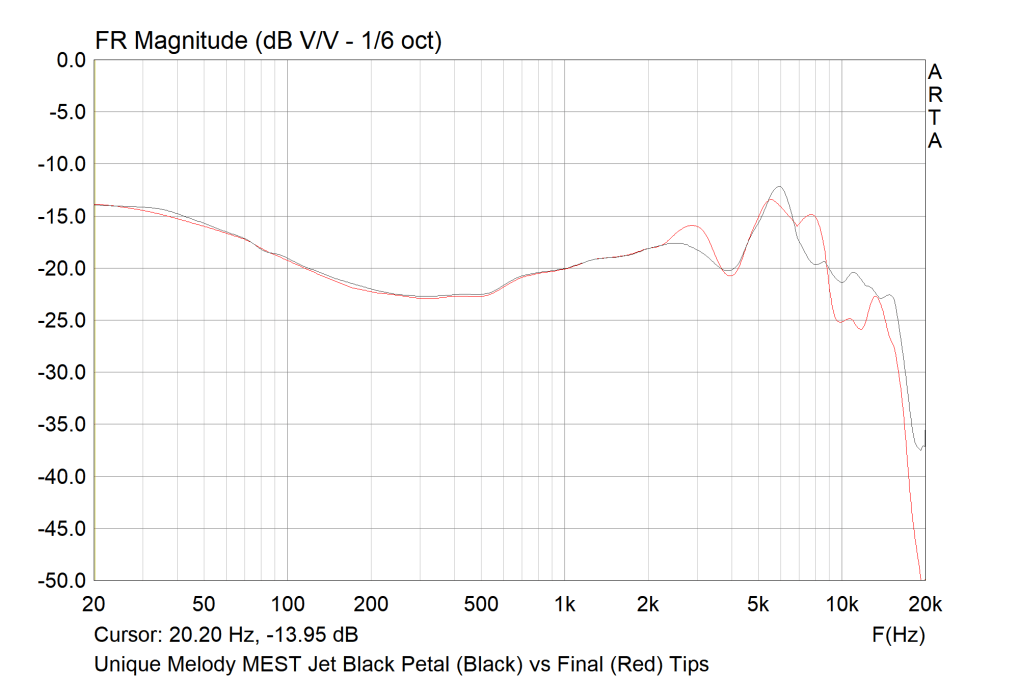
I was intrigued by Headphones’ review of the MEST MkIII, where Caleb had provided measurements with the stock petal tips and Final Audio E Tips. I figured this would be a good test for the MJB too. Measurements reveal MJB is indeed very tip-sensitive. E tips, for instance, provide a notable increase in upper-mid presence in addition to slightly tempering the lower-treble. However, it also introduces a more prominent mid-treble and affects extension. The standard Petal tips sound a bit more treble-focused, while the E tips have a more desirable midrange timbre and a bit more balance and coherence. However, the E tips lack the same micro detail and soundstage of the Petal tips, losing some of the magic of MJB. In addition, though treble isn’t as forward, the timbre is less desirable as it becomes sharper and more brittle due to the mid-treble bump. Traditionally, I would consider foam tips to tame a brighter IEM. However, I found they overly dulled the technical brilliance of MJB.
Included Ear Tips
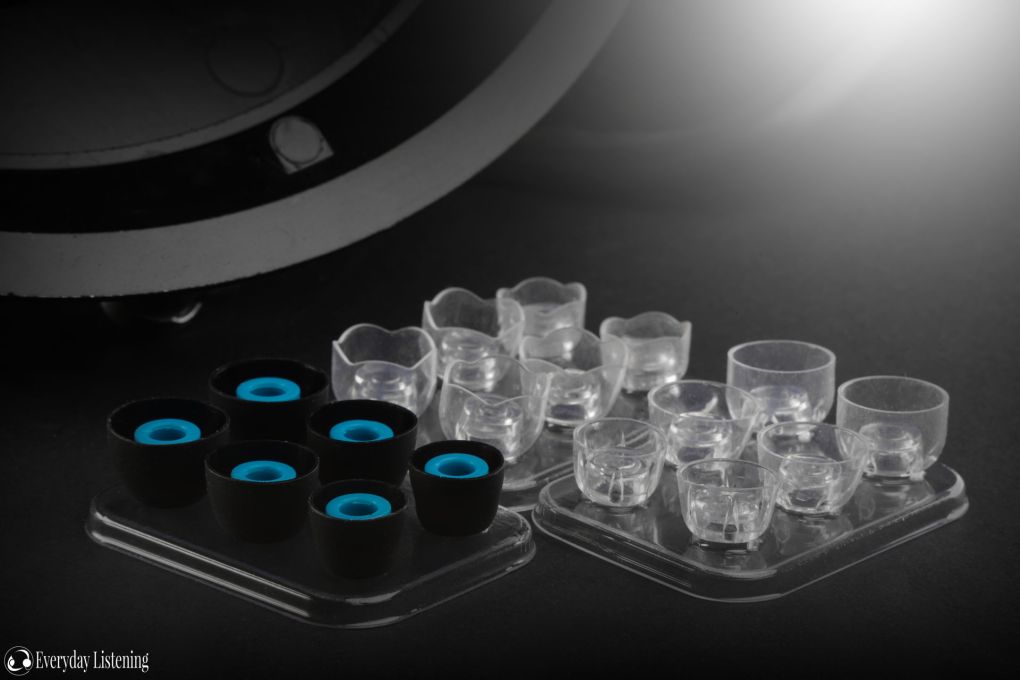
As for the alternative tips provided in the box, we have two thermoplastic options. The wavy flowered tips offered a more consistent seal for me than the regular black silicone tips in addition to a deeper fit due to their shorter stem. These tips were quite similar to the E-tips but with a more desirable treble. They offered a bit more mid-presence and toned down the lower treble, producing a more balanced sound and a more “normal” timbre. It sounds a bit smoother and less treble-focused, and the midrange isn’t as breathy. However, you also lose sparkle at the very top, and the soundstage is narrower. The vented tips are a cool proof of concept as there is zero wearing pressure, and it feels like you are wearing a traditional earbud. In turn, there is next to no noise isolation, and bass is largely diminished, so the listening experience isn’t optimal. For most listeners, it will be between the crisper yet more spacious black silicone tips and the more sealing, smoother but more intimate flowered thermoplastic tips. Overall, I actually felt the standard black silicone tips tended to bring the best out of MJB. Though they sound a bit bright, they have the most magic in them, and I used these tips for the following review.
Bone Conduction
As special attention has been granted to designing the complex hybrid BCD system, so too did it feel deserving of dedicated discussion. In my experience, bone conduction tech is most effective in the high-frequency range. While MJB uses 3 drivers, in practice, I still felt the high frequencies were where I felt the difference most, albeit rarely, bass and midrange cues would surprise me. Specifically, it adds a sense of scale and dimension to the soundstage. Directional cues appear well beyond the confines of the head. It’s a similar sensation to something like the Forte Ear’s Macbeth, but a bit more prominent and frequent. A track where the effect was especially overt was “Freedom” by George Michael due to the laterally placed tambourines. MJB was able to bring out an uncanny sense of width that many IEMs aren’t capable of. While I wouldn’t expect a physical sensation here akin to something like Shokz’ sports BCD headsets, MJB definitely offers one of the most potent and capable effects of any IEM that complements the air conduction system without intruding.
Bass –
Jet Black offers a modest sub-bass lift that injects some dynamics and weight into its otherwise lean and agility-focused sound. Above, mid-bass returns to a neutral position with upper bass sitting just south. In turn, MJB offers a split character, boasting a relatively powerful slam and rumble on tracks that call for it, whilst being immensely clean and lighter-footed on tracks mastered with less sub-bass. This isn’t a warm, rich IEM but a clean, responsive one with solid timing, excellent extension, and standout separation. Sub-bass holds the spotlight and steals the show with excellent detail retrieval, but those wanting richness and punch may find Jet Black to be too lean due to the subsequent drop-off. MJB isn’t the most natural, organic IEM, in turn, but it is bold, powerful and responsive.
Bass quality doesn’t stand out in such a prestigious price range, but it certainly doesn’t disappoint either. Some may feel some mid-bass texture is missing on first listen, but this is more a byproduct of its tuning. MJB offers great note definition and control. Sub-bass, especially, is highly defined and responsive with excellent texturing. On tracks with less sub-bass, I find the mid-bass can get drowned out a little, which can make these qualities hard to appreciate at times. Under scrutiny, the dual BCDs appear to contribute a slight sensation of grandeur and volume to lows within the soundstage rather than bolstering attack, impact, or texture. It also doesn’t make the IEM sound unnatural or strange. Notes are well textured and mostly natural, albeit the leaner mid and upper-bass regions may limit versatility for some listeners.
Mids –
Above, the lower midrange returns to neutral before a gentle, progressive climb to a small 3kHz hump. This is quite a popular tuning methodology and indeed rewards with a mostly approachable voicing. While mids appear quite laid-back relative to Harman-target IEMs on measurement, when combined with a sizable 6kHz peak, vocals aren’t overshadowed or distant at all in actual listening. In fact, the midrange is clear, revealing, and highly resolved with a good sense of immediacy. As I am partial to a warmer sound, I do find these qualities may have been pushed a step too far, as the voicing is somewhat breathy with an emphasis on head voice and diminished bravado. Mouth sounds tend to be slightly over-emphasised, encroaching upon sibilant at times, if never quite hitting my personal limit. Accordingly, MJB can sound a tad metallic on some tracks.
Still, it’s an interesting tuning and, as many have said before, yields benefit within the realms of fine detail retrieval and overall resolving power. The tone is dead neutral, and the note body is slightly lean due to the upper-bass scoop. However, accordingly, separation is standout, which makes each detail pop. Jet Black offers a nice spread of layers too, and each is clearly defined. It offers a holographic, airy quality with excellent speed and resolving power. As the upper midrange hasn’t been overly pushed forward, enough coherence is retained to suit most genres. Notes are highly defined and presented in an agile, swiftly decaying manner. Mest Jet Black is a technical standout with a tuning that will straddle the line of comfort for some but also rewards with excellent articulation and definition if this is your schtick. It should also be reiterated that tip rolling opens up prolific options to tone down articulation and achieve a more coherent, natural voicing should you desire.
Highs –
The top-end defines the presentation on Jet Black as the most prominent and technically impressive frequency range. Indeed, MJB is both detail-forward and incredibly detailed, which will sate the appetite of the most ravenous treble head. A 6kHz peak serves as the inception of its incisive note delivery. When running sine sweeps, this peak isn’t quite as aggressive as measurements may suggest, but it is still prominent, especially with petal tips. Foreground details are brought right to the fore and are crisp in their delivery. Percussion, cymbal hits, and the general leading edge of notes are sharp and responsive with excellent definition; no fine details are glossed over. Similarly, MJB is not forgiving of poor mastering and can sound over-sharp and thinned out at times. I found MJB to deliver a beautiful rendition of strings and acoustic guitars, but on occasion, a cymbal would sound a little crashy or an “S” would be overemphasised.
Despite this, I never felt it was missing note texture, perhaps owing to the bone conduction tech. And above, the mid-treble takes a step back top mitigate overall brightness, before rising back up in the upper treble. As a result, and despite the name, you don’t get a jet-black background here but rather a modest air and openness combined with excellent sparkle and micro detail presence. In this regard, MJB hangs with the very best in terms of detail retrieval, only bested by TOTL outliers. As the mid-treble region hasn’t been emphasized, MJB lacks brittleness, so notes aren’t overly bright, thin or sharp in their presentation, simply well etched. The lower treble does place a kind of sheen over the highs and mids, but it isn’t glaring, just an adjustment to timbre. Background and micro details are abundant, in addition to being clearly presented due to excellent extension. MJB ultimately offers excellent treble energy and resolving power with a tuning that further reinforces this impression.
Soundstage –
On first listen, I wasn’t hearing the hugely wide-open stage the MEST series has been lauded for. However, I realised that the stage can, in fact, stretch to such a degree, but this quality is also track-dependent. Specifically, directional cues are able to project well beyond the head in an almost uncanny fashion. When called for, MJB presents scale and distance like few IEMs I’ve tested. Furthermore, even when the BCD system is not in effect, it still presents a wide, well-above-average-sized stage too.
Layering is interesting as MJB doesn’t present the most coherent, tight-knit stage, but an expansive one with hyper-delineated layers. This is mostly apparent on tracks that bring the best out of the BCD system. The responsive, detailed, and sparkly treble also lends the MJB towards sounding quite holographic to my ears, giving it a very multi-dimensional quality. Due to the strong note definition on display and neutral note size, it should as no surprise that separation is a highlight. Albeit occasionally to the detriment of coherence, this further enhances the sense of space on display as there is a palpable ether surrounding each note.
Drivability –
With a lower 12.6 Ohm impedance and 106dB sensitivity, MJB offers a good middle ground between efficiency and hiss resistance. It isn’t too sensitive to the extent that it is overly demanding of current. Similarly, it will reach ear-splitting volumes from lower-powered portable sources, such as dongles and receivers.
Output Impedance Sensitivity
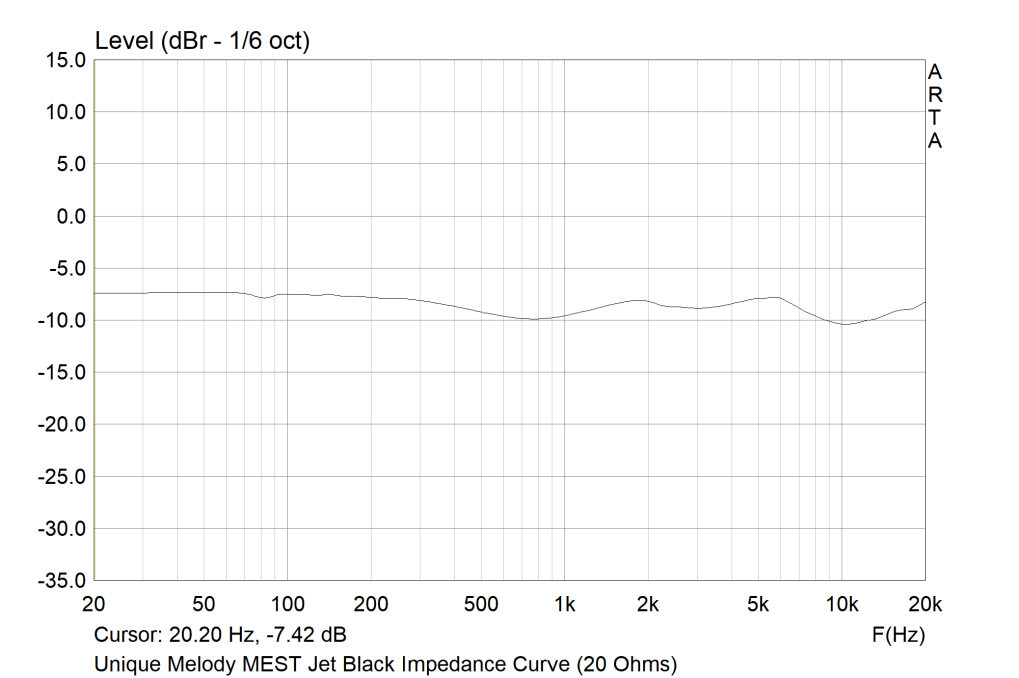
Despite the complexity of its design, MJB offers a broadly flat impedance curve that gives it a fairly consistent character between sources. In subjective listening, they do sound a smidge leaner but overall, the difference is not night and day. I would still consider the overall timbre more desirable from a low impedance source of 1.5 Ohms and below, but you can comfortably pair MJB with higher impedance sources without too much concern of drastic tonal changes.
Driving Power
With all of this said, I did find MEST Jet Black to scale well with proper amplification. The differences are quite typical as with all high-end IEMs. Switching from a portable source to a desktop source showcased a jump in bass control, resolution and overall spaciousness. MJB has all of the resolution to take advantage of a high-end source and needs a bit more juice to maximise dynamics and range. I would consider one of the larger portable sources, like the Fiio BTR17, to be the level of device you would want to drive these earphones to their potential.
Suggested Pair Ups
As always, personal preference heavily plays into this. My ears craved warmth on the MJB and therefore, I was more inclined towards warmer, mid-bassy sources. Neutral sources also work just fine and bring out the technical nature of MJB. However, to me, bright sources were just too intense. Otherwise, they are efficient but not too hiss sensitive, not overly wonky with higher output impedance sources. MJB scales well with amplification.

Ryan Soo
Avid writer, passionate photographer and sleep-deprived medical student, Ryan has an ongoing desire to bring quality products to the regular reader.
 Everyday Listening