

Nostalgia Audio Pendragon Review – Sumptuous

Pros –
Lush, coherent tuning, Powerful yet highly controlled bass, Well-textured and authentic note presentation, Gorgeous design, Flexible source pairing
Cons –
Separation below average, Darker top-end won’t suit all, Large shells
Verdict –
Pendragon really comes into its own during extended listening, delivering a rich, refined yet relaxed presentation that isn’t lacking nuance and complexity in the slightest.
About Nostalgia Audio –
Nostalgia Audio is a Hong Kong-based brand specialising in boutique IEMs and custom cables. Co-founded by Artanis and Adrian, the two set out to produce the products they personally wanted and felt were absent in the market. To that end, they sought to develop audio products to suit a diverse range of needs and preferences with the belief that there is no one-size-fits-all approach. The duo focus on meticulous attention to detail, both inside and out, and never shy away from innovation, combining cutting-edge technology with artisanal handcrafting techniques.
Introduction –
It has been some time since I’ve tested a product from Nostalgia Audio (NA). The once humble HK-based brand reached out to me almost 4 years ago to review their first IEM, the Benbulbin. What I experienced at the time showcased impressive maturity, and NA subsequently demonstrated that this was just a taste of what they were capable of. Since then, their product range has greatly expanded and diversified into both audiophile-targeting and professional-series IEMs alongside custom cables to suit both.
Pendragon is the latest audiophile flagship from the brand, following an extensive 2 years of development. It is a celebration of Nostalgia Audio’s 5th Anniversary and is a spiritual successor to the popular Camelot, slotting in right above Durandal, which sports similar Western design motifs. At Pendragon’s heart lies a whopping 14 drivers in a quad-hybrid arrangement, not to mention all of the technologies pioneered by former flagships. Nostalgia Audio has evidently pulled out all of the stops for their latest and greatest making it clear that Pendragon is built to make a statement.
Pendragon is available for $3,799 USD at the time of writing. You can read more about it and secure one for yourself at Nostalgia Audio!
Disclaimer –
I would like to thank Adrian very much for reaching out to organise a review of the Pendragon. All words are my own, and there is no monetary incentive for a positive review. Despite receiving the earphones free of cost, I will attempt to be as objective as possible in my evaluation.
Contents –
- Page 1: Intro, Unboxing, Design
- Page 2: Sound and Source Pairings
- Page 3: Comparisons & Verdict
Specifications –
- Driver: 2x DD Sub, 2x BCD Mid-Low, 6x BA Mid-Ultra High, 4x Super High EST
- Impedance: 19 Ohms
- Sensitivity: 115 dB
- Crossover: 6-Way
Behind the Design –
Quad Hybrid Architecture
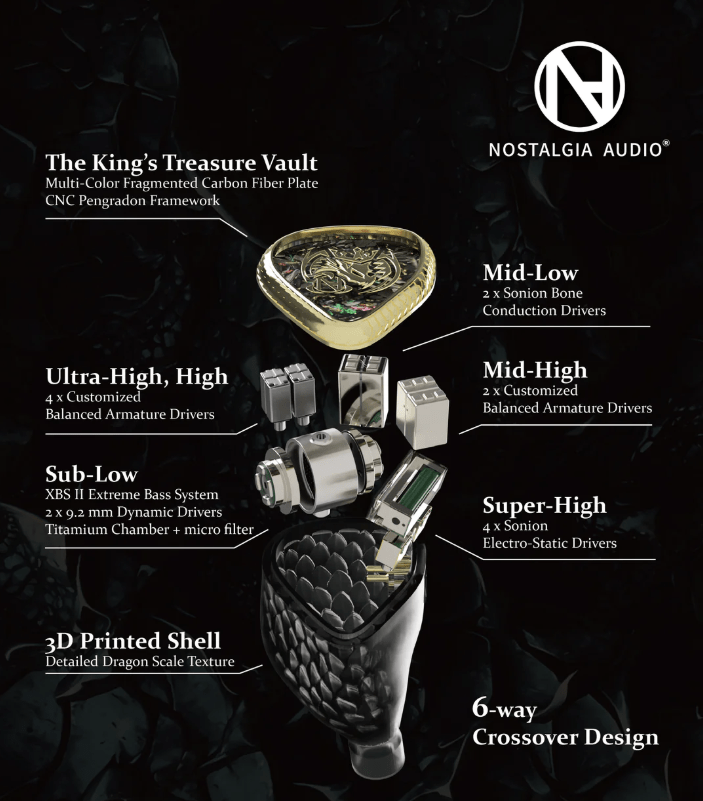
Pendragon utilises 14 drivers in total, united by a 6-way crossover. Covering the sub-bass are 2 custom 9.2mm dynamic drivers making up the XBS II Extreme Bass System. This comprises an aerospace-grade titanium alloy enclosure that reduces resonances with a 3D printed micro filter to precisely control air flow. Above, 6 Knowles and Sonion BA’s are placed in a 2+2+2 configuration, portraying mid-high, high and ultra-high, respectively. 4 Sonion electrostatic super-tweeters cover the very top, and all of this is augmented by 2 Sonion bone conduction drivers.
Electromagnetic Shielding Coating

Shielding is one of the most important aspects of audio design in order to reduce interference, thereby achieving the greatest resolution. A specialised coating has been applied to the driver units made from zinc oxide and indium tin oxide. ZO is a key ingredient used in sunscreens for its excellent rejection of UV radiation, while ITO is used for its anti-static properties. Nostalgia Audio then implement a polyaniline polymer matrix, which is a conductive polymer that offers further anti-static properties. It also offers EM shielding similar to a Faraday Cage. Nostalgia Audio posits that these methods reduce EM wave interference by 98.7 %.
Micro-Nano Printing
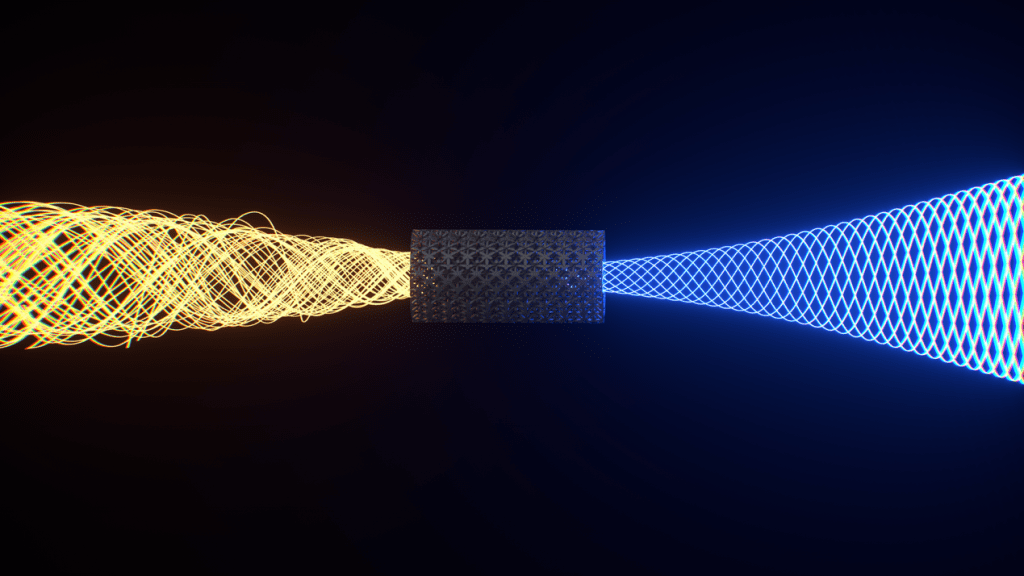
As aforementioned, 3D Printing was used extensively for Pendragon’s construction, not only for the shells but also for filters and internal acoustic design. NA used AI to analyse different internal designs and find the optimal geometry for each frequency. They then used 3D printing at a 2-micrometre tolerance to develop filters and conduits. This includes Spiral Flow Device II, which specifically enhances midrange performance. It comprises a helical ridge structure (similar to the thread structure of a screw) that creates a vortex effect within the acoustic chamber to reduce energy loss and improve phase coherence in the 3-5kHz range.
CNC Machined Faceplate

The final complication is a 5-axis CNC-machined aerospace-grade aluminium faceplate. NA used a thousand CNC processes to create a dragon-scale texture, which is then protected by an anodization treatment that aids scratch resistance. Multi-coloured forged carbon fibre panels adorn the outermost surface. Each is independently crafted, making every Pendragon bespoke. The 3D printed housings also share a dragon scale texture derived from a gold microparticle coating on the inner surfaces that achieves a three-dimensional effect and lustre.
Caliburn Cable
A custom cable has been crafted for Pendragon exclusively, dubbed Caliburn. It uses a coaxial shielding structure with 4N German OFC copper in a Litz Type 4S four-strand configuration. The core has its own PVC insulation in addition to a USA-made SoftFlex PVC outer sheath to provide ultimate shielding and durability without sacrificing ergonomics. An inner cross-weave mesh made of 5N silver-plated OFC copper offers additional shielding from interference. Black and grey elements with metal hardware complement the aesthetics of the earphones themselves.
Unboxing –
Evidently, much has gone into the design and manufacturing of Pendragon; however, it feels like the unboxing leaves something to be desired at the exorbitant asking price. While I personally have no qualms with a more minimal unboxing, I can understand that some may expect more theatrics for a flagship, statement product.

A matte sleeve slides off a card box with themed print and a brief statement from NA. Sliding off the upper lid reveals the IEMs with a protective plastic film, a cardboard accessories box and a vinyl carrying case. Unlike previous flagships from the brand, Pendragon does not come with a bespoke leather or metal carrying case but a general vinyl unit with Nostalgia Audio branding only. It is functional, however, with a hard skeleton and non-scratch suede lining. Within is a 3D printed eartip case containing 3 varieties of tips. There are 3 pairs of NA’s extra wide sound barrel tips (XWB) that offer a large sound tube with a vortex structure to reduce resonances, 3 pairs of hard-stemmed silicone tips offering a bassier sound, and 3 pairs of grippy heat-activated TPE tips. The Caliburn cable sits within the case with a Nostalgia Audio vinyl organiser clip.

The accessory box holds a personalised nameplate with the build number, a 2-pocket mesh bag for protection during portable use and a few stickers. Overall, the unboxing contains the essentials and some nice-to-haves, but is one of the more Spartan offerings for a flagship product.
Design –
The countless hours of CNC processing and multi-layer resin design immediately reward the viewer upon viewing. Pendragon is simply a handsome IEM. In addition, though employing a multi-component shell, the tolerances and seams are nigh perfect, with each element marrying function and artistry. Of course, the anodised scale-textured faceplates with forged carbon inlays look spectacular. They are free from bubbles or imperfections, a testament to the technicians who hand-finish each unit. While I am sometimes disappointed to see resin shells on such lucrative IEMs, here, the execution is elevated with golden scales tastefully immersed within smoke resin. It gives the IEMs a depth and intricacy deserving of praise.
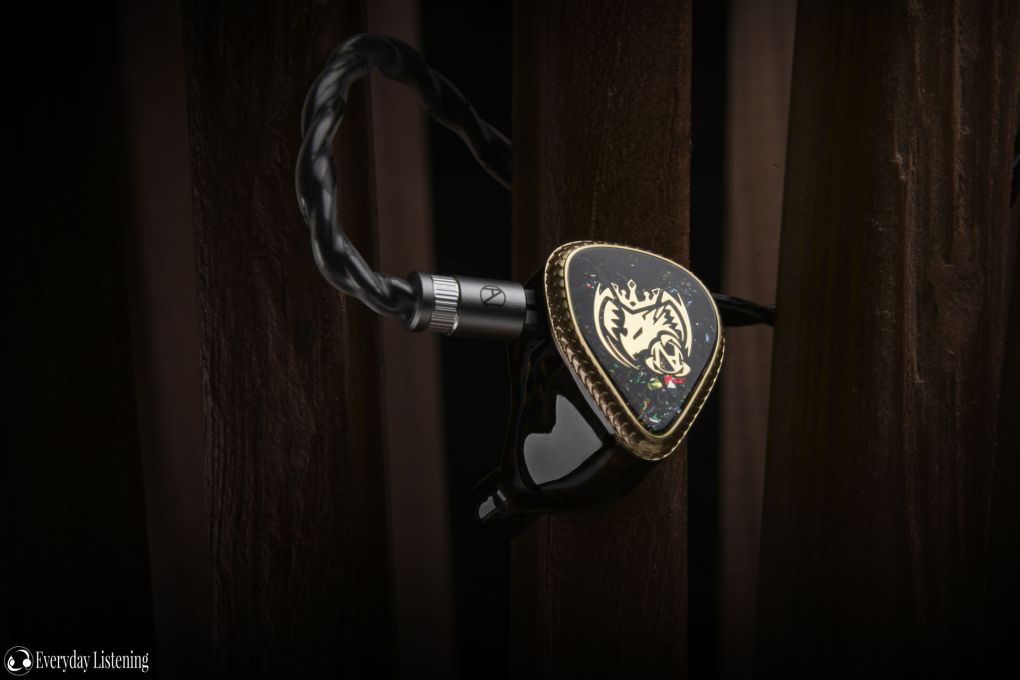
Recessed 0.78mm 2-pin connectors make an appearance, allowing for wide aftermarket cable compatibility. With that said, the included unit is of excellent quality, being an in-house developed, handcrafted product; however, not officially a Vortex Audio cable as on previous flagships. Black TPU insulation complements gunmetal alloy hardware. Though a fairly large gauge, the 4-wire braid is impressively supple with minimal microphonic noise and zero memory, coiling easily for storage and avoiding tangles with aplomb. Premoulded ear guides offer a comfortable and stable fit, and the cable is terminated in a 4.4mm plug, which has become the main balanced standard in recent years. There is no modularity on either end, but the quality of the cable itself cannot be faulted.
Fit & Comfort –
It is instantly apparent that Pendragon is a large IEM, especially width-wise. Where Benbulbin had an almost hyper-sculpted design with a notably deep fit and pronounced anatomical features, Pendragon is smooth and bulbous with few complexities. As with most IEMs sporting BCDs, this is likely to enlarge the contact area with the outer ear cartilage to maximise conductive effect. In turn, it doesn’t have any features to relieve pressure points, instead offering broad contact points that naturally disperse pressure, avoiding small hotspots. With that said, Pendragon will definitely not be for those who struggle with IEM fit in general, nor those with smaller-than-average ears. After a few hours, wearing pressure is evident, if not bothersome to the extent I had to stop listening.

Still, despite their size, the housings are very light, which aids comfort and fit stability. The nozzles are also well-angled and medium length, offering an average fit depth but a strong, reliable seal that easily matches more shapely IEMs. Pendragon appears to have a sealed housing, which contributes to this impression. Wearing pressure isn’t too high due to the medium fit depth, but driver flex is very apparent. I have never personally experienced any performance degradation or issues as a result of driver flex, and the same goes for Pendragon during my testing period. The upside is that passive noise isolation is well above average. With foam tips, they would be suitable for very noisy listening environments, such as air travel and even with silicone tips, I never felt ambient sound was overly affecting fidelity.

Ryan Soo
Avid writer, passionate photographer and sleep-deprived medical student, Ryan has an ongoing desire to bring quality products to the regular reader.
 Everyday Listening