

Nostalgia Audio Pendragon Review – Sumptuous

Sound –

Testing Methodology: Measured using Arta via IEC 711 coupler to Startech external sound card. 7-9KHz peaks may be artifacts/emphasised due to my measurement setup. Measurements besides channel balance are volume-matched at 1KHz. Fit depth normalised to my best abilities to reduce coupler resonance. Still, due to these factors, my measurements may not accurately reflect the earphones or measurements taken by others. I gave Pendragon 100-hrs of burn-in prior to review.
Tonality –
Having only tried one model from Nostalgia Audio, I was excited to hear what style of sound the company would bring to the table for their flagship model. True to their intentions, Pendragon is broadly well metered with a relaxed L to U-shape and an overall rich, polite character. It is bass-forward but not to the extent that versatility is compromised. That said, if you want a strictly balanced sound, Pendragon may be too rich and full-bodied. Bass sees moderate broad emphases with a light mid-bass focus imbuing a warmer character whilst avoiding overly rounded or tubby notes. The midrange is laid-back and has a coherent yet articulate character. Rather than the typical 3kHz hump, Pendragon has 2 and 4 kHz emphases that achieve a similar effect with minimal timbral oddities.
Overall, a natural and well-expressed midrange. Treble is impressively linear and sits just in front of the midrange, but never at the front of the sound. In this sense, Pendragon has excellent long-term listenability, but still enough treble presence that all details and intricacies are present if never exaggerated. As expected, overall extension, resolving power, and note definition operate at a very high level. What surprises when listening to Pendragon is its restraint. The complex driver setup presents a natural, coherent sound, letting excellent resolution invigorate the listening experience rather than outlandish tuning.
Eartips
Nostalgia Audio provides 3 varieties of ear tips in the box. The XWB tips offer the most balanced sound and were the default tip I used for this review. There are also blue foam-filled ear tips that tone down the upper midrange and treble, granting a slightly smoother and darker sound alongside a more intimate soundstage. While passive noise isolation is improved, I personally preferred a bit more brightness, especially given that the Pendragon is already on the darker side. The final pair are thermoplastic tips similar to Azla Xelastic tips. I found them to offer a slight step up in upper-midrange presence, producing a slightly more present, open sound here. However, they also shift the treble focus, reducing lower treble crispness and enhancing air to a small degree. Overall, I found them to sound quite convincing but preferred the more stable imaging offered by the XWB tips; hence, they were used for the remainder of this review.
Bass –
Pendragon offers a low end that is prominent and always present without overstepping. It has a powerful, punchy voicing that makes it bassy but still not what I would consider a bass-head IEM. Where the trend on Asian flagships is often to emphasise the sub-bass in favour of a cleaner overall tone, Pendragon is warmer and euphonic. It has a smidgeon of mid-bass bias with sub-bass just behind, and upper-bass toned down for midrange separation. In turn, it still has plenty of dynamics and power at the very bottom, but also offers a sense of fullness and gravitas that many high-end IEMs have come to lack. Notes are still on the bold over full and rounded side, and bass is well-structured, offering exemplary extension into the physically felt frequencies without excess pressurisation that may fatigue. On tracks lacking sub bass, there’s more warmth and punch, which ensures they never sound sparse or dry. The downside is that separation isn’t quite as proficient as the very best, no fault of the quality of its bass, but simply its fuller tuning.

To extend, bass quality is as good as you would expect at the asking price. The dual woofers serve up plenty of quantity but also function to tighten up note delivery and increase definition. Sub-bass has heaps of power, weight, and a concise attack. It isn’t the quickest-decaying low-end, but I find that this actually makes the note delivery more natural. The mid-bass is very impressive, as though it is present and full; it is also very well textured. Pendragon doesn’t skip any fine details. It isn’t hyper-separated, but all of the nuances are still easy to pick apart. Even saturated tracks such as MF Doom’s “Crosshairs” avoid any smearing of fine details on those plump descending bass lines. Pendragon offers the unique quality of excellent PRAT on quick and electronic tracks due to its keen attack, and defined texturing, and natural decay on slower, instrumental tracks. Though bass will be too forward for purists, those wanting a versatile low-end with top-level resolving power and a rich, powerful tuning will find Pendragon one of the best.
Mids –
As opposed to a more typical W-shape, mids are laid-back but remain natural and clearly expressed. As aforementioned, this has been achieved with dual 2 and 4 kHz emphases, giving male and female vocals a bit more parity over the typical 3kHz hump. Another advantage is a slight boost to vocal clarity, yet without any intensity or sharpness – owing to the laid-back presence and warmer bass. The voicing is natural and full-bodied with no oddities. Where many W-shaped earphones can sound a bit dry, especially in the lower-midrange, Pendragon is instead medium warm and coherent. As colouration is mild, there’s no chestiness, muffle or veil. Similarly, though the top-end is on the articulate side, it isn’t overly bright. Midrange note definition operates at a high level overall, and vocals are detailed without a hint of sibilance or intensity.
Raw midrange instrument resolution takes a step back relative to vocals, which tend to sit more in the spotlight within the midrange itself. However, as bass and treble sit in front to some degree, instruments overall occupy equal footing. I was impressed by Pendragon’s layering, especially perhaps due to the implementation of BCDs combined with a darker background. There is excellent separation between layers, and each is well-defined, which adds dimension and complexity to its sound and makes the listening experience more involving. Resolving power is very good too, and as the tuning is well-metered, there is no masking of fine details despite the richer voicing. Separation once again isn’t on the highest side, but it is certainly never an impediment. If you like high clarity or a super open sound with isolated notes, Pendragon is not for you, as it instead focuses on coherence whilst maintaining texture and fine detail, as in the bass.
Highs –
The top-end is defined by excellent technical performance with a toned back tuning that gives you everything, just in ample quantity. As such, treble never glares over the presentation. I find myself returning to similar descriptors throughout this review, which are restraint and care. Many IEMs sound more impressive on first impression, only to tire during ownership. Pendragon is no such creation. There’s a broad 5-8kHz shelf showcasing impressive linearity. It sits just in front of the mids but behind the bass and, therefore, does not fatigue or glare. The linear tuning gives Pendragon an excellent sense of note body, texture and authenticity. It isn’t the most crisp and hyper-etched flagship, but it offers a very nice note timbre and a good balance between leading-edge definition and natural decay and shimmer thereafter.

Above is where some will love or hate Pendragon. The EST implementation is very linear and offers excellent extension, but it is on the darker side. This means that sparkle and micro-details are abundant but presented in a subtle, laid-back manner. The upside is that treble lacks the usual timbral oddities observed on an upper-treble emphasised IEM. Pendragon has all of the information but never thrusts it to the fore. This can make it sound a bit blunted relative to many high-end IEMs. Nevertheless, top-level extension is evidenced by the sheer soundstage dimensions, which are exacerbated by the clean, dark background. Pendragon errs on the stable and layered over vibrant and etched side, whilst still offering a very satisfying foreground detail presentation with great timbre in particular.
Soundstage –
Pendragon offers a spacious stage occupied by large, full-bodied notes. This equates to a rich, grand listening experience. On tracks that call for it, Pendragon is able to extend well beyond the head and deliver nicely rounded stage proportions with a sense of depth projection too. Raw dimensions fall short of the very best despite the BCD tech, but the counterproposition is Pendragon’s coherence. Imaging is tight-knit and accurate. Layering in particular, I was impressed with due to excellent foreground/background contrast. Positioning is very stable and realistic, yet Pendragon is still able to portray an involving, multi-dimensional image. As aforementioned, separation isn’t as hyper-emphasised as on many flagships. This affects the immediate perception of spaciousness and holography. Pendragon sways on the stable and coherent side, instead giving it more of a club as opposed to a concert hall style of presentation.
Drivability –
With a 19 Ohm Impedance and 115dB sensitivity, Pendragon is a very efficient IEM despite the complexity of its circuitry. Indeed, I’ve found that the IEM is able to achieve ear-splitting volumes from typical portable sources. Despite this, I did find that it scales well with power and naturally for an IEM of this calibre you will want to pair it with a proficient source be that portable or desktop.
Output Impedance Sensitivity
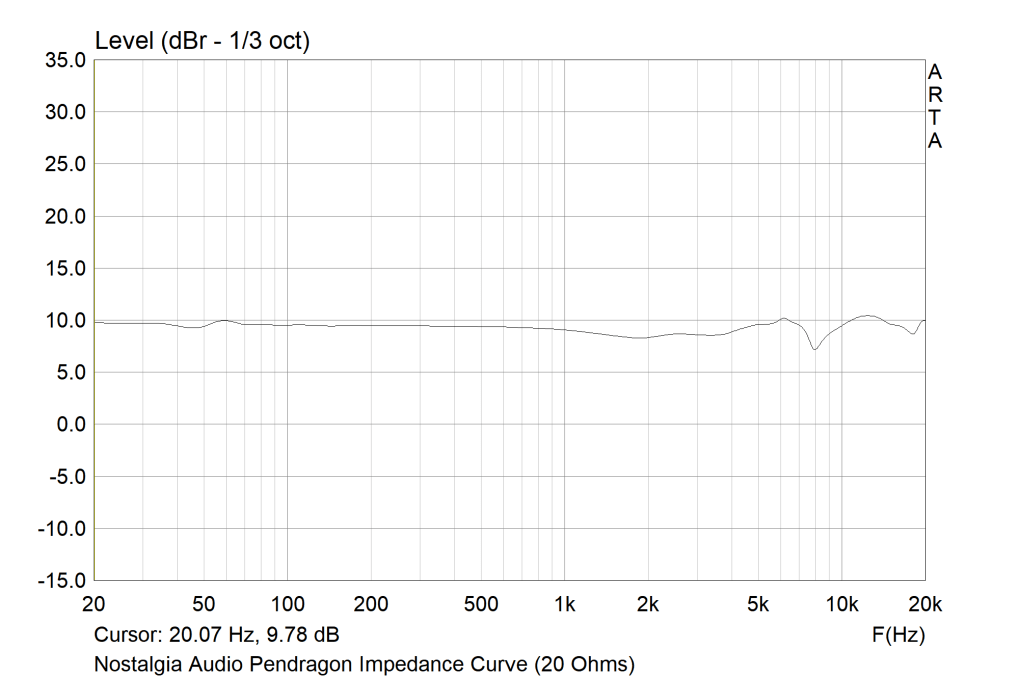
Pendragon offers an impressively linear output impedance despite the complexity of its driver setup. A little unevenness creeps into the high-end with a 20-ohm output impedance source but it isn’t something that is exceedingly noticeable in subjective listening. While a lower output impedance below 2 ohms is advised for maximum fidelity, Pendragon can get away with higher source which widens pairing options.
Driving Power
Comparing the DITA Navigator with my desktop stack with THX amplifier reveals that the desktop setup provides a notably more responsive and robust low-end. There is slightly more quantity and extension, slam at the very bottom is more pressurised and tighter. Besides this, the soundstage becomes more spacious. I would consider one of the larger portable sources, like the Fiio BTR17, to be the minimum level of device you would want to drive these earphones to their potential.
Suggested PairUps
Pendragon benefits from a good amplifier in order to get the most out of its dual woofer system. It is impressively stable from higher output impedance sources and isn’t overly sensitive to the extent that hiss becomes a huge problem. As far as tonality is concerned, it is quite a forgiving IEM as the tuning isn’t pushed too far in any direction. Subejctively, darker sources are best avoided as the IEM is already on the smooth side. However, warmer sources didn’t irk and similarly, bright or neutral sources are well suited to Pendragon’s lusher tuning.
Guinevere
The flagship cable from Nostalgia Audio, Guinevere, is designed to complement any flagship IEM, making it feel right at home with Pendragon. This is a gold, silver, platinum, and palladium alloy cable with a Litz geometry. It has a golden colour scheme that perfectly matches the styling of Pendragon. Sonically, the pairing is subjectively a double-edged sword as the cable enhances the strengths of Pendragon but doesn’t serve to increase balance or widespread appeal per se. Specifically, the sound becomes fuller, smoother, but also more controlled and spacious. Bass is slightly more extended with greater parity between sub and mid-bass. It is tighter and more defined. Mids are denser and slightly fuller, but the increase in spaciousness means separation is similar overall. The top-end upholds similar presence, there is a slightly more detailed foreground and a hint more openness and sparkle. The sense of space increases, overall sounding just as open as the standard cable, despite the bump in overall fullness. This pairing epitomises endgame lushness.

Ryan Soo
Avid writer, passionate photographer and sleep-deprived medical student, Ryan has an ongoing desire to bring quality products to the regular reader.
 Everyday Listening