

Astrotec Lyra Nature Limited Edition Review – Full Bloom
Sound –
I feel earbuds aren’t discussed as much as they once were which is ironic since earbud tuning has come a tremendously long way. Perhaps due to my particular ear shape, I’ve always struggled with the sound either skewing too warm and congested with covers or too bright without. Over time, I’ve observed a trend towards more natural tonalities in the earbud community. The Lyra Nature was the first earbud I tried that sounded pleasantly balanced and natural with no covers installed. Because of this, I found it to have a leg up on competitors with regards to detail retrieval as it didn’t suffer from the top-end roll-off that comes with using foam covers. The far more costly Fiio EM5 rivalled this impression as it was able to overcome this limitation with a sharp, aggressively detailed top-end that balanced out the attenuating effect of foam covers. In so doing, that model was able to achieve the best of both worlds, a robust bass and a well-balanced top-end.
Tonality & Covers –
So where does this put the Lyra Nature Limited Edition? Immediately, it offers a slightly less prominent bass and a fuller, more powerful midrange than the original. It also has better high-frequency extension with good evenness across the midrange and lower-treble but a noticeable upper-treble lift that gives it a good amount of headroom. Accordingly, one can make a case for listening both with and without foam covers. Without covers, it sounds brighter than the vanilla Lyra though the fuller midrange sounds no less natural, simply more forward, while treble sits in balance and bass takes a step back.
With covers, this is inverted. It sounds smoother and fuller, assuming a balanced bass and midrange at the cost of a smooth, laid-back treble. Depending on your preference, you have two very viable signatures. For me, I did enjoy the more coherent and refined sound provided with the stock donut foam covers that I didn’t find to introduce any muffle or congestion. It then achieves a deeper extending and more dynamic bass performance than the original Lyra sans cover but has a less airy and energetic treble. This impression is inverted without covers.
Cables –
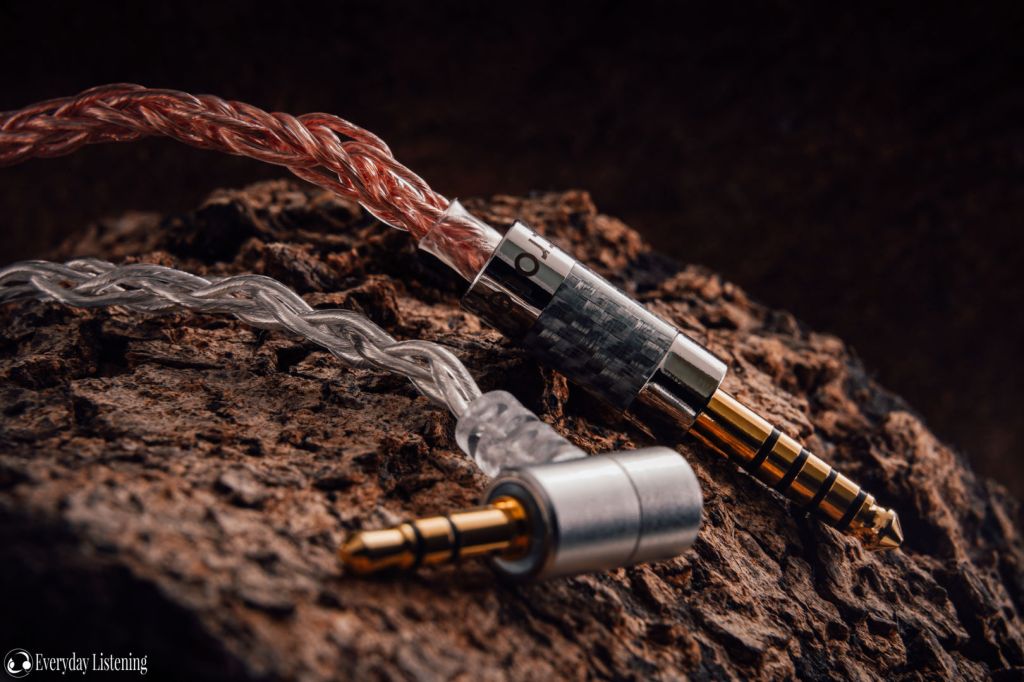
The Lyra Nature LE comes with 2 cables, both of high quality. Strangely, it was the 8-core copper cable that I preferred rather than the SPC cable as I found it to offer better separation throughout and a sharper note presentation. The Nature LE sounded cleaner and clearer with this cable, in addition, the soundstage was larger. Simply put, the copper cable sounded better across the board to my ears. However, do note that I am also switching from a single-ended to balanced output here as the copper cable has a 4.4mm termination. Driven from my THX789, this means it does get more driving power which can weigh into this impression.
Bass –
While an above average performer within its form factor, the Lyra Nature remains an earbud with minimal seal. While the overall quantity of bass is well-balanced with the midrange, sub-bass rolls off quickly, delivering a tight, concise impact but diminished rumble and slam. The mid-bass and upper-bass steal focus, with covers especially, you get a more affirmative mid-bass punch than the vanilla Lyra. I hear progressively increasing emphasis as the frequencies rise though it was clever of Astrotec to implement a small lower-mid nadir that prevents congestion. The note timbre is on the fuller and smoother side; the upper bass rise especially gives instruments a rich, organic warmth and instigates the fuller character of the midrange.
This full and warm note structure means you don’t get huge separation in the bass, but the presentation isn’t too woolly or bloomy either. In particular, driver control is outstanding, and each note upholds admirable definition and great textural quality in turn. The reduced sub-bass presence also gives the mid-bass more room to breathe, avoiding smearing fine details. As such, the Lyra Nature LE comes across as a pleasantly articulate earphone with a smooth texture yet strong detail retrieval. It has a concise note attack and decay and noticeably higher driver control than most competitors. As such, though it isn’t overtly focused on timing or definition, it achieves good tactility rivalled by very few earbuds.
Mids –
A highlight of the Lyra range, Astrotec demonstrate the ability to tune a surprisingly natural midrange on the earbud form factor, that lets their products stand above the crowd. Though modestly warm and slightly full-bodied in the bass (with donut foams), the Lyra Nature is impressively linear through the midrange itself. It also showcases excellent extension with a slight 4k bump but never introduces peakiness or intensity in so doing. This helps to retain clarity and well-balanced vocal positioning relative to the bass. As the lower treble is also quite even, just slightly laid-back, the presentation has a smooth articulation, zero sibilance and a very refined overall character. Of course, the midrange is coloured by the surrounding frequencies, so don’t expect a neutral tonality here nor huge clarity or note definition.

Rather, the Lyra Nature LE provides an organic and smooth rendition focusing on a highly natural voicing and high vocal intelligibility rather than huge vocal clarity. The cleanliness of the note presentation and overall coherence are excellent which works to minimise excess roominess and congestion or muffle. The Lyra Nature was a similarly strong performer and we can observe a few key trade-offs. In particular, upper-midrange extension is slightly better and the LE trades the warmth of the OG Nature for a slightly more full-bodied note structure and a slightly cleaner tone. Altogether, this enables it to showcase an jump in coherence and timbral accuracy if at the cost of definition and separation.
Highs –
A common weak point of earbuds relative to IEMs, the Lyra Nature LE provides a surprisingly strong performance here just shy of the best I’ve heard. Treble is impressively even-handed, even with foam covers. The lower treble is slightly smooth, a little laid-back relative to the uncovered Lyra Nature. However, the transient response is slightly sharper, meaning through it isn’t as crisp, fine detail retrieval is enhanced. A highlight of its even-handed response is the accuracy of the instrument body on display, providing a highly textured portrayal of cymbals and strings especially. Above, you get a decent 8k peak and then linear extension rolling off just above the middle-treble.
This is a much stronger performance than most earbuds I’ve tested but bested in terms of resolution of micro-detail by many IEMs around this price. Still, combined with the open form factor, this contributes to a good sense of background detail that adds a lot of organisation to its expansive stage. It means it doesn’t simply sound spacious and diffuse like most earbuds, but layered and multi-dimensional, elevating the sound beyond the constraints of the in-ear form factor in this regard. Again, don’t expect much micro-detail or any sparkle at the very top. This earphone has a clean, dark background a slightly faster decay after the initial leading edge. Surely its virtues are its refined and textured portrayal in the foreground combined with its exemplary sense of space and layering.
Soundstage –
One of the primary reasons earbuds have retained their loyal following; the Lyra Nature LE provides a huge soundstage relative to almost any IEM. This is mostly with regards to its sensational soundstage width, while depth is hampered by a more diffuse centre image. This may be due to me struggling to achieve an ideal fit, but such is a complication of earbuds so I believe it is fair to report this, YMMV. One key characteristic to note is the way it expands too, unlike most IEMs, the edges of the stage taper off smoothly, there’s no hard limit to their dimensions. This further exacerbates the sense of space on display.
Imaging performance is some of the best I’ve heard from an earbud. Granted, this isn’t the pinpoint accurate, holographic imaging you might hear on a good IEM. However, the stage is highly layered with heaps of atmosphere. Directional cues aren’t super sharp but localisation is easy to pinpoint. Separation is a good performer in the earbud realm as the extent of its warmth and roominess isn’t excessive and the note presentation is concise and controlled throughout.

Ryan Soo
Avid writer, passionate photographer and sleep-deprived medical student, Ryan has an ongoing desire to bring quality products to the regular reader.
 Everyday Listening
Beautiful photos man.
LikeLike
Thank you!
LikeLike