

Astrotec Phoenix 6 Review – Maturity

Sound –

Testing Methodology: Measured using Arta via IEC 711 coupler to Startech external sound card. 7-9KHz peaks may be artefacts/emphasised due to my measurement setup, less so with a deep fit. Measurements besides channel balance are volume matched at 1KHz. Fit depth normalised to my best abilities to reduce coupler resonance. Still, due to these factors, my measurements may not accurately reflect the earphone or measurements taken by others. I gave the Phoenix 6 100hrs burn-in to ensure maximum performance prior to subjective breakdown.
Improved QC –
If there’s a recurring theme here is the maturity of Astrotec and their designs. Not only does this apply to the improved tolerances and complexity of their shells, but also to the sound. I must admit, I have experienced more QC control issues with Astrotec than any other company I’ve worked with. Part of this comes down to Sonion’s EST drivers that appear to be especially fickle over international shipping as 3 models I’ve reviewed using these drivers have suffered from severe channel imbalance. I am delighted to report that the new Phoenix 6 has perfectly fine channel matching and showcases improved quality all-around. The little niggles and defects I observed on past Astrotec models are long gone which gives me a lot more confidence in this recommendation.
Tonality –
Refinement applies also to the sound tuning in a big way. Where the original Phoenix leaned hard into colouration and engagement, the Phoenix 6 is a far more even-handed approach to a similar kind of clear yet rumble-focused sound. To my ears, it is a tremendously likeable and nicely balanced in-ear monitor without overcompensating and coming across as remotely sterile or unengaging. Emphases are progressive and in all the right areas; large peaks and troughs have been kept to a minimum. The Phoenix 6 reflects the tastes of the times well with a progressive sub-bass boost and minimal shelf which is to my preference to maximise separation whilst retaining weight and rumble. The mid and upper-bass are clean, and the lack of tonal colouration here means the lower midrange requires no recession.
This lays the foundation for a natural, well-bodied and coherent midrange presentation. Pinna gain is appropriate, just a few dB laid-back through the upper midrange that I must note is to my personal preference. A 5k hump sits in equal presence to the upper midrange imbuing a balanced detail presence with a slightly energetic voicing. Of note, the 8k peak was not present to me in listening and I am subjectively hearing a more even 5-6k emphasis contrary to my measurement. This is a common region that my measurement setup amplifies due to coupler resonances and peaks can vary due to many factors, fit depth being a big one. Overall, this is a refined sound with a slightly relaxed nature but one of impeccable taste and versatility that I believe the vast majority of listeners will greatly enjoy.
Ear Tips
I didn’t personally enjoy the sound and ergonomics of the stock tips, I found that the Phoenix 6 was better served by aftermarket alternatives. Here, I settled on the Acoustune AET07 tips that you may see on MMR’s IEMs. These tips suit a deep fit and gave me a great seal. The sound was balanced with a strong imaging performance and a controlled bass. I found the Azla Sednafit short tips provided a slightly more defined and weighted bass but a thinner midrange that I wasn’t entirely a fan of. However, those wanting a more revealing sound may find them to their preference. The Final E tips are also a strong option for those wanting a slightly more coherent sound with a bit more warmth and density. At the same time, I didn’t find the fit quite as good as the AET07’s nor was the imaging and bass performance. As usual, do experiment here to find your preference and the best fit for your ears.
Bass –
A defining feature of the original Phoenix, this remains a very likeable aspect of Astrotec’s latest flagship. While the tuning has undergone an evolution in terms of balance and linearity, this also means those that loved the thunderous sub-bass of the original may still prefer that model. The 6 is infinitely cleaner and undoubtedly the more accurate monitor on the contrary. The presentation remains fun and engaging with a superbly implemented sub-bass boost that barely colours the tone. Notes are bold and well-weighted in turn but are delivered with zero bloat, muddiness or bloom. The mid-bass retains plenty of room to breathe and, at the same time, no portion of the bass sounds recessed which provides a consistent character between different genres and mastering styles. The transition into the lower midrange is superbly even too which contributes to a far more natural-sounding midrange on a whole. I couldn’t be more enamoured with the tuning, especially when taking into account the impact of bass colouration on the rest of the sound.

As expected from a high-end hybrid monitor, extension is excellent, and rumble is both physical and delivered with excellent definition. Dynamics perform at a high level due to the combination of sub-bass enhancement alongside strong separation and a tight, controlled driver. I do feel the original Phoenix has a slight advantage on sheer dynamics and its wooden shells do provide a different style of decay that many enjoy. The Phoenix 6 sounds more controlled yet less free-flowing in a sense. It has higher note definition and separation by a good amount but also less drive at the very bottom. It is a tight and responsive performer which works in tandem with the vastly cleaner tuning to earn its higher price tag. Attack is quick and powerful, decay swift yet with enough sustain to promote a natural timbre on genres such as jazz. Unless your preference were explicitly for a warm or perfectly flat tuning, the Phoenix 6 presents not only as technically capable but also highly versatile.
Mids –
Where Astrotec monitors have all displayed a fairly consistent bass character, it is within the midrange that they can vary wildly. The Delphinus 5 is likely the most contentious amongst their high-end monitors for its bolstered lower-midrange and reduced pinna gain that gave it a rather boxy voicing. In juxtaposition, the Phoenix was considerably V-shaped forming a coloured and high-contrast sound that required some modification to tame for listenability. The Phoenix 6 heralds the company achieving a sense of stability and maturity as its midrange carries the best qualities of both forming a very convincing overall package. This is a lightly laid-back yet very progressive and naturally voiced midrange with a lick of additional lower-midrange presence giving its male vocals a sense of gusto and power. This does mean it has a slight but not intrusive roominess, a big improvement over the D5 and an improvement in voicing and timbre over the Phoenix too. Where many laid-back monitors are warm or V-shaped, the tonality here is clean with only note body being a touch enhanced. Density is appropriate, neither too great nor stretched thin.
In tandem with a small 5k peak, the earphones are appropriately articulate, clear and nicely extended and also avoid intensity, sharpness and sibilance. Separation isn’t enhanced but it performs at a high level, surprisingly so when taking the IEM’s strong coherence into account. Furthermore, though clear and tonally neutral, the earphones are on the forgiving side due to the upper midrange. That said, though the tuning is nigh ideal for my tastes, the resolving power isn’t quite what I’d expect for such a tall asking price. To clarify, though not ill-defined and quite convincing in terms of layering, small details aren’t presented quite as clearly as many similarly priced models; many of which also benefitting from a more revealing tuning. Still, the Phoenix 6 comes across as a comfortable performer within its price class technically with a very refined tonality that performs strongly in all metrics. As someone who finds Harman and DF-neutral signatures to be on the intense and revealing side, the lightly laid-back nature of the Phoenix 6 is oh so easy to enjoy, especially during long listening sessions.
Highs –
The Phoenix 6 is the conduit for a sublime experience with jazz and instrumentals. The high-end continues the character of the midrange with an even tuning and slighty laid-back nature that contrasts to the very aggressive Phoenix. At the same time, it’s also a far cry from the first-generation of EST monitors whose EST drivers were often difficult to appreciate as here, they are clearly on display. The foreground sees good focus with a small 5-6kHz emphasis before linear extension into the top-octave. There is minimal emphasis in the air and sparkle regions giving this earphone a clean, dark background and a slightly more damped sense of shimmer and decay. At the same time, this permits a sense of authenticity that many upper-treble boosted high-end IEMs lack. Overall, instrument timbre is natural and showcases impressive linearity. I find the restrained nature works much to the benefit of overall texture and timbre. The Phoenix 6 certainly isn’t lacking with respect to micro-detail but does have the typical “whispy” EST note presentation even with the quad-tweeter setup.
Its delicacy is not necessarily to be taken as a negative as note body has been bumped up a notch and both body and texture perform at an accurate level. I noticed this most with regards to the leading edge of notes that clearly isn’t as defined and incisive as a good BA monitor such as Soft Ear’s RS10. This means the Phoenix 6 doesn’t appear as detailed in immediate comparison, especially with its more laid-back mid and upper-treble. However, boot up a track such as “Affaire D’ Amour” by Jacques Lesure and this clearly isn’t the case. Fine details are abundant if not overtly showcased, micro-details are lavishly sprinkled throughout the stage. The Phoenix 6 is able to achieve impressive contrast and headroom on account of its super raw extension and resolving power combined with its relaxed voicing and adequate foreground focus. This is an IEM that excels with space and easy listening, but also one that doesn’t falter in the slightest under scrutiny. These qualities make it a strong choice for those wanting a highly detailed sound without any form of brightness or fatigue and similarly, would like to avoid overt darkness.
Soundstage –
Tying it all together is the soundstage which is both impressive in scale and complexity. The raw dimensions of the stage and its well-rounded proportions are likely one of the IEM’s most impressive qualities. The Soft Ears RS10 is a personal favourite amongst all IEMs but in direct comparison, it was outclassed by the Phoenix 6 with regards to stage dimensions. The Astrotec flagship is a master of immersion, placing the viewer in the centre of an involving and three-dimensionally enveloping stage. If you like speed, sharp direction and super imaging accuracy, the Phoenix 6 is not the most accurate nor does it delineate between each layer like some competitors. It is all about atmosphere and the space between each element. In so doing, I would posit that separation performs at a very high level. It’s not the most revealing monitor, but due to its clean tone and balance alongside its large stage, there is clear space between each element. Its laid-back nature means small details aren’t showcased, but they are also never over-shadowed.
Driveability –
Another area of huge advancement over the Phoenix, the 6 is considerably easier to drive much like a normal BA high-end IEM, perhaps owing to improvements in Sonion’s EST drivers themselves. The Phoenix 6 has a considerably higher 108dB sensitivity and a low 5 Ohm impedance that makes it highly efficient and far more suited for lower-power sources than its predecessor.
Output Impedance Sensitivity
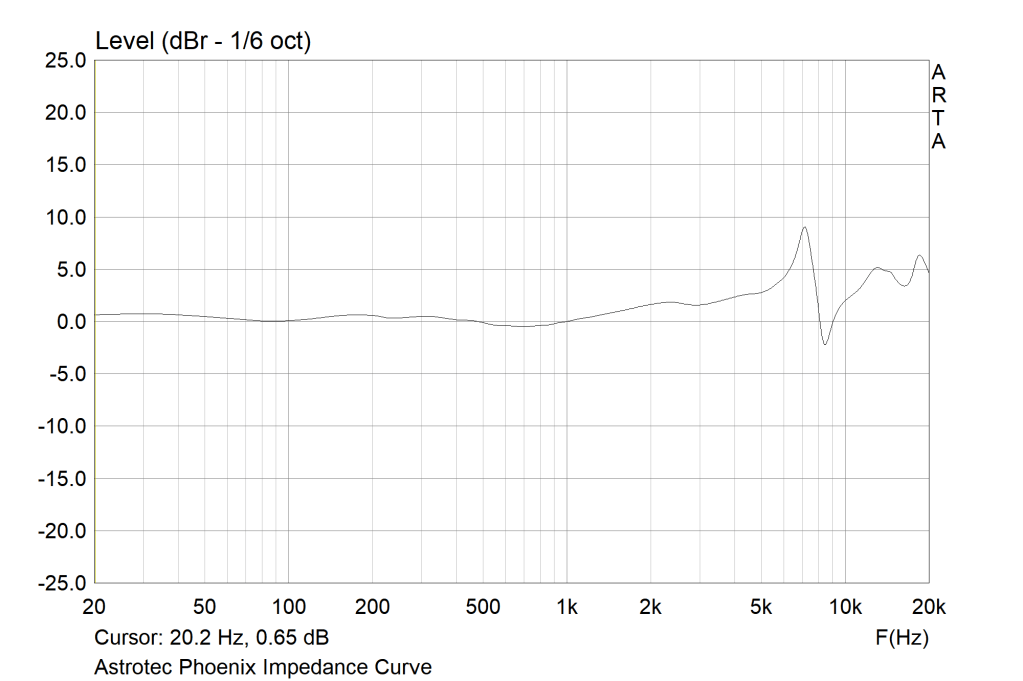
The Phoenix is not a flat impedance design and, as a result, the sound does change with any source with an output impedance higher than 1. Even then, the extremely low impedance of the monitor means you would require a 0.4-ohm output impedance in theory to achieve the sound intended by the manufacturer. In reality, the changes are not that significant, and, for many, changes may even be desirable. As above, with a 20-ohm impedance, we see a progressive increase in upper-midrange quantity alongside a spike in the lower-midrange. From a 10-ohm source like the Hiby R6, the Phoenix subjectively sounded quite enjoyable with a crisper, more revealing sound. While I personally best enjoyed the IEM from a 1-ohm device, users can definitely explore different tonalities with impedance adaptors or particular source pairings and can expect a brighter sound as impedance rises.
Driving Power
Unlike the original Phoenix, the 6 is very efficient. In fact, it is one of the most sensitive high-end IEMs I have on hand just behind the Campfire Audio and Empire Ears designs. Indeed, this does mean that the Phoenix 6 will pick up noise if your source does produce background hiss, however, it isn’t something that stands out as an overt weakness of the design. For instance, on the Shanling M2x with the amp on but volume set to 0, background noise was just barely audible but completely negated when music was playing at any level.
This is more something to note if you have an especially noisy source. In terms of driving power, the Phoenix 6 is efficient and played well with a wide range of sources. Switching from dongles such as the Hidizs S9 Pro to DAPs and my desktop stack provided a consistent experience. I noticed the biggest difference in the sub-bass which was slightly more weighted on the desktop amp and the treble which was more defined. However, this IEM is altogether perfectly suitable for lower powered sources due to its efficient design.
Suggested Pair Ups
The Phoenix 6 is no longer the fickle creature that its predecessor was. It is now very efficient and works beautifully from lower-powered sources. Its signature does change with higher output impedances but in a manner that many listeners may even enjoy. Given the laid-back nature of the IEMs, a 10-20ohm output impedance helps to liven up the treble and midrange – and this comes at no loss to bass extension or impact, forming an enjoyable and put-together presentation. As a result, I would posit that impedance should be the determining factor in terms of source pairings. Source colouration is less of a concern as the earphones are balanced and forgiving. They have plenty of leeway to accommodate additional warmth or sharpness in the treble. For the most authentic experience, pair them with a transparent 1-ohm source with a sharper transient response such as the THX789.

Ryan Soo
Avid writer, passionate photographer and sleep-deprived medical student, Ryan has an ongoing desire to bring quality products to the regular reader.
 Everyday Listening