

Softears Volume S Review – Best of Both Worlds
Pros –
Charming design, Excellent balanced yet natural tuning, Excellent dynamics, High-quality accessories and modular cable
Cons –
Tuning modes are redundant, Requires a low output impedance source
Verdict –
The Volume S offers a winning blend of function, form and versatility, appealing to those wanting balance whilst still being forgiving and approachable, earning it a much-deserved spot on my wall of fame.
About Softears –
Softears is a premium audio brand that focuses on in-ear monitors. They were founded in 2014 in Shenzhen, which is often considered China’s Silicon Valley. Over the following years, the company set up its own factory and independent lab, enabling Softears to keep both R&D and production in-house – facilities that they share to some extent with the immensely popular Moondrop. The company ethos entails products that offer comfort, balance and durability. Special focus also goes towards quality control with individual speaker matching, hand assembly and polishing followed by individual product inspection.
Introduction –
The Softears Volume was one of my favourite IEMs of 2022 and a more engaging alternative to the popular Blessings 2, earning it a spot on my wall of fame. 3 years on, its successor has arrived in the form of the Volume S, which has been launched to rave reviews across the board. The new model experiences a complete redesign far more reminiscent of Softear’s premium models and introduces an enhanced driver setup. In addition to the 1DD + 2BA setup seen prior, the S is sporting a passive dynamic driver. It also features some electronic wizardry in the form of two separate crossover systems permitting two tuning settings, high impedance and low impedance, which offer either a balanced or bright-leaning sound.
The Volume S is available for $319 USD at the time of writing. You can read more about it and secure one for yourself at Softears!
Disclaimer –
I would like to thank Weng very much for reaching out to organise a review of the new Volume S. All words are my own and there is no monetary incentive for a positive review. Despite receiving the earphones free of cost, I will attempt to be as objective as possible in my evaluation.
Contents –
- Page 1: Intro, Unboxing, Design
- Page 2: Sound and Source Pairings
- Page 3: Comparisons & Verdict
Specifications –
- Drivers: 10mm Silicone Diaphragm DD, 6mm wool passive DD, 2x BA
- Frequency Range: 8 Hz – 40 kHz
- Impedance: Mode 1: 31.2 Ohms, Mode 2: 9.8 Ohms
- Sensitivity: Mode 1: 114 dB, Mode 2: 124 dB
Behind the Design –
Active + Passive Bass Drivers

Passive radiators have long been used in portable speakers as it permits enhanced bass extension and efficiency in a small enclosure. In addition, they can be used to tune out resonances, enhancing bass quality. This is seen here in the form of a wool membrane 6mm passive dynamic driver that lacks a voice coil. Softears has paired this with a 10mm rigid Ti-dome active driver with a silicone-suspension surround that offers high excursion and low distortion. Tuned rear and front acoustic chambers with a rear-facing strip vent offer enhanced lows and reduce wearing pressure for extended comfort.
Self-Developed ED Series BA

The Volume S also sports a dual-balanced armature array that was self-developed by Softears. One driver covers the mid-highs whilst the other exclusively covers the high-end. Both sports separate audio pathways for enhanced resolution. The sound tubes have all been designed with minimal bends and the shortest possible length to achieve overall phase coherence between the multiple drivers. The internals were 3D printed in collaboration with HeyGears, a professional 3D printing company.
RC Tuning Network

Comprising of a three-way crossover, Softears has added 8 tuned crossover points to achieve their desired frequency response with excellent specificity. They’ve used technology taken from the flagship RS10, therefore, despite its complexity, Softears was able to achieve a mostly flat impedance curve. The Volume S also has another trick up its sleeve as it features two crossover circuits. One offers a lower 9.8 Ohm impedance and a balanced frequency response whilst the other offers a higher 31.2 Ohm impedance with 6dB of additional treble gain for a more vivid, revealing sound. The crossovers are selected using Japanese copal switches that offer excellent reliability and performance.
Unboxing –
Despite being Softear’s entry-level model, the unboxing experience feels very professional and well-outfitted. An outer sleeve with gloss print slides away to reveal a hard box. Removing the outer lid reveals the earpieces and leather carrying case below. Beneath is another compartment containing two sets of ear tips. Softears’ B-type tips are standard single-flange silicone units that are designed to offer the most balanced sound. The company explains explicitly that they tuned the Volume S with these tips in mind. Meanwhile, their UC tips are similar to Azla’s Xelastec thermoplastic tips.
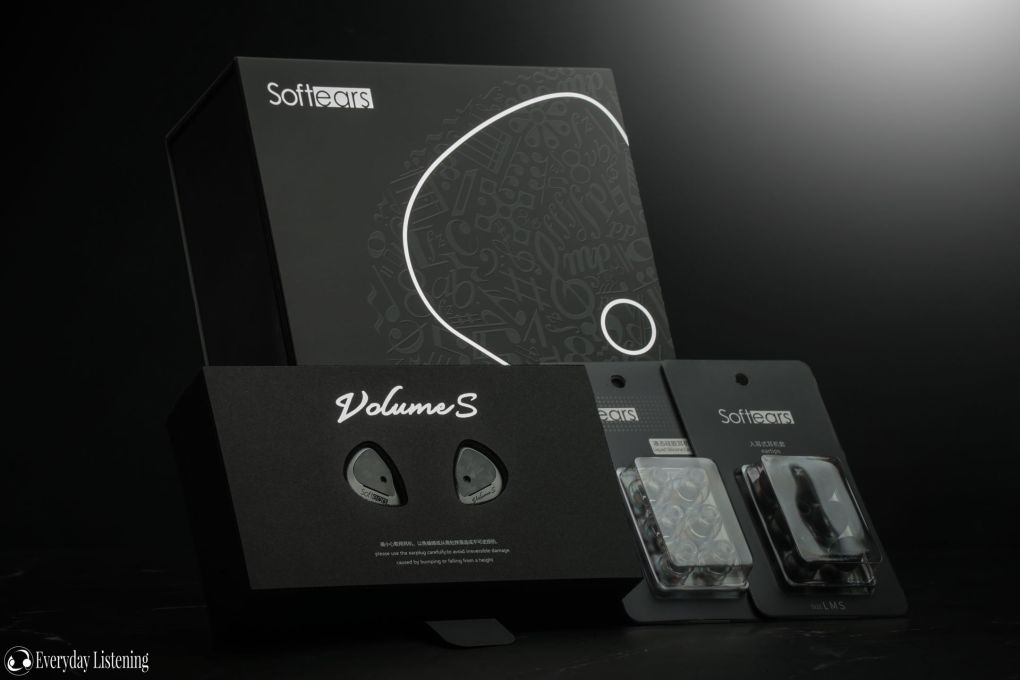
These ear tips have a very grippy texture and are designed to conform to individual ear shape when warmed by the wearer’s body temperature. Softears reason they are a good choice for those wanting a more V-shaped or struggle with fit and seal using standard silicone tips. Inside the carrying case is the paracord cable. It has a modular termination coming with a 3.5mm standard but with an additional 4.4mm balanced connector included. There is also a tuning tool used to adjust between high and low impedance modes in addition to a dual-compartment mesh pouch which is good for portable use. Finally, a microfiber carrying case and metal Softears card complete a premium experience.
Design –
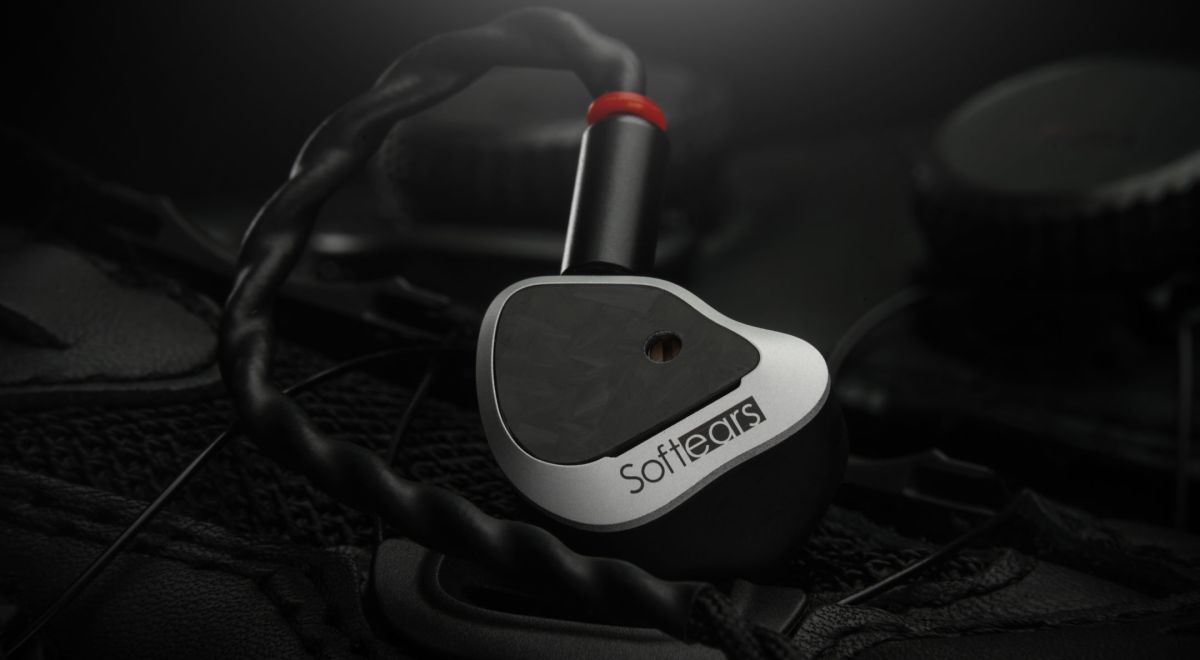
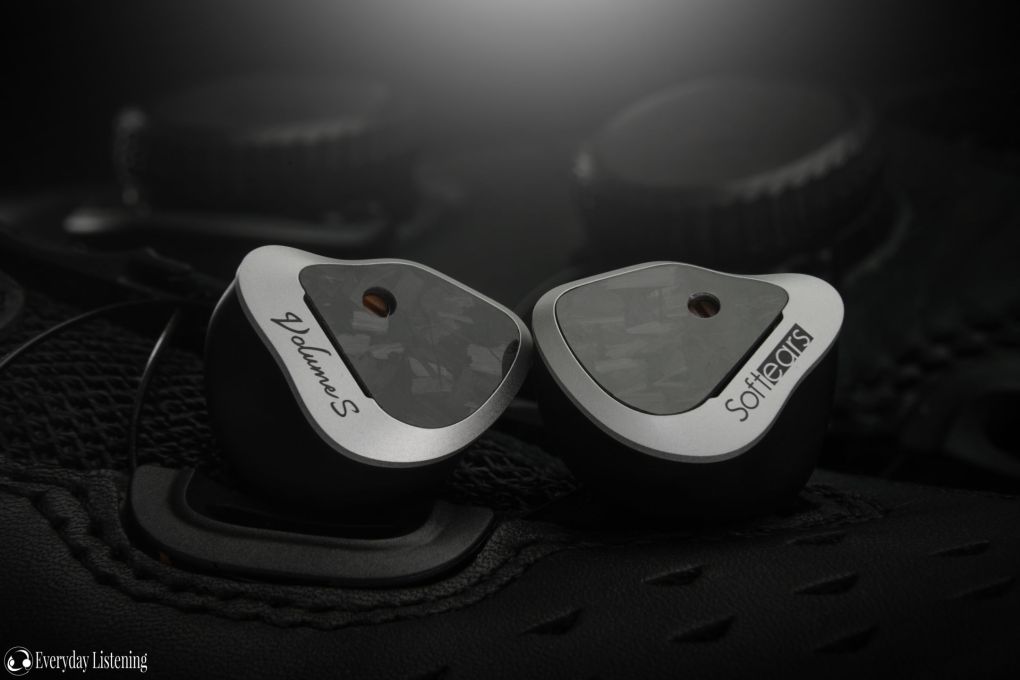
Even when Softears had just launched their first teaser images, I couldn’t help but think this is a handsome IEM. As a huge car and bike nut, the silver-on-black aesthetic definitely appeals. The majority of the shell is matte black resin which bears more similarities to the Moondrop Variations than the OG Volume and Blessings IEMs. Nonetheless, the actual shape of the shell is nigh identical to its predecessor being slightly taller and squatter than Moondrop equivalents. The faceplates employ an alloy surround with a forged carbon fibre insert that hides a slit-style vent and houses the copal switch to adjust the sound tuning. Naturally, Softears uphold excellent tolerances and seams with no apparent glue, overhangs or obvious points of weakness. The aesthetic is premium and svelte, more so to my ears than most similarly priced competitors.
0.78mm 2-pin connectors make a return opening up huge aftermarket support in the event you break or simply don’t like the stock unit. It’s a great cable that said, with a supple fabric sheath, comfortable pre moulded ear guides and even a modular plug system. Despite the sheath, the cable is very soft with zero memory and easily coils for storage as a result. It doesn’t transmit much microphonic noise due to the over-ear fit style but a little more than a non-fabric cable if that is something you are sensitive to. The termination uses a 4-pin connector and screw fastener to maintain a reliable connection. 3.5mm single-ended and 4.4mm balanced are included in the box to suit most modern sources.
Fit & Isolation –
Given the similarities in design to its predecessor, the differences mostly lie in the new look whilst bringing a similar wearing experience. Chiefly, they are light, well sculpted and produce minimal pressure on the outer ear. In areas where they do contact, these surfaces are round and broad, therefore, minimizing discomfort. They are relatively wide and therefore protrude from the ear. Some wind noise is apparent in turn and they won’t be suitable for those with especially small ears of those that enjoy listening to IEMs in bed.
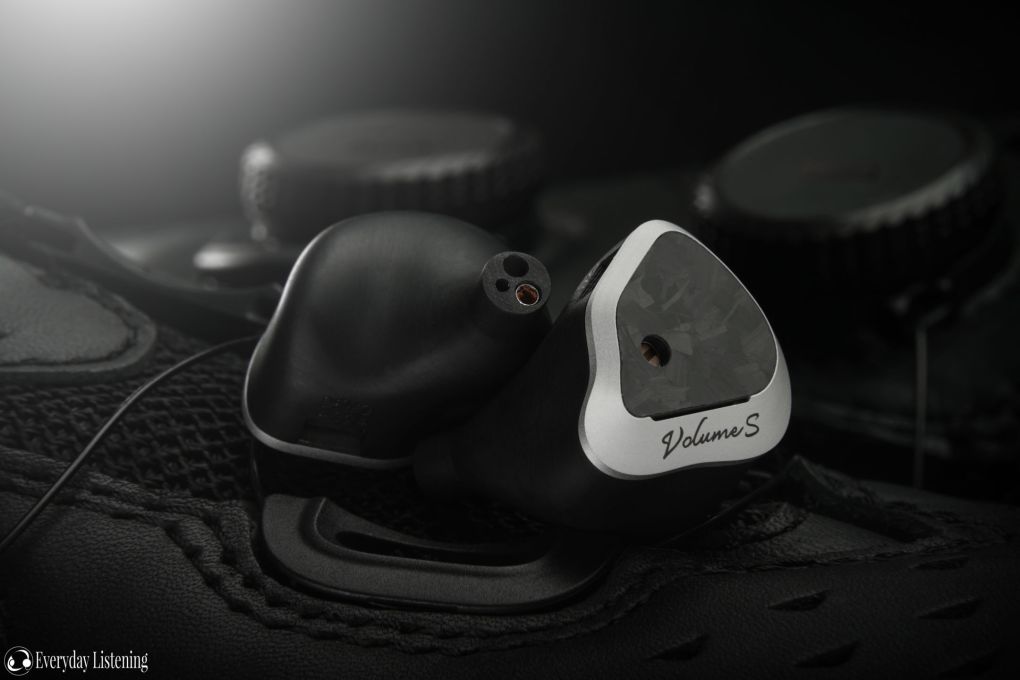
Besides this, the nozzles are well-angled and form an excellent, consistent seal for my ears. There is no driver flex and reduced wearing pressure on account of the vented design. Passive noise isolation is above average for a vented hybrid IEM, especially low frequencies. This makes them better than most for public transport whilst still retaining some spatial awareness for commuting on foot. Fully sealed monitors are still a better choice for those who listen in especially noisy environments, that said.

Ryan Soo
Avid writer, passionate photographer and sleep-deprived medical student, Ryan has an ongoing desire to bring quality products to the regular reader.


Hi, I would like to ask, how does the Volume S compares to Noble Rex5? I have the Volume S and thinking about purchasing the Rex5.
Thank You for your help.
LikeLike